- Date
- 15th May 2025
- Categories
- Carbon Finance
By Dr Samir Thapa and Dr Simon Batchelor (OBE)
This blog is prepared in the context of ongoing discussions on the estimation of the ‘fraction of non-renewable biomass’ (fNRB). The blog tries to address questions on 1) the extent to which woodfuel use leads to deforestation and 2) how emission reductions and removals can be influenced by issues surrounding fNRB.
The use of woodfuel for cooking has several issues associated with it. It is a source of household air pollution which has health implications, and its collection and use is time-consuming for members of the households involved in cooking, which are often women. It has economic impacts on the household depending on where and how it is acquired, and it is said to have a dual environmental impact. One often-quoted impact is that it causes deforestation, and the other is that it creates climate emissions when it is combusted. These two environmental impacts are discussed in the literature and UNFCCC high-level debates as being depending on fNRB.
fNRB is a key parameter to estimate the climate emissions reduced when the source of energy for cooking is transitioned from woodfuel to clean and modern cooking solutions. The cooking energy transitions may include reducing woodfuel consumption through Tier 3 improved cookstoves or eliminating woodfuel consumption if all cooking is undertaken on a modern energy source. ‘Woodfuel’ may include wood and its derivative charcoal.
fNRB is a percentage figure. It is the percentage of the total woodfuel consumption over a given period that will not regrow or renew within that same period. So, for instance, in an extreme example, if the demand for woodfuel in a given forest is down to one household, and their consumption is easily replaced by the regrowth in the forest, then fNRB would be 0. On the other hand, if a community has grown such that there is heavy demand from a woody outcrop that can’t keep up with replenishment, the fNRB might be 70 to 80%.
Until recently the UNFCCC recommended fNRB for many countries was of the order 70 to 80%. These were national figures published by UNFCCC and derived from a method of assessment proposed by the CDM at its 67th Executive Board meeting. Since then, researchers have recommended an updated means of assessment, which proposes a significant reduction in national fNRB. Based on the MoFuSS model the proposed fNRBs are going through a consultation process before coming into use. Project developers and governments can propose their own fNRB if they delineate their area and recalculate the specifics from either MoFuSS or their own methodology and biomass monitoring.
So far, based on a land-use change concept, it is understood that without a conversion to another land use, woodfuel use primarily causes forest degradation and not deforestation per se. Wood fuels consist of several main commodities: fuel wood (also firewood), charcoal, wood waste/debris, processed fuels such as pellets and briquettes and black liquor. Firewood is collected regularly as branches, twigs and/or dead wood and is used extensively in rural and remote areas for domestic cooking. It may come from forest areas or non-forest trees e.g. around households and farms. Typical charcoal production results in intensive forest clearances, carried out as either selective cutting (e.g. in West Africa) or clear cutting (e.g. in South and East Africa).
An area of debate is whether the influence of such charcoal production is mostly temporary or otherwise. This is because clearance based solely on charcoal production can regenerate to previous forest biomass conditions in 10 to 30 years duration1 – after which harvesters return unless such clearance is followed by permanent land-use changes e.g. mining and commercial agriculture. With land use change, charcoal including other woodfuel production often acts as a catalyst, where profits from woodfuel are used to finance the land clearing.
A primary reason for this debate is the confusion between deforestation and degradation. Loss of forest cover at various scales at a given moment in time, as in the case with woodfuel use, is often understood to be deforestation. However, scientifically, deforestation is the long-term, complete loss of forest cover due to conversion to other land uses. With forest degradation, the forest still exists, but it gradually loses its functions as the forest health continues to decline and ultimately ceases to provide its services such as filtering the air and water or providing habitats. Therefore, the practice of woodfuel production is understood to lead to mainly forest degradation. However, the scale and dynamics of woodfuel use will determine the extent of the impact within that frame between degradation and deforestation. In some cases, continuous degradation for example to meet the continuous woodfuel demand because of the population growth could lead to consequences similar to deforestation. Therefore, the lack of proper definition affects the sectoral understanding since degradation is understood to be anything other than deforestation due to land use changes.
Other inconsistent practices can also lead to misplaced claims about woodfuel and their contribution to deforestation. For example, as per FAO, which produces the most comprehensive reports on forestry, any area larger than 0.5 ha (0.001 square miles) with trees higher than 5 meters and a minimum tree/canopy cover of 10 per cent is considered as forests. Given this definition, certain areas, e.g. savannah and woodland from where woodfuel is procured, is not considered as forests. This then could result in undue accounting if such procurement is considered to have been from the forest areas. The inclusion of these sources as forests would reduce such overestimation.
So how can we address the question of the source of woodfuel collection more carefully?
- It would be good to redefine the forest biomass stock to take into account collected woodfuel (branches and dead wood). Currently when capturing woodfuel collection from forests, conventional calculations of forest biomass stock misses out on actual firewood collection sources e.g. deadwood and low-hanging branches because it logs only biomass with a tree diameter measurement at Breast Height2.
- There generally needs to be stronger policy environments. Forest biomass extraction including woodfuel often happens in a policy vacuum, without adequate regulations or poorly implemented ones (e.g. trees felled not following government regulations), where government actions often appear to accept woodfuel as a status quo to be tolerated3. Informal markets with a lack of proper government implementation (e.g. introduction of efficient kilns for charcoal production) can result in substantial revenue and resource leakage, often resulting in data and information that do not capture the entire context.
All the above points combined can then lead to incorrect impressions about the influence of woodfuel use, and related forestry metrics leading to contrary4 and gross overestimation and uncertainty of sustainable forest biomass calculations5.
The direct effect of woodfuel use for domestic and other cooking on actual forests could therefore perhaps be a lot less than commonly discussed, not resulting in material forest biomass deficits. This is important because from a carbon perspective, forest areas degraded for charcoal production are expected to return to similar levels of carbon stock after two decades with no significant differences in carbon storage6. Whether we have two decades to wait for that carbon capture is another question. Emissions from charcoal production in tropical forest ecosystems in 2009 were estimated at 71.2 MtCO2e and 1.3 MtCH4. Such carbon emissions may be recouped faster than those due to other regenerative practices e.g. shifting agriculture, in which trees, bushes and forests are cleared by slashing, and the remaining vegetation is burnt. Woodfuel extraction is therefore expected to lead to medium-term carbon cycle imbalances to be recovered within the natural regeneration cycles of forests.
However, this view that it will come right eventually, has to be set against the growing population, especially in Africa. Such growth and slow promotion of alternative measures may be affecting the balance, and whether globally we have the time for the carbon to be recaptured despite some scientific literature concluding, a decade or more ago, that woodfuel use does not cause deforestation7. Since then, population growth has added nearly a billion people to the countries of interest, and while there has been some progress on the adoption of cleaner cooking with improved biomass stoves, there remains 2.1 billion who do not use improved stoves and a further 1.8 billion who continue to use biomass. Urbanisation with its inward migration to towns and cities, has not relieved the need for woodfuel but only increased the market for it to be used as charcoal. Conversion of wood to charcoal is variously efficient and inefficient across the whole ecosystem. Given this population growth and the increasing pressure on forests, woodfuels are frequently cited and claimed by governments and agencies as being an important driver of deforestation8. Related recent literature (1, 2, 3) also suggests that woodfuel use, especially charcoal production is perhaps causing both forest degradation and deforestation, due to alarmingly increasing forest clearances. Recent FAO report also shows the highest reliance on woodfuel in Africa (63 percent of households), followed by Asia and Oceania (38 percent) and Latin America and the Caribbean (15 percent). Further, more than 90 percent of all wood cut in Africa is used as woodfuel, even though the share of woodfuel in global production decreased from 60 per cent in 1961 to 49.4 per cent in 20229.
Therefore, while various works and analysis suggest a general decrease in forest degradation and deforestation globally with possibilities of overestimation, contextual dynamics come into play at different scales and for different reasons10. Despite globally ‘deforestation’ caused by land use change actually peaking in the 80s and net deforestation decreasing ever since, forest degradation (often cited as ‘deforestation’) is continuing and is significantly high in Africa because of woodfuel use and its demand due to population growth. The increased demand together with the other drivers of actual deforestation and forest degradation are therefore already severely affecting the sustainable supply of woodfuel in Africa. This situation in these contexts should lead to higher localised fNRB indicating the GHG emissions due to woodfuel use.
With these dynamics for increasing woodfuel demand due to population growth, there are however major uncertainties in the scale and level of its impact. This uncertainty stems from the lack of common understanding, data and information. The rate of woodfuel use can influence forest biomass stock and its capacity to provide essential ecosystem services. A clear understanding of the impact of woodfuel use is important to establish:
- 1) If the supply of forest biomass stock is substantially outpaced by the increasing demand and ongoing woodfuel harvesting practices.
- 2) What other impacts are increasing woodfuel use causing at the eco-system level such as loss of biodiversity through habitat loss, soil erosion and reduced water tables. and, importantly,
- 3) And importantly,if these impacts are solely due to the woodfuel demand or there are other direct and indirect causes and drivers as well, such as agriculture, logging or due to the added climate change stress e.g. pests and wildfires.
Understanding these multifaceted impacts, therefore, will require a holistic approach with integrated methodological approaches, where the extent of these impacts could depend on temporal and spatial scales (e.g. Miombo and Sahara region), across different biomass (‘forest’)management and conservation practices as pressures are mostly determined by local politics, ownerships11 and management.
Such studies will also need on-the-ground presence because the spatial models do not have high enough resolution maps to capture these specific interactions and impacts, and woodfuel harvesting on its own often leaves no distinct, discernible patterns on the landscape compared to other drivers. These studies are then expected to provide common universal definitions, and lead to a distinction between causes, underlying drivers and consequences of deforestation and degradation, and disentangle the science of biomass management from the day-to-day practice of woodfuel collection, including in non-forest areas. It is expected that all this will then contribute to streamlined approaches to generating new localised and contextual data and information. This is required since data is often only available as aggregated national and regional understandings, which may fail to capture important local conditions and dynamics. because often data and monitoring remain with gaps and are incomplete.
Specific findings could provide understanding of the scale of solutions required to not only reduce emissions based on what is being consumed as per the historical baselines and business as usual scenarios, but also that which would potentially contribute to removals of greenhouse gases. Such could be situations where forests are not allowed to grow back to their full biophysical potential because of continuous and significant pressure where potential measures could then result in net positive balances leading to carbon removal. This could be done through analysis of the rate of deforestation in relation to the sequestration and full growth potential of the saved forests as well as the other synergistic and counterfactual scenarios. Previous studies have shown such possibilities where forest plots in proximity to villages with modern cooking solutions have greater forest biomass, abundance and diversity than comparable plots without such solutions. Dynamic models like MoFuSS also show that interventions can result in large gains in forest biomass stock. This then could also incorporate specific issues such as the impact of woodfuel harvesting on below-ground biomass, especially concerning intensive charcoal practices and its regeneration.12
This blog lays out some of the issues surrounding forest degradation, deforestation and the calculation of the ‘fraction of non-renewable biomass’ (fNRB) used in carbon finance. The existing global discourse has limited data and insight into how biomass is collected and utilised by the growing population and these uncertainties will affect the willingness of governments, project developers and the private sector to sign up for carbon offsets. Conservatively low fNRB whilst ‘safe’, will often constrain the application of carbon finance to projects. A greater understanding of the full local contextual dynamics of biomass carbon resources, their utilisation and the potential to increase carbon capture could strengthen the emerging use of Article 6 for carbon finance.
***************************************************************************************************************
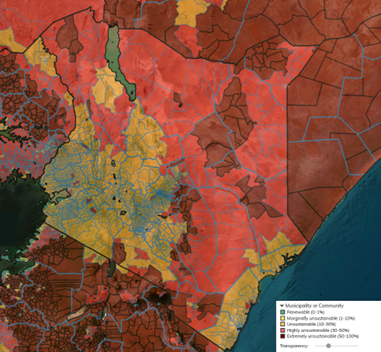
Featured Image: Screenshot of Kenya map from MoFuSS (https://www.mofuss.unam.mx/), (April 2025). Used under Fair Use Act.
***************************************************************************************************************
Footnotes:
1 Globally, 93% of forests are naturally regenerating and 7% are planted/plantation forests. Global Forest Resource Assessment 2020 Key Findings
2 Paper 5: The role of woodfuels in deforestation and forest degradation by Daniel Jones, Scoping study for a potential new DFID programme: ‘Miombo Forests, Livelihoods and Climate Resilient Landscapes, LTS International
3 Paper 1: Biomass energy in the miombo region, Matthew Owen, Scoping study for a potential new DFID programme: ‘Miombo Forests, Livelihoods and Climate Resilient Landscapes, LTS International.
4 The cited deforestation figure from the Tanzania GRA (470,000 ha/ yr) is quite different from the GFW tree cover loss data (average 160,000 ha/ yr) for same period 2015-2020.
5 Literature however shows that only 7% overall deforestation was due to charcoal production with the highest of 14% in Africa in 2009 calculated based on demand in the tropical countries, and wood fuel harvesting for urban markets affects less than 2% of the total wooded area in African countries.
6 Paper 5: The role of woodfuels in deforestation and forest degradation by Daniel Jones.
7 The environmental impacts of charcoal production in tropical ecosystems of the world: A synthesis
8 For example, between 2015 and 2020, as per FAO, Tanzania lost almost 470,000 ha (1.16m acres) of forest annually – a primary reason being charcoal production as the growing population in urban centres rely on charcoal due to rising gas prices. The situation mirrors most of Africa.
9 The State of the World’s Forests 2022, FAO.
10 Between 1990-2020, South America had the largest annual rate of net forest loss at 4.3 million ha, followed by Africa at 3.5 million ha. However, while it has increased gradually over the last three decades in Africa, in South America, it has decreased significantly in the last two decades from 5.2 to 2.6 million ha. Asia had the highest net gain of forest area remaining positive all along.
11 Globally, while most forest is publicly owned (73%), the share of private ownership is growing, but in transition or disputed. In Tanzania, in 2015, out of a total forest area of nearly 48 million ha, less than 1% was under public ownership, 7% was privately owned by individuals and business enterprises, and nearly 88% was under unknown/unknown/another category.
12 Decaying root systems of harvested trees can be a significant component of below ground carbon storage, where harvest occurs in relatively short rotations. Carbon remaining at a point in time can be estimated using the decay function.