
- Date
- 9th October 2025
- Categories
- Electric Cooking
By Syprose Ochieng (Gamos East Africa), Mercy Kamau (SCODE Limited), Dr Jon Leary (Gamos East Africa), & Philomena Mitalo (Clean Cooking Association of Kenya)
In this blog, we aim to highlight the importance of conducting Kitchen Energy Audits as shared during our virtual dialogue on the 12th of February 2025. A shift to modern energy-efficient electric cooking (eCooking) solutions offers economic, environmental, and health benefits. However, many households lack the necessary insights to make informed decisions about their cooking energy consumption. As a result, the Kitchen Energy Audit for eCooking study aimed to:
• Assess the range of technological products on offer/use in Household Kitchens.
• Assess what to look for and how to upgrade household wiring so that it ceases to be a bottleneck preventing safe usage of eCooking.
• Determine current expenditures on cooking fuels and Appliances.
• Assess power leakages in wiring within premises.
This dialogue draws insights from one of the 12 studies conducted under the eCooking Capacity Building and Market Development Programme (eCAP) in collaboration with MECS and Kenya Power. It is part of a series run by the eCooking Community of Practice (CoP) which is composed of over 588 members across the clean cooking and electricity access sector, policymakers, private sector, development partners, and research organizations. The CoP aims to strengthen the development of Kenya’s emerging eCooking sector by bringing together actors from the clean cooking and electricity access sectors. The CoP is co-convened by Gamos East Africa, the Clean Cooking Association of Kenya (CCAK), Kenya Power, and the African Centre for Technology Studies (ACTS), with support from the Modern Energy Cooking Services (MECS).
Understanding Kitchen Energy Audits
Energy audits have been commonly used in the commercial & institutional sectors, to reduce the cost of powering businesses and factories. Inspired by this approach, the household kitchen energy audit project was developed to systematically evaluate the household’s energy consumption patterns related to cooking. This included analyzing the types of fuels used, the efficiency of cooking appliances, wiring conditions, and potential savings from switching to electric cooking. Unlike general household energy audits, which focus on lighting and appliances, kitchen energy audits study specifically targeted the highest energy-consuming activities such as food preparation and cooking.
Methodology
This study started with broad preliminary research to identify key kitchen energy audit parameters and wiring assessment criteria. Data collection tools were designed and integrated into a digital platform for remote and efficient data collection. The consultants also ensured that household selection was done critically to enable diverse representation. Collected data was analysed to identify trends, inefficiencies, and potential areas for improvement. Insights from the analysis informed the refinement of tools, resulting in a robust framework for assessing kitchen energy consumption and wiring conditions.
Key Takeaways
1-Reducing Household Energy Costs
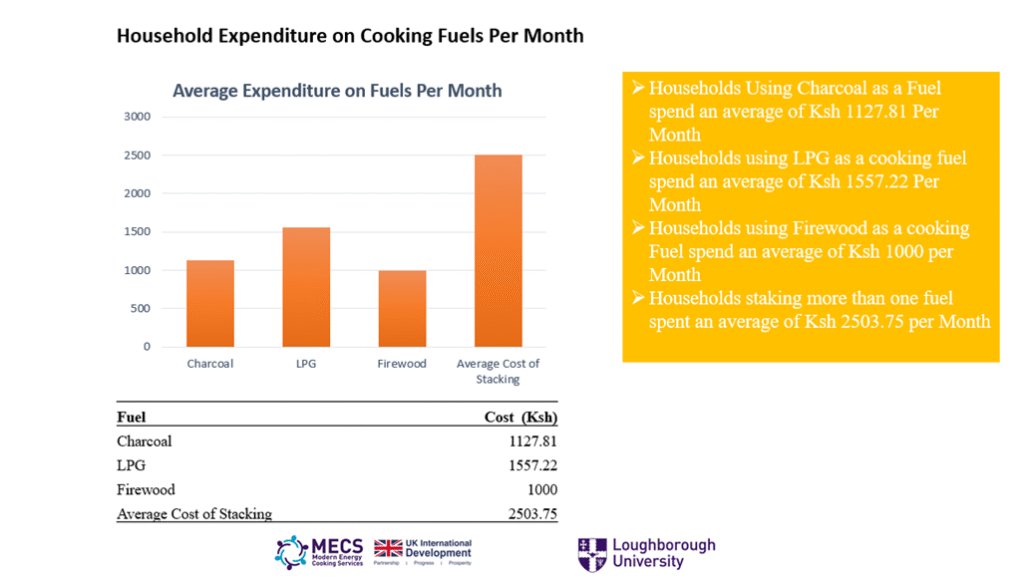
Households can potentially reduce their fuel expenditure when they conduct a kitchen energy audit for the various fuels they are using. Households often spend significant amounts of money on charcoal, firewood, and LPG without knowing the possible savings of transitioning to electric cooking. For example, data from energy audits show that households using efficient electric pressure cookers (EPCs) can save up to 30-50% on cooking energy costs compared to LPG or charcoal. Households using charcoal spend over Kenya shillings 1,127.81 a month, those using LPG spend Kenya shillings 1,557.22 monthly. However, the study also showed that the household that practiced fuel stacking, spent more on fuel on average, thereby emphasizing the need to transition to modern clean cooking solutions to avoid stacking expensive fuels that increase energy cost for households.
2-Household Fuel Sources
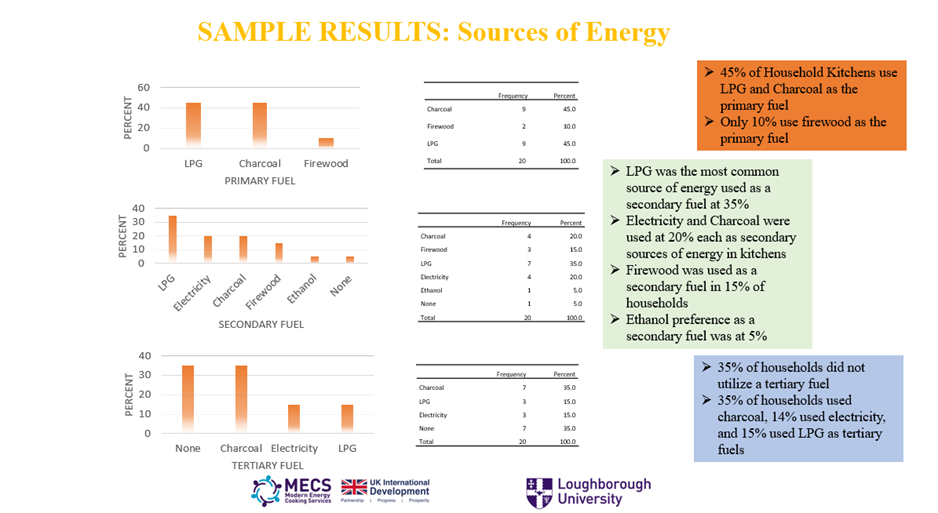
Findings from the 20 households involved in this study showed that 48% of households relied on LPG and charcoal as their primary cooking fuels, while only 10% primarily used firewood. For secondary sources of fuels, LPG is the most used at 35%, followed by electricity and charcoal at 20%, and firewood at 15%. 35% of households indicated they did not use tertiary fuel. These findings emphasize the mix in household energy use and the important role of modern cooking fuels such as electricity in supplementing traditional cooking methods.
3-Determinants of Cooking Fuel Choice
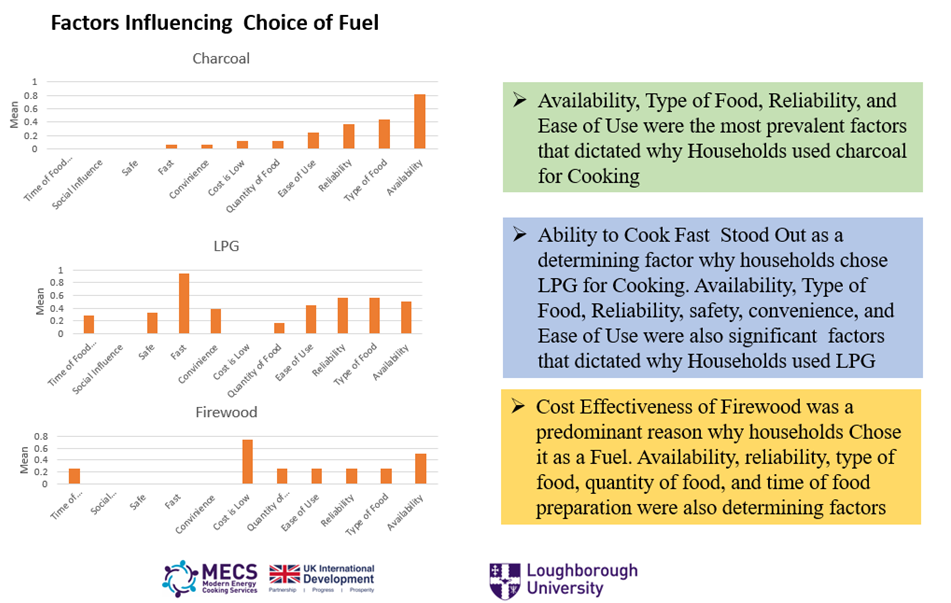
Knowing what drives people’s choice of cooking fuel is crucial when putting together an intervention, to ensure that they are targeted. This study like other studies1,2 shows that fuel availability, reliability, ease of use and type of food are important for households when choosing which fuels to cook with. In this study, LPG stood out with its ability to cook faster, followed by its availability, reliability, convenience, ease of use and safety. However, households that were using firewood noted that they prefer it for its cost effectiveness, type of food being cooked and availability.
Kitchen energy audits play a key role in providing empirical data to demonstrate the benefits of eCooking, such as reduced cooking times, lower operating costs, and reduced indoor air pollution. Additionally, audits can provide tailored recommendations on which appliances best fit a household’s needs.
4-Enhancing Energy Efficiency and Safety
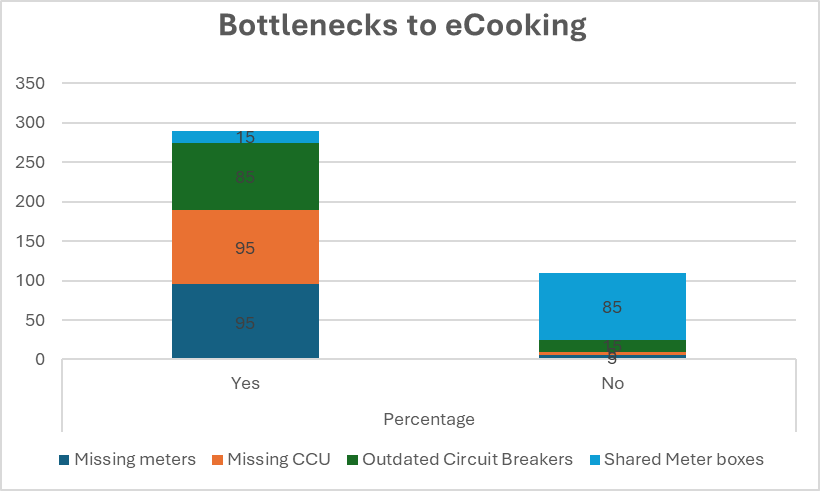
This study highlighted the infrastructural and electric safety issues in many houses. 95% of the 20 households surveyed reported electrical safety was a major concern. Issues such as missing meters were at 95%, those using shared meters were at 15%, absence of Consumer Control Units (CCU) at 95%, and outdated circuit breakers at 85% posing risks of electrical fires, frequent power outages, and difficulties in electricity cost management. Energy audits enable households to detect power leakages and inefficiencies in their kitchen wiring and appliances. Most homes experience power losses due to faulty wiring, inappropriate appliance usage, or outdated electrical systems. An audit provides actionable insights into resolving these issues, making sure that every unit of electricity consumed is used efficiently and creates an enabling environment for eCooking transition.
Key Recommendations for Households, Project Implementers and Policymakers
- Households and institutions are encouraged to carry out annual kitchen energy audits using the kitchen energy audit data collection and analysis tools to track their energy use and understand the cost-saving opportunities that each fuel used has.
- Programme implementers within the clean cooking space should integrate energy audits into their programs to encourage data-driven decision-making.
- Programme implementers should consider developing an application with digital audit tools to enable self-assessments easily accessible to households and institutions.
- Utility companies and the National Construction Authority (NCA) should together ensure that new houses meet quality standards and high-quality wiring to facilitate a smooth transition to electric cooking.
Conclusion
A kitchen energy audit is an important tool that households and institutions can use to understand their fuel consumption by pinpointing inefficiencies, saving time, cutting costs, and increasing safety, to enable them to make informed decisions towards transitioning to electric cooking which has so many benefits as highlighted on this report. Additionally, the aggregated audit results can be used to inform the development of targeted policies, incentives, behaviour change awareness campaigns, and financing solutions, such as subsidies for electric cookers or improved metering options for low-income households.
**************************************************************************************************************
Featured image: Copyright of SCODE
References
1 Nayema, K., Okoko, A., Kausya, M., & Onsongo, E. (2023). Accelerating the Electrification of Cooking in Kenya’s Urban Informal Settlements. UK: MECS.
2 Ocen S, N. G. (2024). Unveiling factors influencing choice of clean cooking solutions among households: a systematic review of literature. Frontiers in Sustainability, 5 – 6. From Frontiers | Unveiling factors influencing choice of clean cooking solutions among households: a systematic review of literature