- Date
- 4th November 2025
- Categories
- Clean Cooking, Modelling
By Tim Woolnough, Gamos Ltd.
A few weeks ago we launched TIMeC, our implications model for eCooking. Today, we are introducing its companion: the Visualisation of Key Data and Decision (VKDD) tool. The VKDD is a quick-start Excel workbook that helps you get to a credible first answer in minutes. Many excellent models in our sector (OSeMOSYS, Clean Cooking Explorer) ask you to assemble a thick stack of inputs before you can say anything useful; the VKDD offers a rapid route to defensible answers so you can start those conversations with numbers that are grounded before committing to a deep modelling exercise.
The VKDD is deliberately simple to use on a quick pass. It concentrates on the most important inputs, guides you with clear prompts, and presents a dashboard that surfaces the big signals – cost savings, time savings, health benefits, and climate impact – all backed by a built-in evidence base. The result is a lightweight way to test assumptions, communicate the case for action, and decide what deserves deeper analysis without getting bogged down. For readers who like real-world anchors on time and cost in kitchens, explore our eCookBooks and this health context piece, “Why ‘Clean Cooking’ is not straight forward”. For climate integrity, see our review, “Evaluating the Gold Standard Methodology for Metered & Measured Energy Cooking Devices”.
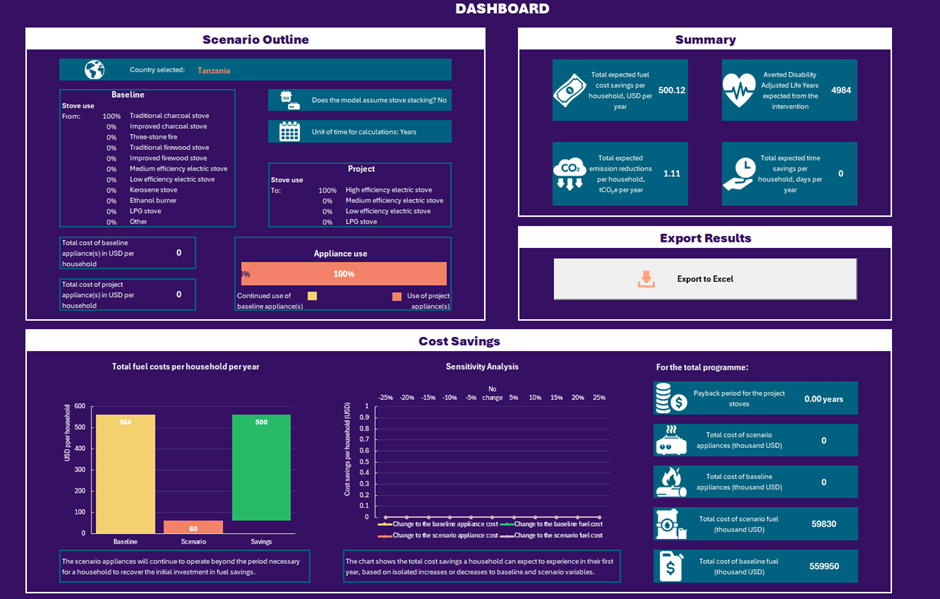
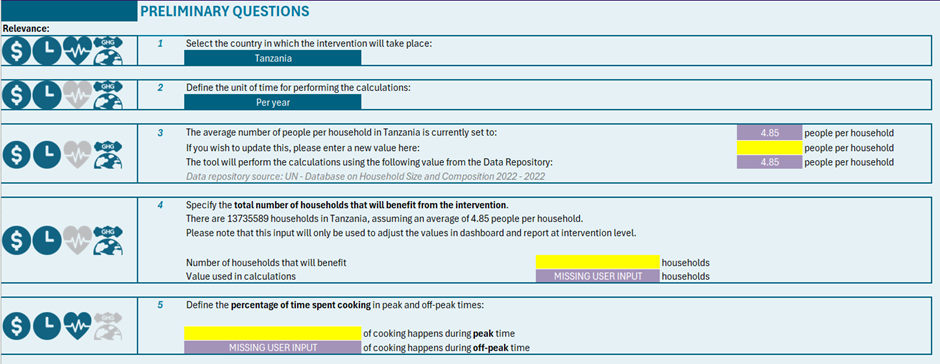
The flow from getting started to seeing outputs is totally transparent. Start on User Inputs, where colour-coded cells lead you through the essentials; review the Dashboard for headline impacts and supporting charts; and feel free to explore the Data Repository which holds the studies powering the tool’s recommendations. You don’t need deep technical know-how because the VKDD walks you through. When you want to document or compare, it exports a tidy pack of 18 parameters you can drop straight into a memo or slide deck.
Within the MECS Modelling Toolkit, the VKDD is the easy-to-use scoping model: reduced inputs for faster starts, guided prompts, and visuals ready for workshops and briefings. The trade-off is less fine control, which is exactly when TIMeC takes over – digging into richer “what-if” logic and system implications. Used together, the pair shortens the distance between good ideas and implementable policy. If you missed the story behind the first release, here’s the TIMeC beta-release blog.
A big part of VKDD’s value is its built-in Data Repository. The tool ships with referenced inputs spanning over 20 countries, and that bank is designed to grow. Recommended parameters flow straight through to the defaults, so newcomers get started right inside real-world ranges without needing to guess, while experts are welcome to override the defaults with their specialist knowledge. In practice, that combination de-risks a first pass and speeds up consensus in mixed-audience meetings.
For climate, VKDD stands on the MECS developed Gold Standard Methodology for Metered & Measured Energy Cooking Devices (MMECD). In plain terms, MMECD calculates emission reductions from measured energy actually used (or metered fuel sold), rather than relying solely on lab-bench assumptions – this approach is widely recognised as a high-integrity pathway for clean-cooking carbon accounting. You can read the methodology itself on Gold Standard’s site (v1.2 is publicly available) and see how its applicability hinges on real usage being recorded and auditable.
Independent MECS analysis finds the MMECD framework robust and conservative, with practical recommendations that strengthen implementation – very useful when you need carbon numbers that stand up to policy and finance scrutiny. In March 2025, the Integrity Council for the Voluntary Carbon Market confirmed Gold Standard’s metered-energy cooking methodology (v1–1.2) as CCP-eligible, tightening expectations around baselines and usage monitoring in clean-cooking carbon credits. MECS has also published guidance for government led programmes under Article-6; for a starting point, see our Carbon finance & clean cooking resources collection.
So what does a first session with VKDD look like? Open the workbook, enable macros, and skim the Data Repository to familiarise yourself with the sources and ranges. Move to User Inputs and complete the yellow cells. Then jump to the Dashboard: you will see headline cost, time, health, and climate shifts, plus context charts to help you tell the story. When you are done, hit Export to Excel to capture the 18 inputs/outputs for your notes or slide deck. It is the first step with maximum momentum.
As the second release in a growing suite, the VKDD is intentionally less control with faster outputs. It is the tool we wanted for the very start of a policy conversation: fast enough to keep everyone engaged, transparent enough to win trust, and rigorous enough – thanks to MMECD and the embedded evidence – to stand up to any tough questions. If you are scoping a national programme, testing an idea for results-based finance, or preparing a briefing for budget decisions, VKDD gets you to a credible first answer quickly, then points you to where scrutiny will matter next.
To get started, just download the VKDD and the supporting documentation from the links below:
***************************************************************************************************************
Note: AI was used to formulate the structure of this blog.