
- Date
- 21st January 2026
- Categories
- Behaviours, eCooking Products
By Dr. Nigel Scott (Gamos Ltd.) and Dr. Simon Batchelor OBE (Gamos Ltd. / Loughborough University).
This blog describes some of the insights from user surveys undertaken as part of an Innovate UK Catalyst part funded project.
The Development and Commercialisation of Innovative PAYG Induction Stoves in Africa was not a direct MECS funded project but we are pleased to present some insights from it. Innovate UK is a UK government funding stream to support innovation both in UK and overseas. The Energy Catalyst funding is part of the UK’s International Climate Finance commitment and aims to accelerate the clean energy transition in developing countries. The program supports innovative clean energy technologies and business models. The funding for Energy Catalyst is part of the Ayrton fund. It requires that the lead for the project be UK based and it only funds less than half the project costs.
The project, executed by BURN manufacturing with Gamos providing UK administration, deployed nearly 10,000 Electric Induction Cookers (EICs) across four African countries. By comparing cooks’ experiences before and after buying their EIC, the survey report was able to quantify the impact of the EIC use on a range of development impacts (financial, time, health, gender, and environment). Customer telephone surveys conducted by 60 Decibels in three of the four countries showed that the devices were well received and customer expectations were met.
High customer satisfaction scores were driven by time savings, ease of use, and cleanliness. The high power rating of the induction devices (2 kW) means that they can bring a pot to boil quickly, so cooking times are reduced. In addition, the EICs come with some automated features such as a timer, which enables cooks to leave the cooker unattended, liberating time for other tasks. Most respondents simply said the EIC was easy to use, and some specifically mentioned it was easy to use the controls. Ease of use was one of the features of the device that turned out to be more highly appreciated by users than they had expected when buying the EIC. Customers appreciated two aspects of ‘cleanliness’. One was that it was clean in the sense of health and emissions. The fact that it doesn’t produce any smoke is a clear health benefit, commonly associated with the term ‘clean cooking’. But users also noted the other more common use of the word clean – the cooker is easy to clean, pots are easy to clean (they don’t get covered in soot), and the kitchen remained clean.
Cost was another issue commonly raised by respondents. Among satisfied customers, affordability and cost savings were among the most highly rated impacts of the devices. These customers commented on how little electricity the cookers use, and therefore, how they have saved on cooking costs. A few also mentioned how the BURN payment plan has made the cost of the EIC itself more affordable. In contrast, high electricity usage and costs were mentioned by a relatively small number of other customers.
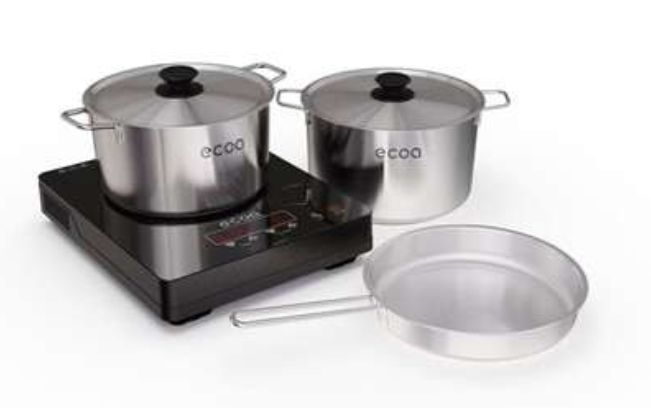
Cookers were sold as a bundle with three induction compatible pots. Getting the cookware right is clearly a tricky problem to solve. Previous experience has shown that it is important to provide induction compatible cookware, otherwise people may find that their own pots don’t work. Having a device that doesn’t work is clearly not a good outcome, and customers can be tempted to abandon the EIC altogether, which in turn leads to costly repossession of devices under the terms of the payment plan. Two thirds of customers felt the cookware provided with the cooker was not adequate, but there was a divergence of views as to what the problem was. Some complained that the pots were too small, while others complained that the pots were too large, especially for small families. We were able to show that satisfaction with cookware declines with larger household sizes, indicating that the pots were better suited to small family sizes. On balance, more customers felt the pots were too big, and they would have preferred more but smaller pots.
Core to the innovation project was BURN’s use of built in technology to provide PAYGO and internet of things (IoT) data on actual EIC use. The environmental impact of clean cooking technologies has long been recognised and carbon markets enable developers to access finance in exchange for the CO2 emissions reductions. High integrity carbon finance is now tied to the metered methodologies that have been picked up by Gold Standard, Verra and CCA. However, there is also a growing recognition of ways in which clean cooking can impact other areas covered by the Sustainable Development Goals (SDGs). For example, a recent paper highlights the impact of black carbon and organic carbon, both emissions from burning biomass and fossil fuels, on climate impacts and other benefits such as health. It presents the case for using metered methodologies for quantifying black carbon emissions reductions as an SDG co-benefit. Gold Standard is not alone in drafting standards for assessing the impact of projects on SDGs, with a view to increasing the finance that can be attracted to projects that contribute to SDG impacts.
With this in mind, the pilot project aimed to assess the impact of EIC adoption and use across a range of SDGs:
- SDG 3 Good health and wellbeing. Respondents were asked about practical experience of two health issues – respiratory complaints over the previous two weeks (coughing, and difficulty in breathing), and sore eyes after cooking. The proportion of respondents reporting either complaint (or both) fell from 4% in Kenya and Tanzania before the EIC to 1% after its introduction.
- SDG5 Gender equality. Women were asked if they had experienced a reduction in any of five cooking related hazards, such as injuries, pain, and domestic violence. Around half of all women had seen a reduction in at least one hazard, the most common was a reduction in injuries from cooking, e.g. burns.
- SDG5 Gender equality. The “proportion of time spend on unpaid domestic and care work” is the indicator for SDG target 5.4. Although the majority of customers (78%) felt that the time they spent cooking had decreased, estimates of daily time savings were inconsistent. Among customers who used only a single cooking fuel, it was possible to show that charcoal requires half an hour per day more than cooking with either electricity or LPG.
- SDG7 Affordable and clean energy. The majority of customers (69%) felt that their cooking costs had decreased. Overall expenditure on traditional fuels dropped by around two thirds (62% in Ghana and Tanzania, 75% in Kenya). The additional cost of electricity can vary enormously. Effective tariff rates varied from 0.09 USD/kWh in Ghana to 0.18 USD/kWh in Kenya. Once the cost of additional electricity was estimated, annual household cost savings ranged from 112 USD (Ghana) to 149 USD (Tanzania). This shows that even in high tariff counties, the costs of the additional electricity used by the EIC are outweighed by savings in traditional fuels.
- SDG13 Climate action. Most CO2 emissions reductions methods rely on estimates of the amount of baseline fuels that are displaced by a modern cooking device, but in this study, both the baseline fuel consumption and the ‘project’ fuel consumptions (both traditional fuels and electricity) are known. CO2 emissions reductions have been calculated using factors and methods from the Gold Standard Methodology for metered and measured energy cooking devices. Emissions reductions were around 0.5 tCO2/device/year in Kenya and Tanzania, but charcoal usage was much higher in Ghana, so emissions reductions were much higher at 1.6 tCO2/device/year.
Overall impacts of the project were estimated by multiplying these figures up by the total number of units deployed:
- Annual fuel cost savings of 1.2m USD/year
- Time savings of 1.3m hours/year
- 900 fewer cooks experiencing one of the health issues
- 4,300 women benefiting from a reduction in cooking related hazards
- Emissions reductions of 5,400 tCO2/year.
The study provides compelling evidence of ways in which electric cooking has multiple benefits for cooks in addition to cost savings. The study shows that fuel savings are big enough to pay back the price of the EIC (just over 100 USD) in a year. It also suggests that fuel cost savings are an order of magnitude higher than any potential carbon finance revenues. This is not to diminish the importance of other impacts that improve quality of life through cleaner kitchens and more time for watching TV and playing with children.
…………………………………….
Figure 1, featured image: Customer engagement in Ghana (photo credit: BURN).
No AI was used in the production of this blog.