- Date
- 20th August 2026
- Categories
- eCooking, Electric Cooking
By Eva Idugboe (Loughborough University).
New York, 6 to 9 July 2026
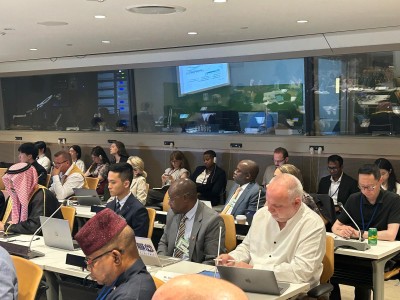
The 2026 High-level Political Forum marked the final in-depth review of SDG 7 before the 2030 deadline. MECS was represented across three sessions at UN Headquarters in New York, with Ed Brown, MECS Research Director and Professor of Global Energy Challenges at Loughborough University, speaking at each. Launching Tracking SDG 7: The Energy Progress Report 2026, Under-Secretary-General for Economic and Social Affairs Li Junhua set out the scale of the task: 655 million people still lack access to electricity, and two billion remain without clean cooking. On current trends, 1.8 billion will still be without clean cooking in 2030.
The week did not stand alone. It followed a UN DESA preview webinar on 2 July, and coincided with the high-level virtual event on clean cooking in Africa on 9 July, convened by Kenya, Norway, the United States, the African Union, the African Development Bank and the IEA.
One argument ran underneath all of it. In “Beyond the Stove: Clean Cooking’s Next Challenge Is Energy Security”, Simon Batchelor makes the case that LPG can be an effective short-term solution, but that a transition built on imported fuels is fragile. If those fuels become expensive or supply is disrupted, households that cannot afford them return to biomass. It is not enough to give a household a cleaner fuel. Cooking energy has to stay affordable, available and resilient. The corollary is that Africa should avoid becoming permanently dependent on imported fuels, a future built on stronger grids and enhanced renewable generation will be far more resilient. Electric cooking as part of the renewed global drive for electrification called for by the Turkish government as the key theme of their COP Presidency was a thread that ran through every session MECS took part in.
From Commitment to Implementation, 8 July
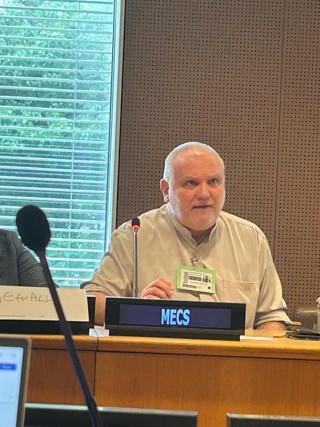
Convened by UN-Energy with support from WHO and the World Bank, in cooperation with Liberia, Uganda and the United Kingdom, this side event launched the UN-Energy Clean Cooking Substantive Priority and its Country Support Repository. Watch Ed’s intervention. The problem it is designed to solve, WHO’s Heather Adair-Rohani explained, is sequencing. Countries receive UN support one agency at a time, first on environment, then six months later on health, then on finance, which makes coherent programming almost impossible. The proposal is for UN-Energy partners to arrive and act together.
Country spotlights grounded the discussion: Brazil, with around 11 million people still cooking on wood or charcoal in the rural north-east, and Liberia, where roughly 96 per cent of the population relies on biomass. Uganda’s statement, delivered by Herbert Abigaba on behalf of Hon. Dr Ruth Nankabirwa, described the National Clean Cooking Unit established with UK FCDO and MECS support, and recalled the poignancy of a sister lost to years of exposure to smoke from traditional cooking.
The question is no longer whether clean cooking technologies work. The question is how we move from commitment to implementation, from pilots and demonstration to national scale programmes.
Statement of Hon. Dr Ruth Nankabirwa, Uganda.
Speaking for the UK, FCDO’s Lydia John set out the commitment behind that work: £130 million for modern cooking solutions since 2016, of which £99 million supports MECS. Since 2018 the UK has helped over 4.5 million people adopt cleaner cooking and mobilised more than £435 million of investment, over £10 for every £1 of UK funding.
Ed described how MECS works across scales: global fora that define what clean cooking means and how progress is judged; the AFREC partnership regionally; and 29 countries of in-country work since 2018. He cautioned against drawing lessons too loosely. The LPG transitions in Brazil, India and Indonesia, for example, teach something real about targeting assistance, but several of those countries were left with subsidy bills that are now very difficult to escape.
On Uganda, he set out the preconditions MECS research has identified for an electric cooking transition to scale: a utility that takes ownership of the demand-enhancement opportunity and its grid implications; a supply chain able to deliver appliances, supported by investment in emerging companies such as Power-Up in-country standards so buyers know an appliance will work; capacity for repair and maintenance; and sustained awareness raising. The contribution was echoed from the World Bank side, whose $300 million Uttar Pradesh clean air programme will be bringing electric cooking and emerging digital solutions into the design of its clean cooking component under our new ACUASA collaboration.
From Call to Count, 6 July
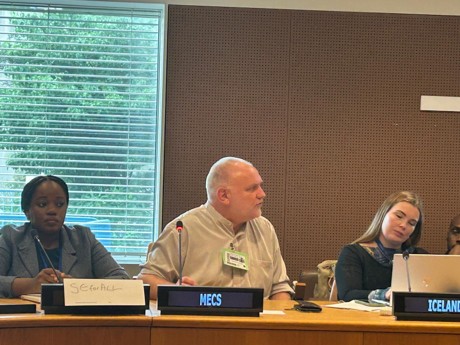
Organised by Iceland and Kenya with ESMAP at the World Bank and with ENERGIA, in collaboration with the Working Group on Gender Indicators in Sustainable Energy and the co-conveners of the Gender and Energy Compact, this side event examined how gender-responsive data, policy and commitments can accelerate progress. Watch Ed’s remarks.
Ed spoke to three pieces of MECS work. The first was the position of clean cooking itself. It has rightly become one of the major arenas where gender and energy intersect, but for too long it had also been relegated to a side issue rather than treated as central, and one of the main reasons for that is that it most strongly affects women. Related to this is how the issue has been framed: attention has too often settled on the bare minimum of change that can be delivered in women’s lives, rather than on what women actually want. The MECS Gender Framework was developed to carry a gender perspective through all of the programme’s clean cooking work, and will be central to the AFREC roadmap.
The second was the SDG 7 Policy Brief produced with the Access Coalition, examining the relationship between SDG 7 and SDG 10, the goal on reducing inequalities. Its central proposition is to conceive of energy access as a right. That framing immediately raises the question of who lacks access and why, and how often the answer is women. It sets out concrete actions to place inequality closer to the centre of energy analysis: improving the visibility of those without access; recognising that sub-national action can target inequality more effectively; considering minimum energy access thresholds; and tackling inequality at global as well as national scale.
The third was the post-2030 briefing note launched during the week as previously noted, which argues for a focus on the quality of access rather than a dualistic “yes you have, no you haven’t” measure, and on the sustainability and security of access over time.
Two days later, closing the clean cooking side event, ENERGIA’s Sheila Oparaocha noted that 11 member states, among them Norway, the United Kingdom and the Netherlands, had raised women’s leadership and agency during the formal review of SDG 7 and its interlinkages.
Looking beyond New York
Closing for Norway, Hans Olav Ibrekk, Policy Director for Energy and Climate Change at the Norwegian Ministry of Foreign Affairs and co-facilitator of the SDG 7 Technical Advisory Group, noted that a conversation which once drew fifteen or twenty people now fills rooms in Paris, Addis Ababa and New York, but that political attention has not yet fully translated into finance. Of the $2.2 billion mobilised at the Paris summit two years ago, $740 million has been disbursed.
The day after the HLPF sessions, the high-level virtual event on clean cooking in Africa set out how the next set of international milestones, beginning with the UN General Assembly, will be used to mobilise further investment and build momentum towards the next Summit on Clean Cooking in Africa early next year. Beyond that lies COP31 in Antalya. Ed’s closing point in New York was that for all of the focus on meeting the ambitions that the international community entered into in 2015, the sector will still be having these conversations after 2030, and MECS’ immediate priorities reflect that: the AFREC roadmap for the continent, the scale-up of electric cooking with utilities and finance partners, and the post-2030 agenda the programme has just opened with CCG and our network of international partners.
…………………………………………………..
AI disclaimer: Human led draft. AI LLM used to convert session transcripts into blog format; all quotes and figures verified against source by the authors.
Featured image, top: Prof. Ed Brown at Implementing Global Plan of Action for the Energy Decade, HLPF, New York. Image copyright of Michelle Hallack, ESMAP, 2026.