By Prof. Matthew Leach (Consultant to Gamos Ltd.).
As electric cooking (e-cooking) moves from “interesting idea” to core part of energy access strategies, one question keeps coming up: how do we plan for it? For utilities, regulators, and governments, e-cooking isn’t just about putting efficient appliances in homes. It’s also about how those new loads fit into grids, mini-grids, off-grid systems, and national energy plans—financially, technically, and socially. That is where energy modelling comes in.
As a member of the senior management team of the Modern Energy Cooking Services (MECS) programme, let me set out how different modelling tools can help countries and practitioners think clearly about scaling e-cooking. This is based on a talk I gave as part of the ESMAP webinar series within the webinar Operationalizing and Scaling Electric Cooking Interventions on 20th January 2026.
What Do We Mean by “Modelling”?
The word “modelling” often sounds intimidating – almost like it issomething done by specialists in dark rooms with complex code. However, modelling is simply about simplifying a complex situation so we can understand the implications of different choices.
In practice, that means:
- Turning millions of households, appliances, fuels, and behaviours into simplified scenarios.
- Testing questions like:
- What if 20–40% of households in a country switch from charcoal to e-cooking?
- What would that mean for electricity demand, fuel expenditures, health impacts, and emissions?
- How should utilities and governments plan investments in generation and networks in response?
Models don’t magically produce “the right answer”. Instead, they channel the assumptions and preferences of the people who design and use them, help highlight trade-offs, cost drivers, and system impacts, and provide a more solid evidence base for policy, tariffs, investment decisions, and program design. There is also a well-known fact that the people who learn most from models are the people developing or applying them, as the process of choosing what to include and what to leave out, and finding the data to use, helps one think through the issues more clearly.
Different Questions, Different Tools
Let me emphasize that there is no single tool that can do everything. E-cooking touches many levels of decision-making, from what people cook in a single kitchen to how an entire national power system develops. There are three broad “levels” where modelling can happen:
1. Household-Level and Bottom-Up Models
At this level, models zoom in on what people actually cook and how they cook it: Which dishes?, How often?, On what appliances and fuels?, How much time and energy do those patterns consume?
These models are extremely useful for comparing the costs of different fuels (e.g., electricity vs. charcoal vs. LPG) for specific cuisines, understanding how appliance efficiency (e.g., electric pressure cookers vs. hotplates) changes the economics, and designing pilots and financing schemes that work for real households.
MECS has developed the TIMEC (The Implications Model for eCooking) tool to work at this level. It uses detailed cooking data to simulate household cooking profiles and can then aggregate those profiles up to tens or even thousands of households, allowing scenario analysis for communities or target groups.
Bottom-up tools like TIMEC are powerful when you want to answer questions such as:
- “If this particular community shifts 50% of its meals to e-cooking, what happens to monthly costs and electricity demand?”
- “Which appliance + tariff + financing combination is most attractive for these households?”
With Climate Focus MECS has also developed a companion tool to TIMeC, called VKDD ( the Visualisation of Key Data and Decision tool) which provides an even quicker route to first-pass results for the costs and benefits of a modern energy cooking transition. This serves as a great scoping tool, and links particularly well to the Gold Standard Methodology for Metered & Measured Energy Cooking Devices (MMECD) that MECS initiated and helped develop.
2. Spatial / GIS-Based Models
The next layer uses geographic information systems (GIS) to scale up from a few households to entire regions or countries. Here, I would highlight OnStove as a well-known example. For each location (e.g., a village or local administrative unit), OnStove can incorporate typical cooking needs and practices, the available fuel and stove options, local prices and basic socio-economic and environmental data. For that location, the model then calculates the health, climate, time, and economic impacts of different cooking options and ranks or selects the “best” solution based on user-defined preferences (e.g., health vs. cost vs. emissions).
By replicating this analysis thousands of times, tools like OnStove can produce maps showing:
- Where e-Cooking is most beneficial,
- Where LPG or other options may currently be more suitable,
- How priorities might change under different assumptions.
However, a key limitation is data availability. To run detailed GIS analysis across an entire country, you need data on how cooking practices, fuel prices, demographics, electricity access, and more vary according to location. Where those data are missing, models must fall back on simplifications or assumptions.
3. National Energy System and Integrated Models
At the highest level, e-cooking must be integrated into national energy system planning (which in turn link to macro economic modelling and strategic decision making and policy at the highest levels). Question might include:
- How much electricity will all these new e-Cooking loads require over the next 10–20 years?
- How will that affect generation expansion plans, renewables integration, and grid investments?
- What is the impact on fuel imports, emissions trajectories, and energy security?
Here, countries often use energy system models such as OSeMOSYS. Consider an example from Kenya, where the model includes cooking as one of the demand sectors, alongside industry, commerce, etc. Scenarios modelled are often defined by policies in place and future policy preferences: for example a “business-as-usual” pathway that keeps biomass dominant and a “high electrification” pathway where electricity plays a major role in cooking by 2050. The model then optimizes how to meet those demands at least cost, under constraints like renewable energy targets, emissions limits, or technology availability.
The results show:
- How the mix of cooking fuels might change over time.
- How much generation capacity and grid infrastructure would be required.
- The relative costs and benefits of different clean cooking pathways.
I would express caution though: these models do not tell you what to do. In this case the policymakers have already defined the scenarios they care about (e.g., “high e-cooking by 2050”) and the model helps to explore implications of different such pathways, not to abdicate decision-making.
Measuring Impacts: Health, Time, and Climate
A separate but related strand of modelling focuses on the impacts of cooking transitions – especially for Health (indoor air pollution, disease burden), Time use (especially women’s time spent collecting fuel and cooking), and Climate and environment (emissions, deforestation).
Here, I would point to the WHO’s BAR-HAP tool as the most widely used example. BAR-HAP comes pre-loaded with national data for many low- and middle-income countries, such as population, current fuel mixes, health statistics, fuel and electricity prices, etc. It then lets users specify one or more transitions (e.g., “40% of charcoal-using grid-connected households in Kenya move to electric pressure cookers”), the pace and extent of uptake, and different policy measures (subsidies, financing mechanisms) and who pays for them. It produces outputs in physical units:
- Avoided deaths and disability-adjusted life years (DALYs),
- Emissions reductions,
- Reductions in unsustainable wood harvest,
- Cost flows across stakeholder groups (households, government, financiers).
Then monetizes and sums those impacts to estimate the net social benefit.
For governments trying to convince ministries of finance or planning that e-cooking is worth investing in, BAR-HAP-type analysis can be a powerful advocacy tool.
Data: The Foundation of Good Modelling
No modelling talk is complete without a word on data. Can I be explicit:- modelling is always constrained by the data you have or don’t have, and the choice of modelling tool to use for a particular situation should be strongly influenced by what data you expect to have available.
The good news is that there are now many open data platforms relating to electricity access, clean cooking, and socio-economic conditions. Several major institutions (including the World Bank and partners like SEforALL, MECS, ESMAP, and others) are working to package data with ready-to-use modelling platforms.
But even with these resources, users should be realistic about uncertainties, test sensitivity to key assumptions (prices, appliance efficiency, behaviour), and avoid over-interpreting “precise” numerical outputs as hard truths.
Choosing the Right Tool: Start with the Question, Not the Software
Some practical advice: before selecting any tool, be very clear about what question you are trying to answer.
- “We want to compare fuel and appliance options for a target group.”
→ Start with household-level tools like TIMEC. - “We need a national map of where e-cooking vs. LPG vs. other options makes most sense.”
→ Consider GIS tools like OnStove. - “We must quantify health, time, and climate benefits for a proposed transition to convince policymakers.”
→ Use impact tools such as BAR-HAP. - “We want to integrate e-cooking into national power system expansion planning.”
→ Look at integrated energy system models (e.g., OSeMOSYS-based frameworks), potentially in collaboration with specialized modelling teams.
Many of these tools are open source, but the more integrated and complex they are, the more likely you’ll need technical support or partnerships to use them effectively.
Ultimately, my message is that modelling is not about perfection – it’s about making better-informed choices. For countries and organizations serious about scaling e-cooking, using the right combination of models is fast becoming a necessary part of the toolkit.
……………………………….
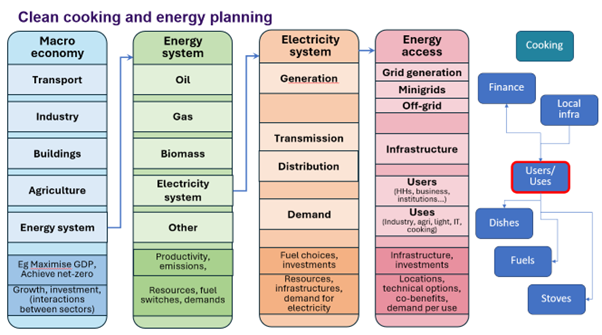
Image credit: Developed by Matt Leach, 2025.
This blog is based on a transcript of Prof. Matt Leach delivering a talk as part of the ESMAP webinar series. The transcript was converted to a blog by AI, and further edited by humans.