
- Date
- 9th January 2026
- Categories
- Inclusion & Disability
By Divya Wesley, Prabhat Education Foundation
How often do we pause to think about the independence that a single power plug can bring? Rarely. Yet, for many women with disabilities across India, it can mean the difference between dependence and dignity.
This is the story of Rekhaben (she is orthopaedically challenged), but it also represents the story of thousands of women like her.
Each day, Rekhaben wakes up at 5:30 AM to prepare breakfast for her family of children and grandchildren. In Gujarat, it is culturally common to have only two meals a day, breakfast and dinner, so the morning meal is elaborate and essential.
Her kitchen is spacious enough, but she has set it up as per her requirement, while making space for a large fish tank. But Indian cooking is demanding, it involves grinding, blending, and making fresh pastes to create rich flavours. While her onions caramelise on the stove, Rekhaben quickly picks up her mixy (mixer grinder) and carries it across the room to plug it in, all while being cautious that her ‘pallu’ (the loose end of a Sari) is not too close to the fire from the gas stove. The only available power point is high up, so she climbs onto the bed to reach it, all while rushing to ensure the onions don’t burn.
In Phase II of the Access to Energy Study, we explored alternative cooking methods for people with disabilities identified in Phase I. Electrical appliances emerged as a viable option, but before anything else, we needed to identify where a plug point could be placed so that it could actually serve its purpose.
Understanding Rekhaben’s challenge, we installed a lower, easily accessible power plug something she could use independently and safely.
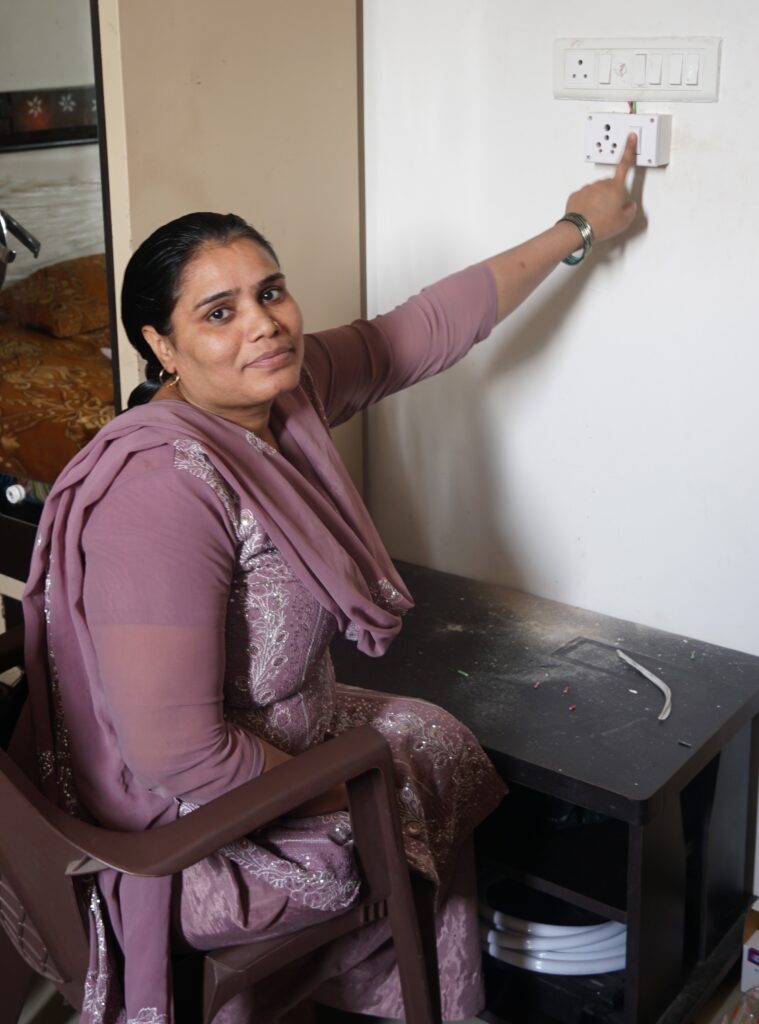
Today, she no longer rushes across the room or climbs onto beds. She uses not only the appliances provided in the study but also her very own mixy, joyfully. During our recent visit she proudly said, “I made three varieties of chutney today.”
That one sentence meant everything. It wasn’t just about the chutney, it was about freedom, choice, and joy. She now uses her mixy to her heart’s content, not just when absolutely necessary.
That plug point is not just an electrical fixture, it is a symbol of dignity, autonomy, and inclusion.
Too often, the needs of women with disabilities are overlooked, sometimes because they do not demand, sometimes because their struggles blend into daily routines. But this study has shown us one powerful truth: Simple accommodations can transform lives.
Sometimes, independence is just one plug point away.
***************************************************************************************************************
Featured Image: Photo Credit: Punita Naik, India, 2025.