By Richard Sieff (Gamos Ltd/MECS), Samir Thapa (Loughborough University/MECS), Bikash Pandey (Winrock International), Badri Baral (Winrock International)
Summary
In 2024, MECS funded a readiness assessment by Winrock International for a scalable, market-based financing model to promote electric cooking (eCooking) adoption in Nepal, targeting one million households. Building on earlier work by Winrock under the FCDO funded Sustainable Energy Challenge Fund (SECF)1 – the largest development sector eCooking intervention to date in Nepal with close to 50,000 households reached by end of 2025 – the model avoids direct appliance subsidies and instead uses demand aggregation and credit financing to improve affordability, strengthen supply chains, and unlock private capital. The model operates via two market-based delivery channels (PAYG businesses and community based organisations) supported by results-based finance, revolving funds, working capital, and loan loss guarantees, with incentives targeted across the value chain. The final report for the readiness assessment found the model to be viable and this blog documents the report’s key findings and explores next steps, with the Winrock team currently exploring funding opportunities to implement the model.
Background – the Nepal eCooking context and the Sustainable Energy Challenge Fund
The rationale for the financing model and readiness assessment was based on Nepal’s low eCooking adoption rates and the findings of the SECF work. In Nepal, despite widespread household electrification and ambitious Government targets to promote eCooking as part of its national agenda and decrease reliance on biomass and LPG, only 400,000 households (~7%) currently use eCooking and as few as 0.5% of households use eCooking as a primary fuel. Over half the population still rely on traditional biomass-based cooking which causes high indoor air pollution and severe health risks that disproportionally affect women and children, while the rapid growth of LPG cooking further affects Nepal’s widening foreign trade deficit. Despite the low overall eCooking adoption rates, the work by Winrock under the SECF demonstrated that people with low incomes could purchase and successfully adopt eCookers when suitably supported. Under Winrock’s initial pilot 20,000+ households were reached by the end of 2023 using a market development based approach, which offered performance-based incentives to microfinance institutions (MFIs) to operate as market aggregators and credit financing provisions for eCooking promotion. Bulk aggregation unlocked consumer incentives, enabling the MFIs to negotiate with manufacturers longer warranty periods (from 12 to 18 months) and a reduced purchase price (by 25%).
Preliminary research helps validate the SECF credit and aggregation approach
To help further validate the SECF approach, a review of other eCooking financing mechanisms used in Nepal was conducted by Winrock as part of preliminary research. The review found appliance subsidies could lead to market distortion deterring investment, mechanisms without credit financing were suitable only for small scale initiatives, and carbon finance while highly promising was still in a nascent stage in Nepal (although recent regulatory developments are highly encouraging). Working capital and results based financing (RBF) were viewed as beneficial but needing to be complemented by other mechanisms to address concerns over their long term sustainability. The review found the SECF approach had most potential in terms of mass scalability, prompting a more detailed analysis to identify where adjustments to the model might be necessary when scaling.
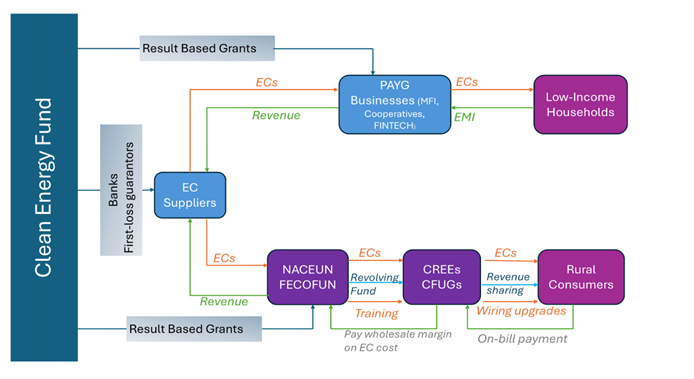
The main change identified was the need to include more organisation types to act as demand aggregators and finance providers rather than rely solely on MFIs as the performance of different participating MFIs had varied under the SECF. This finding led to the financing model being adjusted to include two channels: one with a wider range of PAYG businesses (e.g. Fintech organizations); and another operating via Community Rural Electrification Entities (CREEs) and Community Forest User Groups (CFUGs). As Image 1 shows, both channels are supported by results-based finance, working capital, and loan loss guarantees, with incentives targeted across the value chain.
Methodology
To assess the viability of the adjusted financing model, the readiness of the key stakeholder groups that would be involved in its operationalisation was evaluated using six criteria identified from the earlier SECF deep dive:
- willingness to participate;
- compatibility of existing practices;
- network strength;
- sector coverage;
- organizational capacity;
- and level of support required to implement the financing model.
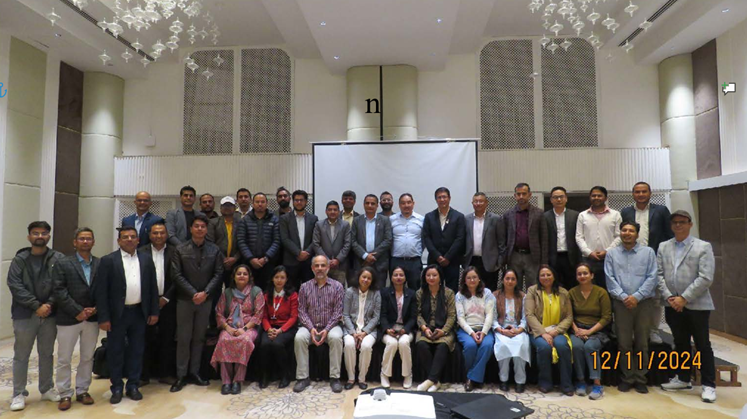
Data informing stakeholder readiness was then collected via 50 key informant interviews (KIIs), MFI consumer focus group discussions (FGDs), and a stakeholder consultation workshop.
Results
The study found the financing model to be viable although readiness to operationalize the model varied among the key stakeholder groups. Banks, MFIs, fintech companies, CREEs, suppliers and distributors were found to be ready for the most part, while CFUGs and local governments tended to lack readiness. The key findings for each of the stakeholder groups are documented below:
- Banks have not previously prioritised eCooking due to small ticket sizes, but would support scale-up via wholesale lending to demand aggregators and suppliers—preferably through MFIs/reputable firms, with loan-loss guarantees for lesser known counterparts.
- Suppliers/distributors are ready to scale imports (or establish local assembly) if demand is reliable. They can also access bank credit, offer dealer credit, discounts and longer warranties, but would need to expand their network beyond major cities and strengthen rural after-sales services.
- MFIs/cooperatives are well placed nationwide: those which participated under the earlier SECF pilot already have suitable loan products, while others may need support on product design, behaviour change, and monitoring and evaluation.
- Fintech companies can aggregate demand and support awareness, supply chains and monitoring through their wide networks. Although not able to lend directly, fintech organisations could act as loan agents enabling EMI payments.
- The CREE network (and its umbrella organisation NACEUN) has a ~0.5 million household network and could be effective for aggregating rural demand although NACEUN’s existing revolving fund would need additional finance.
- CFUGs (and its umbrella organisation FECOFUN) has a ~3 million household network and thus large scope to aggregate demand, but lacks capacity to offer credit. Lending would therefore need to come from partner financial institutions.
- Local governments have high potential but tended to be subsidy-oriented and reluctant to adopt market-based models.
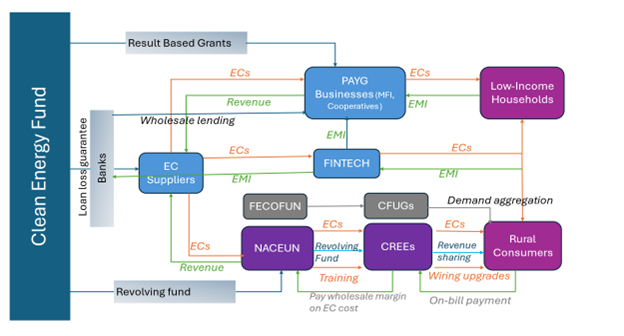
These findings informed refinements to the proposed financing model (image 3): notably prompting loan loss guarantees, strengthening MFI networks, leveraging fintech capabilities, expanding revolving funds. Advocacy for policy reforms and promotional awareness campaigns were recommended complementary activities.
Conclusion & Next Steps
Overall, the readiness assessment found the refined financing model to be a viable approach to scale eCooking in Nepal and the Winrock team are now exploring opportunities to take the model forward and implement. Indeed, the financing model seems well positioned to be operationalised via a range of collaborative and funding mechanisms as it:
- aligns with the objectives of major multilateral investment funds which tend to be results-based, multi-actor structure and focus on impact at scale2.
- could support Government of Nepal3 integrated energy planning by mobilising private investment for appliance uptake and increased domestic electricity consumption while allowing public funds to focus on grid and off-grid electricity infrastructure improvements. In the same way, eCooking in micro, small & medium enterprises (MSMEs) and institutions could also be supported, aligning with Nepal’s new NDC 3.0 eCooking target for firms and institutions.
- could serve as a national level aggregator for larger regional/global aggregators helping to connect Nepal with enhanced economies of scale benefits.
- provides required scale for eCooking projects to benefit from voluntary carbon markets and Article 6 arrangements under Nepal’s new carbon trading regulation (2025)4.
Going forward, the Winrock team welcome engagement and discussions with organisations keen to explore collaborative approaches to unlock the financing model’s potential and support Nepal’s clean cooking and climate targets while preserving market integrity. Interested parties, should contact Winrock International Nepal using the details below:
- For Winrock International, Nepal: Badri Nath Baral, Country Director, (bnbaral@winrock.org)
- For Winrock International, USA: Bikash Raj Pandey, Director- Clean Energy and Circular Economy, (bpandey@winrock.org)
***************************************************************************************************************
Footnotes
1SECF is part of the Nepal Renewable Energy Programme (NREP) operationalised by the focal Government agency for clean cooking, the Alternative Energy Promotion Centre (AEPC) and DAI Global UK, with Winrock International as an implementing partner. NREP aims to significantly increase private sector investment in the distributed sustainable energy market including via solar water pumps, solar PV systems, as well as through eCooking.
2A potential example could be funds unlocked by the Global Electric Cooking Coalition (GeCCo) which, being a coalition, has a strong multi-actor structure as well as a central focus on scale.
3As the SECF fell under AEPC, the financing model is well positioned to support Government of Nepal initiatives towards integrated energy access inclusive of eCooking.
4Potential benefits from carbon finance could increase further through ongoing work to integrate co-benefits (e.g. for black carbon and health) into digitally verified metered methodologies for clean cooking carbon finance projects, which are already securing higher premiums for credits due to greater accuracy and transparency. There may also be future scope for impact bond arrangements to unlock carbon finance and eCooking uptake.
***************************************************************************************************************
Links: Access the full Readiness Assessment report.
Disclaimer: ChatGPT5 was asked to review the draft version of the blog for flow, clarity, and consistency with results then followed up by human checks and editing.
Image credits: All images are Copyright of Winrock International, (2024-25).