- Date
- 18th June 2025
- Categories
- Kachione blog series, Scaling eCooking, Solar eCooking, Women
By Robert Van Buskirk, June 2025
As we continue the work of expanding solar-powered cooking systems across rural Malawi, reflect on the first phase of “Empowering Efficiency: Distributing off-grid solar electric cooking systems using women- lead organizing in rural Malawi”, and move forward with the current phase, I find myself returning often to one guiding question: what is the real value of the resources we invest?
The reason that answering this question is a key element of our work is that when money and resources are scarce—and they are very scarce in rural Malawi—you want to make sure that every dollar you have is used to maximum effect.
What makes answering this question difficult is that there is a diversity of impacts from e-cooking adoption and it is a challenge to include and value the many different benefits that may accrue.
Our work in Malawi, like much work in the development space, involves difficult choices. Do we add a battery to the system or keep it simpler and cheaper? Do we spend time training users more deeply, or do we prioritize wider distribution? Every issue we address and every problem that we solve requires time and resources.
To prioritize the limited resources we have, we try to maximize our benefit-cost ratio: i.e. the positive impact produced per unit effort and money (something agencies like the World Health Organisation wrestle with in the BARHAP work).
And for us our target ratio is 10:1, that is for every dollar we spend, we want to see at least ten dollars’ worth of benefit.
Why 10-to-1 and not some other ratio? There happens to be a charity that has been focusing on philanthropic cost-effectiveness analysis for more than a decade, and our 10-to-1 cost-effectiveness threshold reflects their standard practice:
“We maintain a minimum cost-effectiveness threshold, or bar, that helps us decide whether to direct funding to a program … [we fund] grants that we estimate are at least 10x cash.” [1]
This is not a rigid rule, but it serves as a compass. If we cannot realistically trace a line from cost to meaningful impact—whether financial, social, or environmental—then we take a second look.
The Daily Cost of Cooking is Multi-dimensional
Traditional cooking methods have many different costs: time, effort and money is spent collecting fuel, smoke from combusting inefficient fuels costs families their health and welfare, tending and managing a fire while cooking takes substantial time, and unsustainable wood harvesting damages the environment and contributes to global warming. Most of the day-to-day costs of cooking fall on women.
What a Solar e-Cooking System Includes
To reduce the costs of cooking for rural Malawians, we introduce an off-grid solar e-cooking system that includes:
- >600 watts of solar panels
- An electric pressure cooker
- Optional battery storage
- Simple, local training and maintenance
- Equipment for other uses: lights, electronics or solar pumping
The cost of deploying this full system—including hardware, logistics, and community support—is around $300 to $400. The panels are built to last well over a decade, and with basic care maintenance, the entire system can be used for 10 years.
What do Families Gain from Solar e-Cooking?
When we add up all of the different ways that the costs and burdens of traditional cooking can be reduced with solar e-cooking the total value returned per unit investment becomes very substantial:
Fuel collection time savings. Once solar panels are installed on the roof, no time need be spent to collect, transport or buy fuel (wood, charcoal or LPG) for any of the cooking provided by the panels. At 3 hours/week savings, and a time value of $0.2/hour, this is $31/year saved.
Saving money. Although they collect the majority of their woodfuel, there is always a need to purchase some at some points in the year. For a user-owned solar e-cooking system, no money is needed to buy fuel after the initial system investment is made. At $1/week, this is $52/year saved.
Faster cooking. By not having to light and tend to a fire, cooking on an e-Cooking system is substantially faster than cooking on traditional fuels. At 1 hour per day and $0.2/hour time value, this is $73/year.
Improved health. Without any combustion, e-cooking reduces the smoke from fires that create a large health burden from indoor air pollution for billions globally. Our preliminary estimate is that this may save approximately 25 days of healthier life per year per household.[1] At a value of at least $1 per day of extra, healthy life, this represents a value of at least $25/year.
Greater convenience. Cooking with an automated, programmable, insulated cooker allows the cook to use her time more efficiently. While the food cooks, she can step away from the cooker which can turn itself off and keep the food warm until people are ready to eat. At 30 minutes/day and $0.2/hour time value, this is $36/year savings.
Improved ecology and environment. Relying on sunshine rather than trees for cooking energy saves trees, preserves the environment and reduces greenhouse gas emissions. At 2.3 kg of CO2 emissions reductions per day[1] and this is about 0.84 ton of emissions reduction per year, worth about $19 at a carbon price of $23/ton.
Electricity available for non-cooking uses. Once a household has enough electricity for cooking, there is also electricity available for many other uses, which generally require much less energy than cooking. At 0.1 kWh/day (lights and electronics) and $1/kWh (cost of off-grid electricity in small solar systems), this represents $36/year savings.
When we total the value of all seven benefits, we get:
- Time savings: 156 + 365 + 182 = 703 hours/year = $141/year
- Carbon value: 2.3 kg/day CO2e savings = 0.84 tons/year = $19/year
- Monetary savings (fuel and electricity): $52 + $36 = $88/year
- Health: 25 days/year at $1/day = $25/year
- TOTAL: $273/year
Thus, the total benefit produced by the cooking system in a year has a value that is equal to 70% to 90% of the initial investment cost of the solar e-cooking system. This means that if we make sure that the system provides benefits for more than 10 years and we make sure that customers pay at least 1/3 of the system investment, then we attain our target 10-to-1 return on the donor dollars that are co-invested.
Why Donor Dollars are Needed: 70% of the Benefit Value is Unmonetized
Because much of women’s work is unpaid in rural Malawi, as is the health of one’s family and children, at least 60% of the total impact is unmonetized in rural Malawi. This is a key reason that our customers can pay only a fraction of the total investment cost of our cooking systems.
About 7% (i.e. the carbon value) can be monetized with work and effort, but it represents less than one tenth of the total value that the cooking system produces.
But from a development perspective, all the seven dimensions of benefit are valuable to both the beneficiaries and international development efforts. That is why in our efforts, we attempt to optimally enhance all seven categories of system benefits.
A Measured, Intentional Approach
These cooking systems are not silver bullets, and the benefits estimates here are admittedly rather approximate. But the model we’re testing is adaptable, locally maintainable, and designed around long-term sustainability.
The reason we talk about a 10-to-1 return isn’t to be dramatic. It’s to make sure we stay focused on ALL of the outcomes that produce real value, not just the number of systems distributed. It’s to remind ourselves that the true goal is not simply to install equipment, but to deliver value—value that lasts, grows, and is comparable to the most cost-effective development investments that philanthropists support.
Ultimately, we aspire to partner with international donors and philanthropists to create a “development credit” that is like a carbon credit, but which additionally reflects the entire value that a solar e-cooking system can provide. Doing so might very well help solve a key benefit monetization problem that makes it so difficult to organize financially sustainable projects in low-income developing country economies like Malawi’s.
In the meantime, we will keep a laser focus on producing $10 of benefit for every $1 that we spend on our projects …
— Robert
[1] See appendix A of: https://mecs.org.uk/publications/empowering-efficiency-phase-ii-refining-an-affordable-solar-home-system-with-ecooking-for-rural-malawi/ A health improvement of 0.000186 DALY/kWh x 365 kWh/year = 0.068 DALY/year = 24.8 days.
[2] By applying an fNRB value of 60% to the calculation presented in the appendix of Empowering Efficiency Phase II report
[1] See: https://www.givewell.org/how-we-work/our-criteria/cost-effectiveness/cost-effectiveness-models
……………………
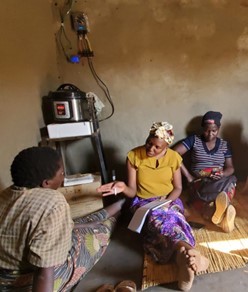
Featured image: Interview and nudge:- Kachione partner women’s groups, who discuss use and needs with consumers (photo credit: R. Buskirk, 2025).