- Date
- 17th September 2025
- Categories
- eCooking, Scaling eCooking
By Jose Luis Ortega Moreno (Loughborough University) and Jacob Fodio Todd (Gamos Ltd.)
Introduction
Recent and ongoing projects in Kenya, Tanzania and Uganda highlight the potential of electric cooking (eCooking) in schools. These countries provide favourable environments for scaling up eCooking due to their centrally managed school feeding programmes, either already in place or under development, along with relatively high rates of electricity access in schools. The often simple, replicable menus and cooking processes common in school kitchens also align well with the strengths of eCooking appliances.
Early morning and daytime cooking aligns well with electricity generation and transmission patterns. In most schools, meal preparation occurs outside the evening peak, offering a valuable opportunity to shift current and future spending on fuelwood toward daytime electricity use. This pivot not only reduces operational costs for schools but also enhances utility revenues during off-peak hours – supporting returns on infrastructure investment and reinforcing the case for expanded grid access.
However, each country has unique school feeding programmes, education landscapes, energy access rates, and cuisines needed to be understood to ensure tailored eCooking solutions.
The following documents synthesise information on the education systems, school menus, eCooking projects, electricity access, and school feeding programmes in Kenya, Tanzania and Uganda, providing insights into the opportunities and challenges for adopting eCooking.
| Kenya | Tanzania | Uganda | |
|---|---|---|---|
| Total Population | 55 million1 | 67 million2 | 49 million3 |
| Education System | Primary education is free and compulsory (8 years).4 | Primary and lower secondary education (10 years) is free and compulsory (as of 2024 policy).5 | Basic primary education is free and compulsory |
| Children enrolled in school6 | 16.4 million (2020)7 | 15.8 million (2022)8 | 11.4 million (2021)9 |
| Children enrolled in pre-primary | 2.8 million | 1.5 million | 600,000 |
| Children enrolled in primary | 10 million | 11.4 million | 8.8 million |
| Children enrolled in secondary | 3.6 million | 2.8 million | 1.9 million |
| Years in education | Pre-primary: 2 years (ages 4-5) Primary: 6 years (ages 6-11) Junior Secondary: 3 years (ages 12-14) Senior Secondary: 3 years (15-17).10 | Pre-primary: 1 year (ages 5-6) Primary: 6 years (ages 6-12) Lower Secondary: 4 years (ages 12-16) Upper Secondary: 2 years (general education) or 3 years (vocational training) (ages 16-18/19).11 | Primary: 7 years (ages 6-12) Lower Secondary: 4 years (ages 12-16) Upper Secondary: 2 years (ages 16-18).12 |
| Urban / rural divide (enrolment) | 20% of the rural population has never attended school, compared to 9% of urban population. 17% of rural Kenyans abandon education before completion, compared to 13% of urban population (2019).13 | Pre-primary: 31.3% rural / 42.2% urban Primary: 80.2% rural / 87.4% urban Secondary: 29.2% rural / 67% urban | Primary: 91% urban / 85% rural Secondary: 38% urban / 14% rural14 |
| Gender disparities (enrolment) | Primary – 51:49 (boys : girls) Secondary – 49 : 51 (boys : girls).15 | 49:51 (boys : girls) | Primary – 50:50 (boys:girls) Secondary – 53:47 (boys : girls) |
| School year dates | January – October / November16 | Two terms: January – June / June & July – December | February – December17 |
2 WHO, 2023. Data: United Republic of Tanzania.
3 WHO, 2023. Data: Uganda.
4 Ministry of Education of the Republic of Kenya, 2019. National Education Sector Strategic Plan 2018-2022
5 Ministry of Education, Science and Technology of the United Republic of Tanzania, 2023. Education and Training Policy 2014, 2023 Edition.
6 For Kenya and Tanzania, total school enrolment includes pre-primary, primary, and secondary enrolment, whilst for Uganda, only primary and secondary enrolment is included.
7 Ministry of Education of the Republic of Kenya, 2020. Basic Education Statistical Booklet 2020.
8 President’s Office of the United Republic of Tanzania, 2022. Pre-Primary, Primary, Secondary, Adult and Non-Formal Education Statistics.
9 GCNF, 2019. Global Survey of School Meal Programs: Uganda.
10 Ministry of Education of the Republic of Kenya (2019). National Education Sector Strategic Plan 2018-2022
11 Ministry of Education, Science and Technology of the United Republic of Tanzania (2023). Education and Training Policy 2014, 2023 Edition.
12 UNDP, 2017. Nationally Appropriate Mitigation Action on Integrated Sustainable Energy Solutions for Schools in Uganda.
13 Kenya National Bureau of Statistics. (2019). 2019 Kenya Population and Housing Census: Volume IV – Distribution of Population by Socio-Economic Characteristics.
14 Education Policy and Data Center (2012). Primary School Net and Gross Attendance Rates, Uganda.
15 Ministry of Education of the Republic of Kenya. (2024). Pilot Census Report: 2024 National School Census.
16 The Kenya Times. (2024). Govt Announces New School Calendar.
17 Education Policy and Data Center (2018). Uganda.
School feeding
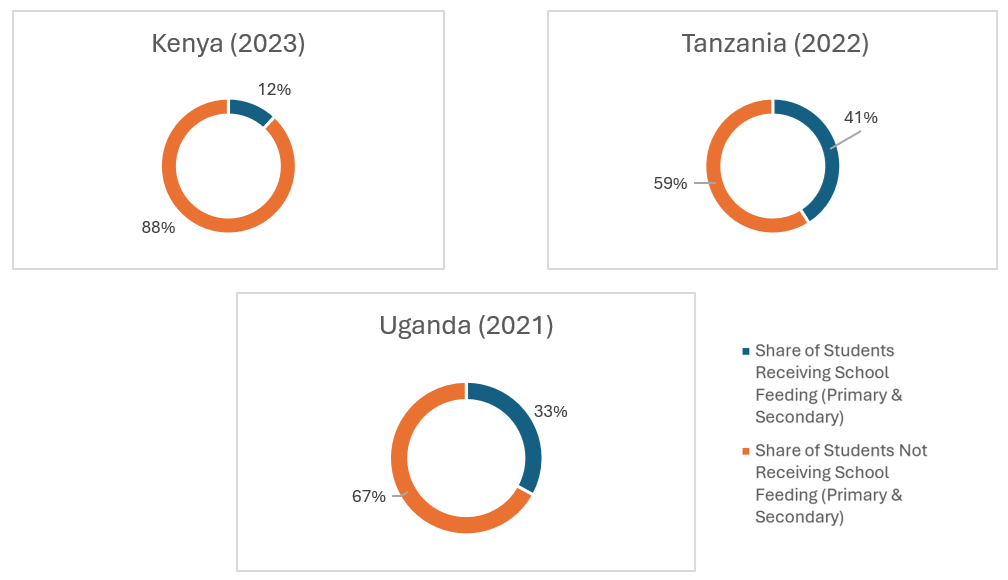
School feeding programmes in Kenya are not compulsory, but are commonly implemented through government initiatives, county programmes, donor support and family contributions. School cooks tend to be volunteers. In private schools, parents and guardians finance day-students’ school meals. The Government of Kenya runs the centrally sponsored and coordinated School Meals Programme (SMP) with the support of World Food Programme (WFP). The SMP is the largest school feeding programme in the country. In February 2025, Kenya’s Ministry of Education announced plans to extend the SMP to 10 million children by 2030.
In Tanzania, parents and guardians are required by the government to ensure that all children attending school are provided with meals. In government schools, meals are mostly prepared on-site, with families supporting the programmes by providing meal ingredients and/or financial support, as well as volunteering to cook. In private schools, parents and guardians finance students’ school meals. Tanzania does not have a nationally owned school meal programme. Instead, there are a number of decentralised alternatives such as the Community-led School Feeding for Public Day Schools, for example, which feeds 6.5 million children annually since 2020, reaching over 16,500 schools across the country.
Uganda’s principal school feeding programme is the Parent-led School Feeding Programme (PLSFP). This is a government directive and but is not mandatory. With the PLSFP parents may provide children with food directly or pay the school to provide meals. The GoU estimates that the PLSFP provided around 4.9 million children with school feeding in 2021. In December 2024, the Ministry of Education and Sports announced a plan to launch a national school feeding programme for all primary school students in the country from 2026.
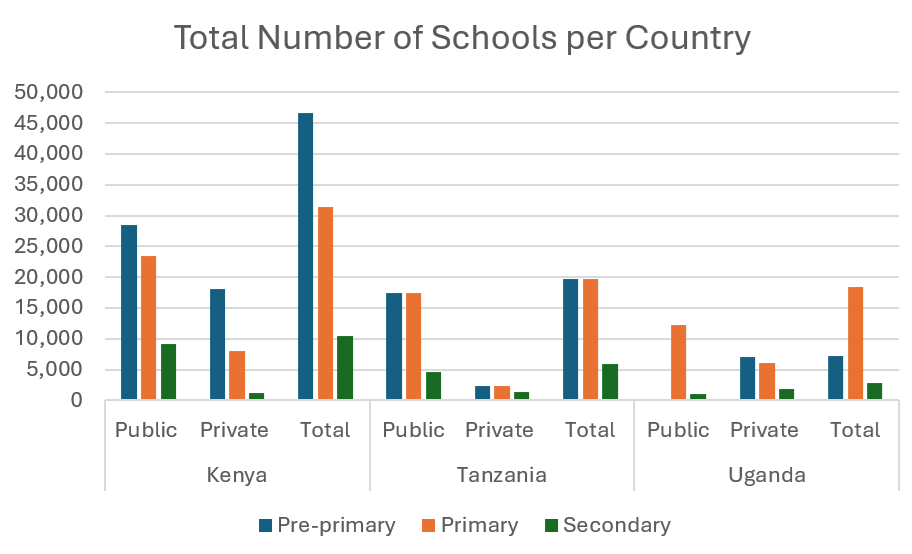
Across the three countries, school menus are relatively decentralised, with no strict or formal guidance on specific foods needed to be provided. For example, Tanzania’s National Guidelines on School Feeding (2020) highlight food groups that should be included in children’s diets.
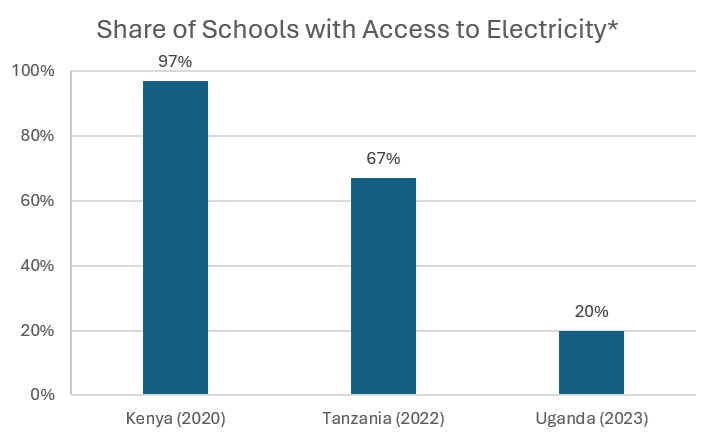
Share of Schools with Access to Electricity21
Most schools providing feeding across Kenya, Tanzania, and Uganda continue to depend on firewood or charcoal as cooking fuel.
However, there is a significant opportunity to transition these schools to eCooking as most schools either already have electricity access or there are plans in place to offer this. In Tanzania, 56% and 77% of all primary and secondary schools respectively have access to electricity. In Kenya, the share of access is even higher, with 97% of primary schools connected to electricity. In contrast Uganda, where institutional electricity access is still a challenge, only 20% of all schools have access to electricity.
Studies evaluating institutional cooking pilot projects, such as a study done by MECS in Lesotho and a MECS paper looking at case studies in Kenya, Lesotho, Guinea and Nepal, have shown that eCooking could significantly reduce the strain of firewood and charcoal costs on school budgets. In Uganda, an average institution with improved cookstoves spends USD 1,170 annually on cooking fuel. Schools in Kenya reportedly pay up to USD 20,000 per year for firewood. In Tanzania, UNIDO found that schools that shifted from cooking with firewood to cooking with bio-waste reported savings of up to 45% of their monthly expenditures on cooking fuel. Whilst more evidence is needed, schools across the three countries could financially benefit from more efficient cooking practices.
Enabling Environment
The ability to accelerate clean cooking transitions in Kenya, Tanzania and Uganda has been strengthened by a broadening the enabling environment.
Governments have been pushing policies aiming to mainstream clean cooking solutions across educational institutions in their countries.
As part of Tanzania’s Clean Cooking Strategy (2024-2034), the country aimed to transition all institutions (including schools) providing services to more than 100 people to clean cooking solutions by the end of 2024. Moreover, the National Guidelines on School Feeding and Nutrition Services to Basic Education Students (2020) serves as the first step towards achieving a centrally-run school meal programme.
Kenya’s National Cooking Transition Strategy (2024-2028) sets out a plan to achieve universal access to clean cooking by 2028. Additionally, the President of Kenya declared that all schools should transition to clean cooking solutions by 2025.
Uganda’s National Appropriate Mitigation Action for Integrated Sustainable Energy Solutions for Schools (2017) outlines a plan to introduce clean energy technologies, such as improved cookstoves, biogas systems, and solar PV installations across educational settings in the country. Through its School Meal Coalition Commitment (2023), Uganda has also agreed to developing and approving a national school feeding policy by 2025, a departure from its parent-led programme.

Opportunities and Challenges
Across the Kenyan, Tanzanian, and Ugandan contexts, there are key opportunities and challenges to the uptake and scalability of eCooking in school settings:
Opportunities
- Recent government policies and commitments to providing free and compulsory education, school feeding programmes, clean cooking services and access to electricity.
- Studies and trials have shown that transitioning away from firewood and charcoal in institutional kitchens towards more efficient fuels and technologies (including eCooking) can have positive effects in reducing air pollution, economic costs, and deforestation. More evidence is needed, but programmes such as the Uganda eCooking Scale and Support Programme, which targets eCooking in 100+ schools, are in place to deliver this.
- Biomass fuel being used for cooking is mainly purchased, as schools require it on a greater scale, straining school budgets as firewood and charcoal prices increase.
- Large shares of the countries’ populations are under 18, meaning schools are key platforms to spread awareness on clean cooking practices and technologies.
- Kenya, Tanzania and Uganda have large-scale school feeding programmes, although all countries must expand the reach of these programmes with clear strategies promoting cleaner cooking solutions.
- In Kenya, access to electricity is already present in most primary schools across the country, although the governments institutional clean cooking strategy poses LPG as the principal transition fuel.
- In Tanzania, a significant number of schools (mainly urban and peri urban) have access to electricity, with those located in rural settings currently lacking access.
- All three countries currently have surplus electricity generation capacity. Redirecting school energy expenditure toward daytime cooking demand ie outside the evening peak and offers a strategic opportunity to optimize grid utilization. This shift supports utility revenues, enhances infrastructure return on investment, and aligns with broader government energy access goals.
Challenges
- The vast majority of schools continue to rely on firewood and charcoal as their main cooking fuel.
- There is a lack of data and studies on school feeding expenditure, schools’ rate of access to electricity, and the reliability of this access.
- Decision making at institutions requires many stakeholders and a substantial amount of time and visits to the institutions before reaching an agreement to purchase and install cleaner cooking technologies.
- There is very low participation of women in institutional financial decision making.
- There needs to be more research on what meals are served in schools before clean cooking transitions can be implemented, as technologies and appliances must be context specific.
- There are significant regional differences in terms of school enrolment and feeding availability across the three countries. There needs to be additional research on this, as well as the reliability of feeding in regions where school enrolment is low.
- In Uganda most schools lack access to electricity.
- Tanzania and Uganda continue to lack a centrally-run and nationally sponsored school feeding programme.
Access the related cooking in schools country context briefs at:
References
Education Policy and Data Center (2012). Primary School Net and Gross Attendance Rates, Uganda. https://www.epdc.org/sites/default/files/documents/Uganda_coreusaid.pdf
Education Policy and Data Center (2018). Uganda. https://www.epdc.org/sites/default/files/documents/EPDC_NEP_2018_Uganda.pdf
Global Child Nutrition Foundation (2019). Global Survey of School Meal Programs: Uganda. https://gcnf.org/wp-content/uploads/2022/09/Uganda_2021_final.pdf
Global Child Nutrition Foundation (2024). Global Survey of School Meals Programs: Tanzania. https://gcnf.org/wp-content/uploads/2024/07/Tanzania_2024_Report_R2.pdf
Global Child Nutrition Foundation. (2019). Global Survey of School Meals Programs: Kenya. https://gcnf.org/wpcontent/uploads/2024/12/Kenya_2024_Report_R2.pdf
International Energy Agency (2023). Uganda 2023: Energy Policy Review. https://memd.go.ug/wp-content/uploads/2020/07/Uganda2023-Energy-Policy-Review.pdf
Kenya Climate Ventures. (2021). Taming Kenyan Schools’ Addition to Firewood. Retrieved April 28, 2025, from https://kcv.co.ke/2021/10/07/taming-kenyan-schools-addiction-to-firewood/
Kenya National Bureau of Statistics. (2019). 2019 Kenya Population and Housing Census: Volume IV – Distribution of Population by Socio-Economic Characteristics.
Khalifa, Y. et al. (2025). ‘The Role of Electric Cooking in Providing Sustainable School Meals in Low-Income and Lower-Middle-Income Countries’. The Lancet Planetary Health. https://www.thelancet.com/journals/lanplh/article/PIIS2542-5196(25)00004-X/fulltext
Ministry of Education and Sports of Uganda (2017). Education Abstract 2017. https://www.education.go.ug/wp-content/uploads/2019/08/Abstract-2017.pdf
Ministry of Education and Sports of Uganda (2024). Uganda’s School Meals Coalition Commitments. https://schoolmealscoalition.org/sites/default/files/2024-09/National%20Commitment_Uganda.pdf
Ministry of Education of the Republic of Kenya (2019). National Education Sector Strategic Plan 2018-2022. https://www.education.go.ke/sites/default/files/Docs/MOE-NESSP%20BOOKLET%20TEXT%20combined%20%20with%20cover%202019%20%281%29.pdf?
Ministry of Education of the Republic of Kenya. (2020). Basic Education Statistical Booklet 2020. https://www.education.go.ke/sites/default/files/Docs/The%20Basic%20Education%20Statistical%20Booklet%202020%20%281%29.pdf
Ministry of Education of the Republic of Kenya. (2024). Pilot Census Report: 2024 National School Census. https://www.knbs.or.ke/wp-content/uploads/2025/01/2024-National-School-Census-Pilot-Report.pdf
Ministry of Education, Science and Technology of the United Republic of Tanzania (2020). National Guidelines on School Feeding and Nutrition Services to Basic Education Students. https://www.fao.org/docs/devschoolfoodlibraries/materials-from-countries/national-guidelines-on-school-feeding-and-nutrition-services-to-basic-education-students-(2020).pdf?sfvrsn=95faac6a_3
Ministry of Education, Science and Technology of the United Republic of Tanzania (2023). Education and Training Policy 2014, 2023 Edition. https://www.moe.go.tz/sw/nyaraka/education-and-training-policy-2014-2023-edition
Ministry of Energy and Petroleum of the Republic of Kenya. (2024). Kenya National Cooking Transition Strategy 2024-2028. https://www.energy.go.ke/sites/default/files/KAWI/Publication/Kenya%20National%20Cooking%20Transition%20Strategy_Signed.pdf
Nsengiyaremye, J. and Khalifa, Y. (2023). ‘Large Electric Pressure Cooker in Schools: Evidence from Lesotho’. Modern Energy Cooking Services (MECS). https://mecs.org.uk/wp-content/uploads/2023/11/Large-electric-pressure-cookers-in-schools-evidence-from-Lesotho.pdf
President’s Office of the United Republic of Tanzania (2022). Pre-Primary, Primary, Secondary, Adult and Non-Formal Education Statistics. https://www.tamisemi.go.tz/storage/app/BEST/REGIONAL%20BEST%202022%20.pdf
Seneroglu, B. (2024). ‘UNIDO Initiatives Inspiring Clean Cooking in Tanzania’. UNIDO. Retrieved April 29, 2025, from https://cleancookingcouncil.org/unido-initiatives-in-inspiring-clean-cooking-in-tanzania
The Kenya Times. (2024). Govt Announces New School Calendar. Retrieved April 28, 2025, from https://thekenyatimes.com/breaking-news/govt-announces-new-school-calendar/.
The World Bank. (2023). The State of Cooking Energy Access in Schools: Insights from an Exploratory Study. https://documents1.worldbank.org/curated/en/099112923154518062/pdf/P1742320a92eaf04d0b62e045485bf0ccc0.pdf
United Nations Development Programme (2017). Nationally Appropriate Mitigation Action on Integrated Sustainable Energy Solutions for Schools in Uganda https://www.undp.org/publications/nama-integrated-sustainable-energy-solutions-schools-uganda
World Health Organisation (2023). Data: Uganda. Retrieved April 29, 2025, from https://data.who.int/countries/800
World Health Organisation (2023). Data: United Republic of Tanzania. Retrieved April 29, 2025, from https://data.who.int/countries
World Health Organisation. Kenya Country Profile. Retrieved April 28, 2025, from https://data.who.int/countries/404
……………………………………….
18 Sources are: Kenya (Ministry of Education, 2020); Tanzania (President’s Office, 2022); Uganda (Ministry of Education, 2017).
19 Figures given for all children of school-age children, not only ones enrolled in the education system. It is likely that the percentage of children receiving school feeding is higher for the three countries as of 2025. Sources are: Kenya (GCNF, 2024); Tanzania (GCNF, 2022); Uganda (GCNF, 2022).
20 Figures for Uganda include children receiving meals through the Parent-Led School Feeding Programme.
21 Data given for Uganda (2023) is for all primary and secondary schools, whilst for Kenya (2020) and Tanzania (2023) is for only for primary schools.
22 Figures for Kenya are for all public primary schools (Ministry of Education, 2020). Figures for Tanzania are for all public and primary schools (President’s Office, 2022). Figures for Uganda are for all primary and secondary schools (IEA, 2023).
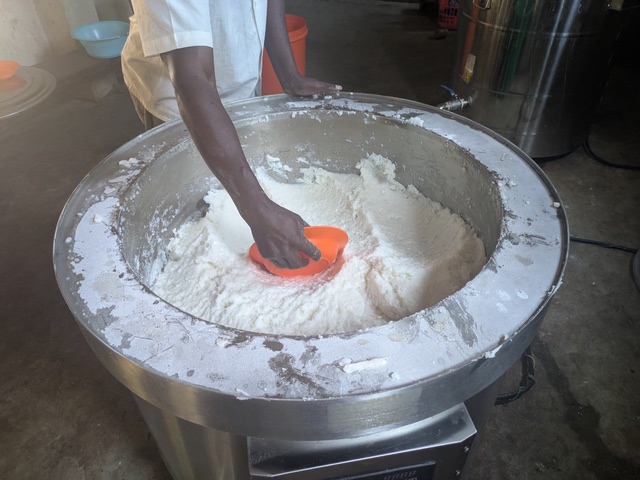
Photo 1, featured at top: Serving posho from an electric boiler, Kampala, Uganda. Photo by Jacob Fodio Todd (MECS).