- Date
- 17th September 2026
- Categories
- eCooking, Electrification
By TaTEDO-SESO.
Introduction
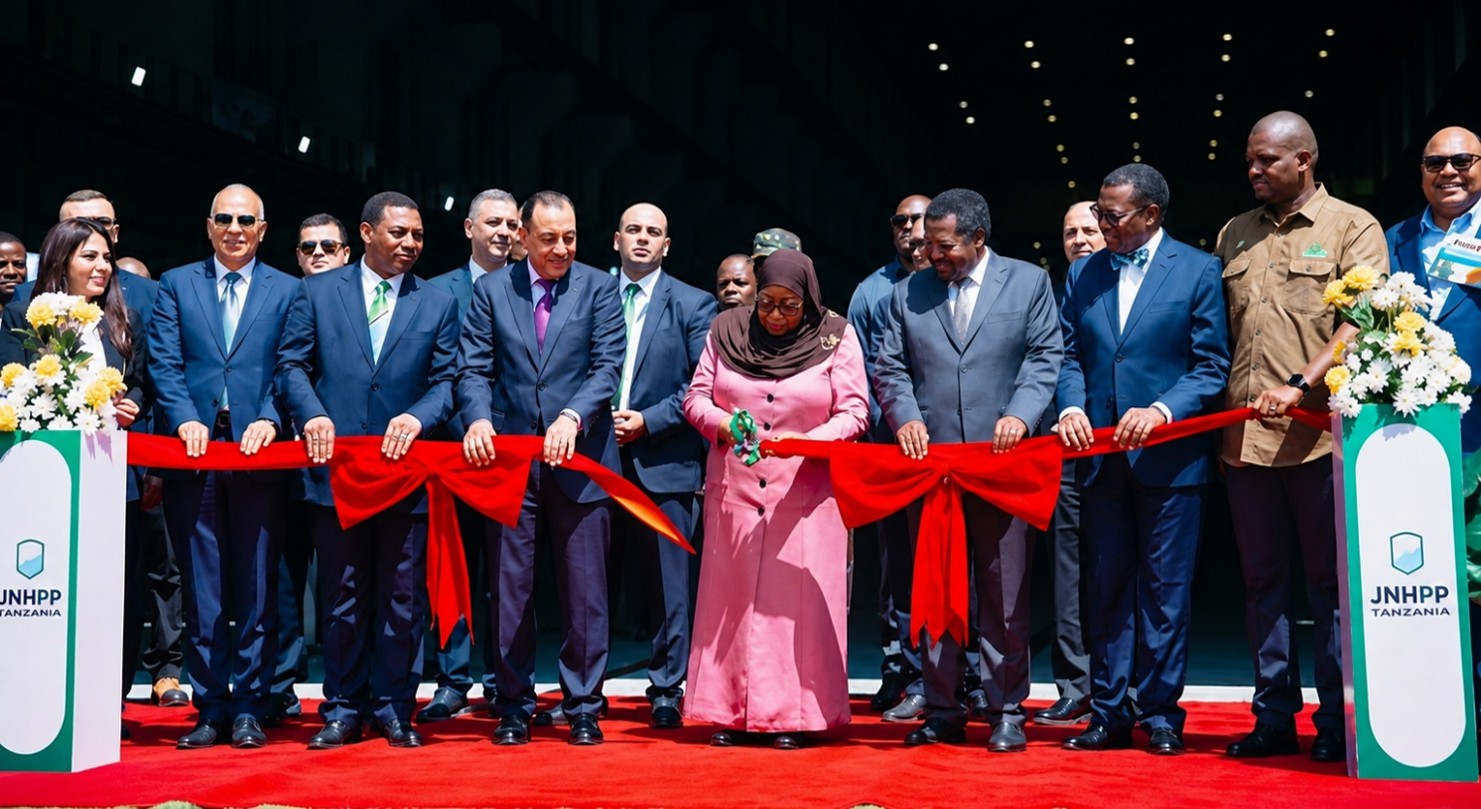
On 22 August 2026, President Samia Suluhu Hassan stood at Stiegler’s Gorge on the Rufiji River and formally inaugurated the Julius Nyerere Hydropower Plant (JNHPP) with 2,115 MW, the largest infrastructure investment in Tanzania’s history. Most coverage told a story about power. It is also a story about eCooking.
Tanzania’s cooking-energy landscape remains stubbornly biomass-dependent: roughly 80 percent of households still cook primarily with firewood or charcoal, and only about 2 percent use electricity as their main fuel. Yet the country now has, for the first time, the generation surplus, appliance technology and financing architecture to change that at scale. JNHPP will not solve clean cooking on its own, but it removes the biggest excuse: that there isn’t enough reliable electricity to cook with.
A Landmark Day at JNHPP
The ceremony, held within Nyerere National Park in Rufiji District, Pwani Region, brought together heads of state and senior officials from across the region. President Samia was joined by Vice President Hon. Emmanuel Nchimbi, Prime Minister Hon. Mwigulu Nchemba, Egyptian Prime Minister Hon. Moustafa Madbouly, and former African Development Bank President Hon. Akinwumi Adesina. TaTEDO-SESO and SESCOM Ltd attended on behalf of Tanzania’s clean cooking sector.
President Samia told the gathering, “When we make decisions in the national interest, we should not give up simply because the path is difficult”, a nod to the project’s long and, at times, contested history. Dr. Adesina struck a similarly forward-looking note, describing Tanzania’s expanded power base as a foundation to become “an energy and industrial hub for the region.”
The plant’s nine generating units, each rated at about 235 MW, cost roughly TZS 7.45 trillion (about USD 2.9–3.35 billion) and were financed entirely from Tanzania’s own resources, without external borrowing, a landmark act of national investment.
What 2,115 Extra Megawatts Actually Mean
The scale is best understood against Tanzania’s existing power system. Ahead of the inauguration, the Minister of Energy reported national installed generation capacity had reached approximately 4,646 MW against peak demand of around 2,010 MW, a surplus of roughly 2,636 MW. JNHPP supplied approximately 44.9 percent of all electricity fed into the national grid in the year to 31 May 2026, already the backbone of Tanzania’s supply.
A surplus of that size is, on its own, only a technical fact. Its developmental value depends on what Tanzanians can do with the electricity. Electrification efforts have long focused on generation and connection; the next question is what that connection is for.
The Gap Between Electrification and Clean Cooking
That question is especially urgent for cooking, Tanzania’s largest category of household energy use and most stubborn clean-energy gap. National household electricity access reached 71.2 percent by 2025 (84 percent urban, 61 percent rural), per the National Bureau of Statistics. Clean cooking access, by contrast, rose from just 6.9 percent in 2021 to 23.2 percent in 2025, real progress, but far short of the 80 percent target in the National Clean Cooking Strategy (NCCS 2024–2034).
In other words: millions of connected households still cook with firewood or charcoal. Indoor air pollution from biomass cooking is Tanzania’s largest single environmental health risk, linked to an estimated 33,024 premature deaths and 1.4 million healthy life-years lost (DALYs) annually. Urban households can spend up to 30 percent of income on charcoal; rural women and girls spend hours daily collecting firewood. The World Bank puts the total annual cost (health, lost productivity and climate impacts) at roughly USD 39 billion.
Why Electric Cooking, and Why Now
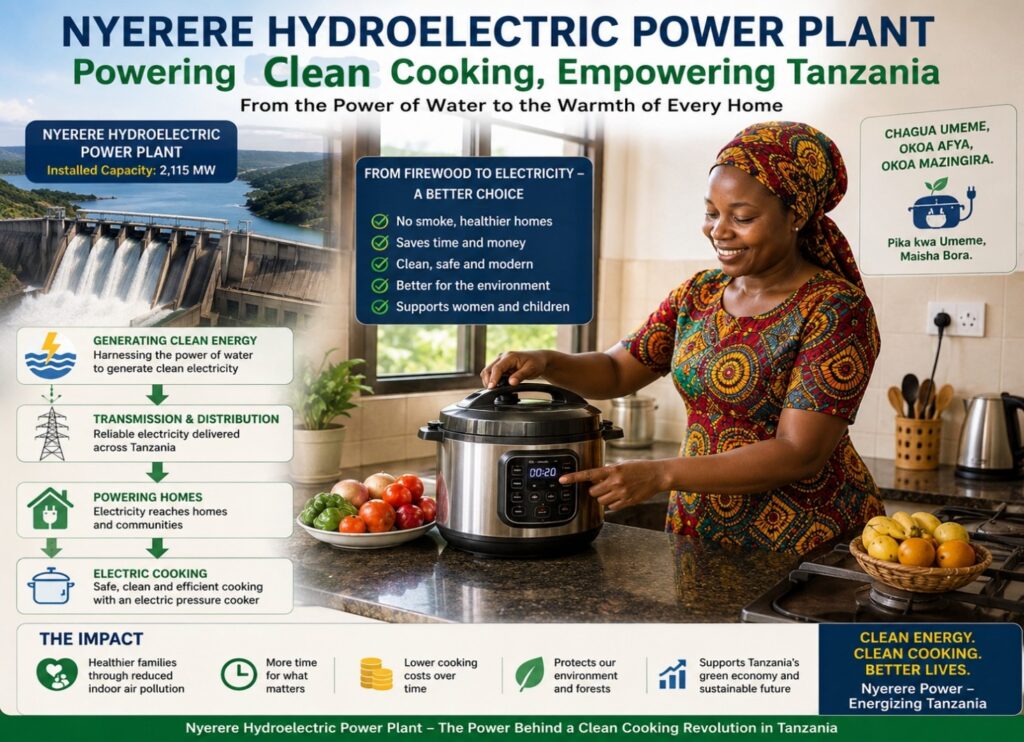
Modern electric cooking appliances (above all the Electric Pressure Cooker (EPC)) have already answered whether electricity can practically replace charcoal in a Tanzanian kitchen. Field evidence from TaTEDO-SESO and partners shows roughly 92 percent of everyday Tanzanian dishes, including beans, makande and meat stews, can be cooked in an EPC, typically in 20 to 35 minutes versus 45 to 90 on charcoal. On the standard domestic tariff, an EPC meal costs approximately TZS 352 versus TZS 2,000–3,000 on charcoal (four to six times cheaper), with payback in six to ten months.
Reliability is what turns that economic case into a household decision. A power cut is a minor inconvenience for a light bulb; it is a much bigger problem mid-meal. Where supply feels unpredictable, households keep charcoal or firewood as backup (“fuel stacking”), which erodes the gains a full transition would deliver. JNHPP’s added capacity strengthens the case for treating electricity as a dependable everyday cooking fuel, not a fallback.
“Women are responsible for cooking, but they do not decide what technology to buy.”— Civil-society respondent, TaTEDO-SESO / JustGESI Key Informant Interviews, 2026
Tanzania Is Already Proving the Model
Tanzania is not starting from zero. TaTEDO-SESO and social enterprise SESCOM Ltd have sold more than 28,500 EPCs through three regional service centres and a network of women-led sales agents, and now export to the Democratic Republic of Congo. SESCOM’s own-brand EPC carries Global LEAP recognition, a mark of international quality.
The financing picture is shifting just as fast. In October 2025, TANESCO launched ‘Konekt Umeme, Pika kwa Umeme’ (Connect Electricity, Cook with Electricity) Africa’s first utility on-bill financing scheme for electric cooking appliances, letting customers repay an EPC through their monthly bill via the existing LUKU prepayment infrastructure. An earlier staff scheme saw roughly 1,000 subsidised units taken up within a week, of 11,000 planned as an early signal of latent demand. In parallel, the Kibasila Primary School eCooking Model Kitchen is piloting institutional electric cooking, targeting 50 government schools.
The Return: Health, Forests, Gender and Climate
The potential payoff is large. TaTEDO-SESO’s Tanzania Electric Cooking Transition Assessment 2026 estimates that if just 40 percent of urban charcoal-using households switched to electric cooking, Tanzania would see USD 220 million in net social benefit yearly, 2,691 DALYs avoided, 1.3 million tonnes of CO₂-equivalent avoided, and 429 million hours of women’s time freed, alongside an estimated 530 GWh of new electricity demand JNHPP now helps supply.
The gender dimension is central, not incidental. Women perform most household cooking and bear the greatest health burden from smoke, yet 72 percent of mainland households are male-headed, and men typically control the purchase decision. The World Bank estimates Tanzania loses roughly USD 12 billion a year in female productivity to cooking and fuel collection. Closing that gap means financing that doesn’t require a male co-signatory, women-led distribution, and savings-group-routed financing, a market-design imperative, the assessment argues, not simply a social good.
There is an environmental dividend too. Biomass demand is linked to an estimated 469,420 hectares of forest loss per year between 2015 and 2020. Every household that shifts to electricity (now roughly 70 percent generated from clean sources such as hydro, gas and solar) eases that pressure, even as Tanzania’s cooking transition remains a multi-fuel one for years to come.
What Still Needs to Happen
Generation capacity was never the hardest part. Research shows 86 percent of EPC buyers could not have afforded the appliance without financing, so affordability, not supply, remains the primary barrier. Import duty and VAT reductions on EPCs, mandated under the NCCS by June 2026, are still pending, and represent the highest-impact, lowest-cost policy lever available. A National Clean Cooking Fund, also due under the strategy, is not yet operational. Quality standards are still under development, and after-sales infrastructure (technicians, spare parts, repair centres) must expand well beyond what TaTEDO-SESO and SESCOM provide today.
The priorities for 2026–2028 are correspondingly clear: scale TANESCO’s on-bill financing toward 100,000 households; remove import duty and VAT on EPCs; launch a national demand-generation campaign built around community-level demonstrations, which research finds more persuasive than awareness messaging alone; extend institutional electric cooking to 500-plus schools and health facilities; and establish a national eCooking monitoring system tracking progress toward the NCCS’s 80-percent target.
From Megawatts to Meals
The success of JNHPP will ultimately be measured not only in megawatts, but in what those megawatts change about daily life. A unit of electricity becomes development when it lights a clinic, runs a workshop, powers a school — and lets a family cook dinner affordably, quickly and without smoke.
The chain from turbine to kitchen has never been more complete: reliable generation, a strengthening grid, falling appliance prices, on-bill financing, and a growing base of households and institutions using EPCs daily. What remains is coordination among the Ministry of Energy, TANESCO, the Rural Energy Agency, EWURA, TaTEDO-SESO, and financial institutions and local government that is turning the surplus into a cooking transition, deliberately planned rather than left to chance.
The turbines at JNHPP are turning, and electricity is flowing. Its next task is to become not only Tanzania’s largest power plant, but one of the engines of its clean cooking future when will reach every Tanzanian kitchen.
Key Facts at a Glance
| Indicator | Figure |
| JNHPP installed capacity | 2,115 MW (9 units of ~235 MW each) |
| Investment | TZS 7.45 trillion — 100% financed by the Government of Tanzania |
| National generation capacity (Aug 2026) | ~4,646 MW against ~2,010 MW peak demand — a ~2,636 MW surplus |
| JNHPP share of national grid supply (year to 31 May 2026) | 44.9% |
| National household electricity access (2025) | 71.2% (84% urban / 61% rural) |
| National clean cooking access | 23.2% in 2025, up from 6.9% in 2021 |
| Households cooking primarily with electricity | ~2% nationally |
| NCCS 2024–2034 target | 80% clean cooking access by 2034 |
| Cost of an EPC-cooked meal vs. charcoal | ~TZS 352 vs. TZS 2,000–3,000 (4–6x cheaper) |
| EPC appliance payback period | ~6–10 months |
| EPCs distributed to date (TaTEDO-SESO / SESCOM) | 28,500+, via 3 regional service centres |
Sources
- TANESCO, Invitation to the Official Inauguration of JNHPP, Ref. MD/GENCORRE/EXTERNAL/031, 10 August 2026.
- The Citizen, “Tanzania positions as energy hub with 2,636MW power surplus,” 15 August 2026.
- The Citizen, “Why Sh7.45 trillion Julius Nyerere hydropower dam is a turning point for Tanzania,” 2026.
- The Citizen, “Samia launches 2,115MW Julius Nyerere Hydropower Project, silences critics,” 22 August 2026.
- The Citizen, “Julius Nyerere hydropower dam becomes backbone of national grid, supplies half of Tanzania’s electricity,” 2026.
- Daily News, “Dr Samia switches on JNHPP plant, a landmark energy project to bolster Tanzania’s power security,” 22 August 2026.
- Tanzania Invest, “JNHPP Julius Nyerere Hydropower Project Launch,” 2026.
- TaTEDO-SESO / SESCOM Ltd, in collaboration with the MECS Programme (JustGESI Project), Tanzania Electric Cooking Transition Assessment 2026: Policy, Financing, Marketing, and Investment Pathways for Achieving the National Clean Cooking Strategy 2024–2034, Dar es Salaam, April 2026.
- United Republic of Tanzania, Ministry of Energy, National Clean Cooking Strategy 2024–2034.
- National Bureau of Statistics (NBS), 2025 household electricity access and fuel-mix data.
- World Bank, 2023–2024 estimates on household air pollution, forest loss and the economic cost of Tanzania’s biomass dependence.
……………………………………………..
Featured image, top: President of the United Republic of Tanzania, Hon. Samia Suluhu Hassan, inaugurating Julius Nyerere Hydropower Plant at Stiegler’s Gorge on the Rufiji River, Pwani Region (photo credit: TaTEDO-SESO).
AI disclaimer: AI was used for spell checking and the creation of the infographic.