- Date
- 23rd September 2026
- Categories
- Clean Cooking
By Dr. Simon Batchelor OBE (Gamos Ltd. / Loughborough University).
I had intended to listen to the speeches of the High-Level Event on Clean Cooking – Event – IEA and pull together a blog of the key points. But why reinvent and mix the words, when His Excellency President Ruto of Kenya said it so well.
Indeed Her Excellency Amina J. Mohammed, Deputy Secretary General, United Nations spoke passionately and said “So I’d like to just put the (my) speech to one side and just please ask you to take President Ruto’s speech because that has every single remedy to what we need to look at.”
So as a blog I am going to follow her advice and quote President Ruto in full, although I have taken the liberty of highlighting some key points:-
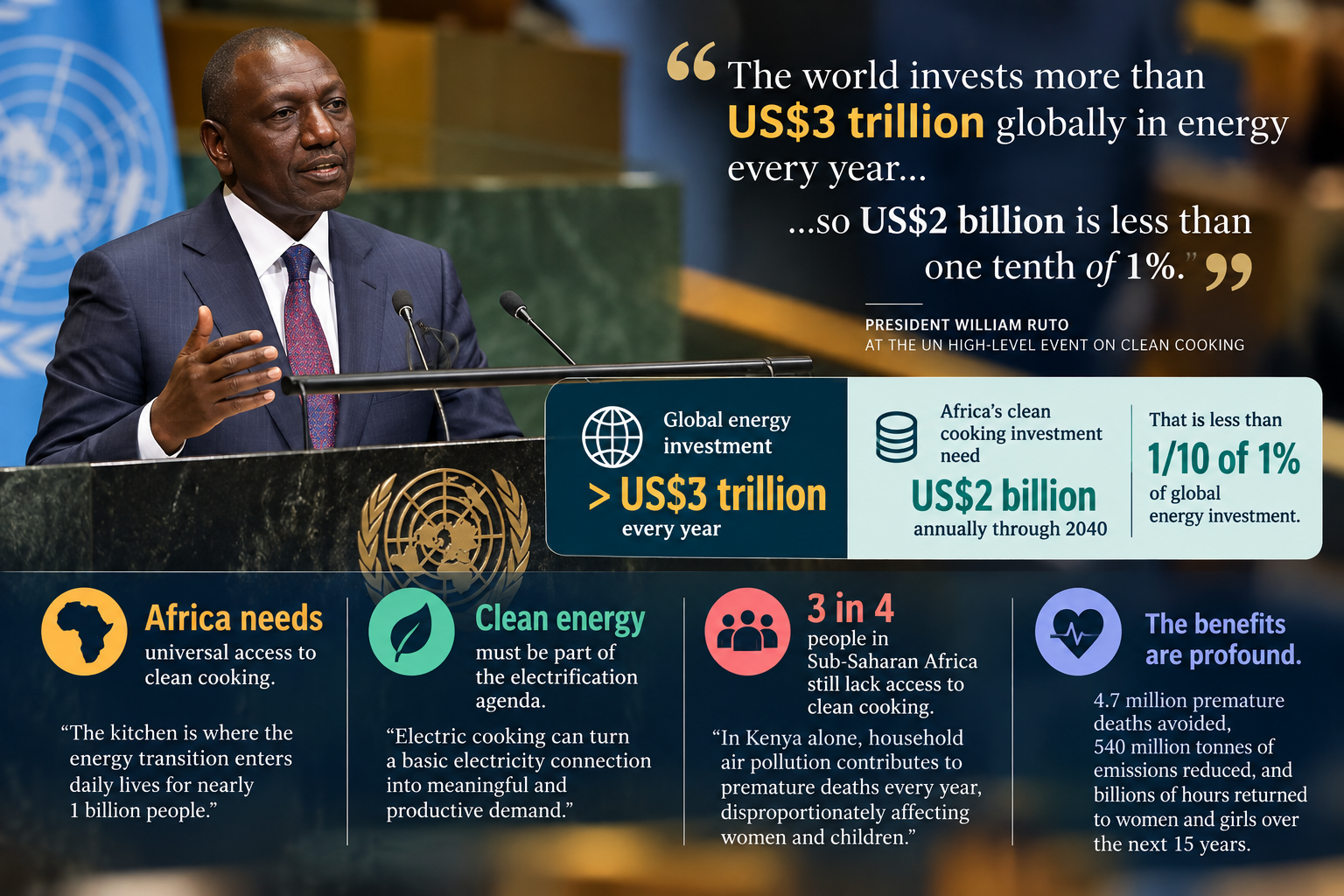
“Kenya is proud to be part of this coalition for millions of African households, cooking is the single largest use of energy across much of our continent. The kitchen is where the energy transition enters daily lives for nearly 1 billion people.
Three in four people in Sub-Saharan Africa still lack access to clean cooking.
In Kenya alone, households’ air pollution contributes to premature deaths every year, disproportionately affecting women and children. And across Africa, the annual toll exceeds 500,000 lives, but the consequences go beyond health. Reliance on polluting cooking fuels drives deforestation, increases greenhouse gas emissions, consumes time that could otherwise be spent on education and economic activity, and constrains opportunities.
After decades of advocacy and action, the world now accepts that cooking with wood and charcoal can kill. That collecting and using these fuels costs women and girls precious hours every day, and that this is an injustice, we have the means to end. That case was made by women, made by health ministers, scientists, advocates, and many of you in this room; that case, in my estimation, has now been won.
Today, I want to make the argument we have yet to win……
Clean cooking is (an) energy infrastructure (issue). It belongs in the plans of every ministry, any institution that shapes how our economies grow, and the challenge does not end at the household poor. It will not be solved while our schools, hospitals, correctional facilities, and other public institutions remain heavily dependent on polluting fuels.
Let me make three points about how we deliver this transition.
First, there will be no single pathway. Different countries will move at different speeds and through different technologies, reflecting their resources, markets, infrastructure, and consumer needs. Our task is to accelerate the deployment of all viable technologies towards cooking that is cleaner, affordable, reliable, and accessible.
Second, clean cooking must become part of the electrification agenda. Electric cooking can turn a basic electricity connection into meaningful and productive demand. It can strengthen utility revenues, improve the economics of investment in generation and networks, and ensure that electrification delivers greater value to households.
The COP31 president, Murat Kurum, who I am told is here with us today, and I hope he’s somewhere in the room, has proposed increasing electricity’s share of global final energy consumption to 35% by 2035. We should arrive at COP31 with clean cooking firmly embedded in that electrification and efficiency agenda, and we should use our accelerated partnership for renewables in Africa as a vehicle for rapid delivery.
Third, the investment required is small in relation to the opportunity, as was said ably by Dr. Birol here. Consider the arithmetic. According to IEA, achieving universal clean cooking access in Africa requires approximately $2 billion annually through 2040.
Consider the other statistics. The world invests more than $3 trillion in energy every year. In other words, Africa’s cooking transition would require less than 1/10 of 1% of annual global energy investment.
I say 1/10 of 1%.
That is why, in the world of Fatih Birol, it’s very small compared to the other number. The constraint is not simply the availability of capital. Capital is held back because demand is fragmented, and too much risk is left with households and small enterprises. Institutional aggregation, local currency financing guarantees, and results-based funding can help correct that imbalance and turn need into investment demand, and the return over the next 15 years will be extraordinary.
I’ll give you the numbers: 4.7 million premature debts avoided, 540 million tonnes of emissions reduced annually by 2040, and 460,000 permanent jobs created. Those jobs matter as much as the future. Every clean cooking transition creates a value chain. Fuel production and distribution, appliance manufacturing and assembly, installation and maintenance, retail, and consumer finance.
More of that value must be created in where the need is most, in Africa. That is why we must bring clean cooking value chains into the project preparation pipeline of the Africa Green Industrialization Initiative, so that this transition also becomes the engine of African industrialization and job creation.
But we must be candid about the other side of this transition.
Millions of people today depend on charcoal and firewood for their livelihoods. A transition that ignores them will not endure. Retraining for alternative livelihoods under managed phase down must therefore be part of the path, just as they are in any serious industrial transition.
Excellencies, ladies and gentlemen, Kenya, like other countries, is pursuing a pragmatic, multi-fuel approach that reflects market realities and consumer preferences. To translate that ambition into investment, we recently launched the institutional clean cooking investment pack. It identifies a 600 million investment US dollar investment opportunity across schools, healthcare facilities, and correctional services…..we all need to continue building that momentum, strengthening partnerships, mobilising investment, and moving from commitment to implementation.
On 27 and 28 January next year, we will co-host the second Africa Clean Cooking Summit with Norway, the United States, the International Energy Agency, and other partners.
I invite you all to Nairobi.”
There were of course many other good speeches, and I hope readers of this blog and followers of MECS research will go to the recording, found here.
…………………………………………….
AI disclaimer: Otter was used to transcribe the President’s speech.
Image credit: AI generated image from President Ruto’s speech, prompted by S. Batchelor.