- Date
- 2nd May 2025
- Categories
- Commercial Cooking
By Richard Sieff (MECS), Carren Atieno, Kinya Kimanthi, and Sheldon Odhiambo (Kijani Testing Limited), Jacob Fodio Todd (MECS)
Introduction
Increasingly, many people choose or are required to eat outside of the home among the broad spectrum of businesses that make up the commercial cooking sector. Prompted by the scale of the sector and opportunities for transitions identified by earlier MECS commercial eCooking research in Nepal, MECS commissioned two studies in Nigeria and Uganda to further explore the scope for commercial eCooking transitions. This blog focuses on the outcomes of the Uganda study carried out by the Kenyan market research agency, Kijani Testing Limited. Drawing on 185 surveys with commercial businesses and 99 key informant interviews, the findings help to better understand the different segments within the commercial cooking sector and how the opportunities for eCooking transitions vary according to segment and business type.
The Ugandan commercial cooking sector: Size and segments
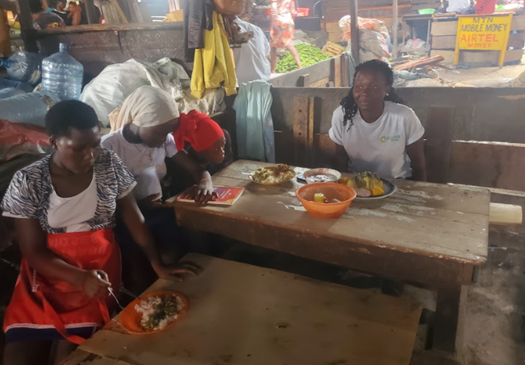
As seen with previous studies in other country contexts, understanding the size of the commercial cooking sector and the segments comprising it proved challenging, with the research team noting limited publicized literature and official documentation. An outlier was census data from the Ugandan Bureau of statistics which categorised the commercial cooking sector into five segments, consisting of 5,000 restaurants, 600 hotels, 1,200 bakeries, 1,500 catering services, and 20,000 roadside vendors as of 2019 The census may underrepresent the informal sector, typically not captured by such documentation due to not being formally registered entities. The surveys conducted by the study further support this hypothesis, with 16% of the 185 businesses engaged identified as ‘kafundas’. Literally meaning “little places”, kafundas are small eateries offering economical meals that are usually informal both in make-up and legal status. As kafundas are widespread and often form a vital part of the socio-economic fabric in informal settlements, the Kijani team added ‘kafundas’ as a sixth key segment to the five identified by UBOS.
A diverse cooking fuel mix
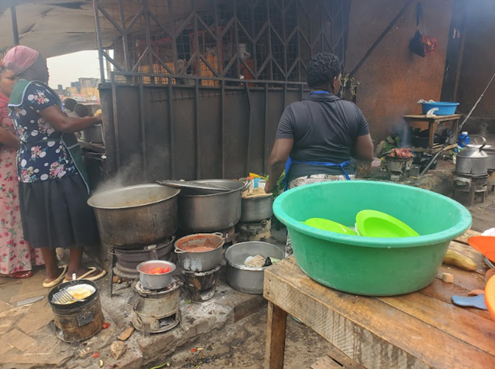
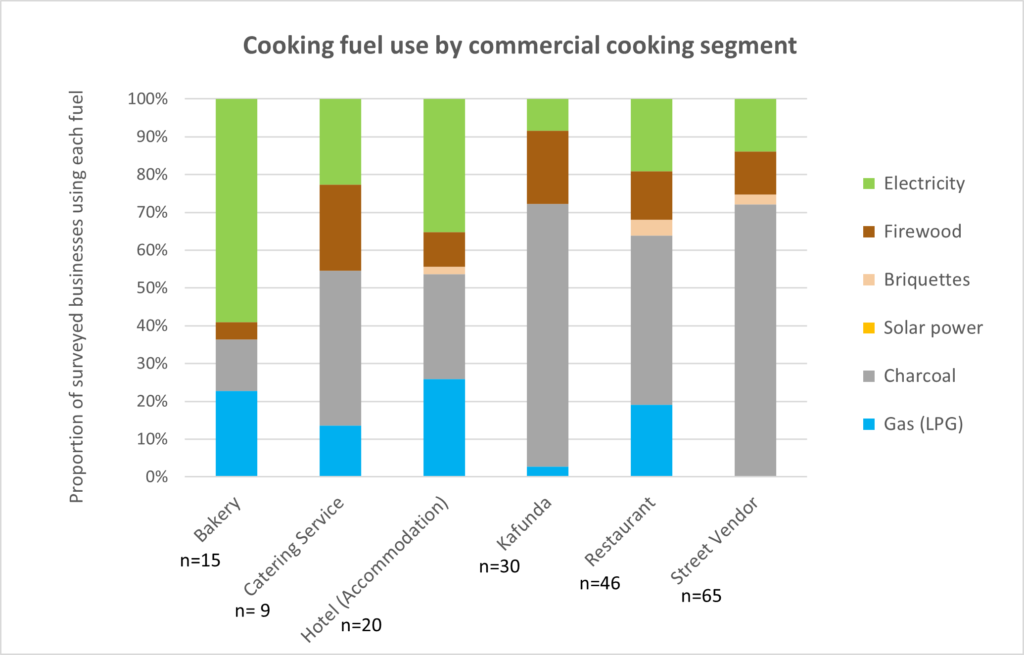
Among the different commercial cooking segments, a range of cooking fuels were found to be in use. Across all segments, charcoal was the fuel used by the greatest proportion of businesses (Figure 1). Most informal businesses (i.e. street vendors and kafundas) used only charcoal and/or firewood for cooking. Bakeries and hotels were the segments with the greatest proportion of businesses using electricity. The existing use of electricity in all segments seems encouraging and an urgent next step would be to better understand for which cooking practices and preparatory activities (e.g. mixing, blending) electricity is being used for, to help inform where scope for eCooking interventions may lie.
Differing opportunities for eCooking transitions among commercial cooking segments
High end restaurants and hotels were identified as the most likely segments for shifts to eCooking due to typically having the requisite electricity infrastructure (e.g. sufficient meter capacity) and the financial resources to purchase eCooking appliances. The study also found perceptions may affect the likelihood of eCooking transitions. Kafundas and local restaurants exhibiting more cultural resistance to change than other sectors, leading the research team to speculate that there may be an element of trying to conserve cultural heritage among these businesses, which tend to serve more traditional Ugandan foods that are often cooked over open fire or using charcoal.
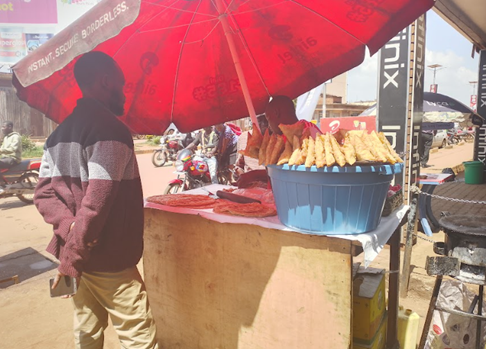
Street food vendors were identified as more open to dynamic shifts to cooking behaviour and thus more open to taking up eCooking practises, the research team reasoning that this was due to most vendors being young, more tech savvy and aware of eCooking benefits. The fact that the range of foods served by street food vendors also extends beyond the traditional menu was also seen as an indication that these businesses may be more open to experimenting with alternatives to traditional cooking fuels. Street food vendors were noted as likely needing financing support to purchase eCooking appliances and in some cases, bespoke portable appliances, to meet the requirements of the particular dish or dishes each served.
Economic and policy landscape
The study found Uganda’s policy and regulatory framework supportive of broader eCooking transitions. Uganda has set an eCooking target of 18% by 2030, an electrification target of 80% by 2040, and introduced a cooking electricity tariff to encourage eCooking. The country’s ban on charcoal production and the resulting rise in charcoal prices was also seen as a potential stimulus for transitioning to eCooking. Businesses surveyed tended to lack awareness of this supportive framework (e.g. only 7% of surveyed businesses were aware of government subsidies or incentives for eCooking), leading the study to recommend greater eCooking awareness raising initiatives and for eCooking policy and regulation to more specifically target the commercial cooking sector.
Commercial cooking equipment supply chains
eCooking supply chains were found to be mostly centred on the capital, Kampala, with a heavy reliance on imports of commercial cooking appliances. Suppliers and distributors were concentrated in urban centres, making access to sales and after sales services (e.g. repair) challenging for rural areas. Local manufacturing was present but tended to focus on biomass and charcoal stoves while concerns over quality and safety assurances resulted in some formalised commercial cooking segments (e.g. hotels) avoiding their products. The study argues that local manufacturers could potentially incorporate higher tier stove production if supported with standardisation processes, while their typical made-to-order approach could align well with the bespoke appliance needs of many street food vendors. In addition, since the study was completed, the team have become aware of increasing commercial sector interest (although currently low uptake) in solar-powered cooking appliances, including those catering for street food vendors, such as Musana’s commercial vending carts. This interest may be due to fiscal incentives: solar powered equipment is zero rated for VAT and also exempt from import duty.
How key stakeholders can help drive the adoption of eCooking in the commercial sector
To help increase the use of eCooking among Uganda’s commercial cooking businesses, the research highlighted several recommendations leveraging key sector stakeholders identified by the study. Industry associations and civil society1 were identified as key organisations for addressing the urgent need to raise awareness of the benefits of eCooking among the commercial cooking sector, while civil society, development agencies, and Savings and Credit Co-operatives (SACCOs) were seen as well placed to assist with financing models to help address the potential barrier of upfront costs of eCooking appliances. The role of the Electricity Regulatory Authority (ERA) was also seen as crucial in raising awareness of the cooking electricity tariff and addressing erroneous beliefs that eCooking is expensive, which can stem from perceived high bills due to businesses sharing energy meters with other domestic and commercial users.
Ways forward
Greater stakeholder collaboration was an overarching recommendation of the study for facilitating commercial eCooking transitions. Examples cited included relevant ministries (e.g. Ministry of Energy and Mineral Development [MEMD]) and industry associates, like Ugandan Hotel Owners Association, and partnering with development agencies to increase the outreach of eCooking awareness campaigns and broader eCooking policy implementation, and appliance distributors working with financial institutions to offer financing and/or subsidies for eCooking appliances.
- For more information on the Kijani study, please follow this link to a PowerPoint presentation of key findings.
- Information on the MECS commercial cooking study in Nigeria by SheConsults 4 ImpactSphere (SC4IS) can be found using the following links: Nigeria Blog / Nigeria PowerPoint
***************************************************************************************************************
Endnote:
1 Key industry associations noted by the study were the Uganda Hotel Owners Association (UHOA), the Uganda Chefs and Cooks Association (UCCA), and Kampala City Traders Association (KACITA). Key civil society organisation highlighted were the research institute the Centre for Research in Energy and Energy Conservation (CREEC) and the non-profit organisation, Uganda National Alliance on Clean Cooking UNACC.
Featured Image: Kafunda setting. Photo Credit: Kijani testing Limited, 2024.