- Date
- 10th September 2026
- Categories
- Alternative Fuels, Clean Cooking, eCooking
By Dr Simon Batchelor (OBE), Gamos Ltd. / Loughborough University
This blog takes some of the learning from a new paper “Factors associated with continued use of LPG for cooking over a two-month period in peri-urban Cameroon, Kenya and Ghana” by Abdul-Azeez Kuna and colleagues, part of the CLEAN-Air(Africa) Group, funded by NIHR, and seeks to question how their findings might translate for eCooking.
For years, the clean cooking sector has tended to celebrate a very visible milestone: adoption. A household buys an LPG stove. A cylinder is distributed. An electric pressure cooker is delivered. A programme reports another family gaining access to clean cooking. But what happens two months later?
The new analysis and paper provides interesting insights. Rather than simply asking who had adopted LPG, the researchers returned to households in peri-urban Mbalmayo in Cameroon, Obuasi in Ghana and Eldoret in Kenya to see whether they were still using it two months after adoption. The paper was published this month (Sept 2026) although the field research was conducted in 2019.
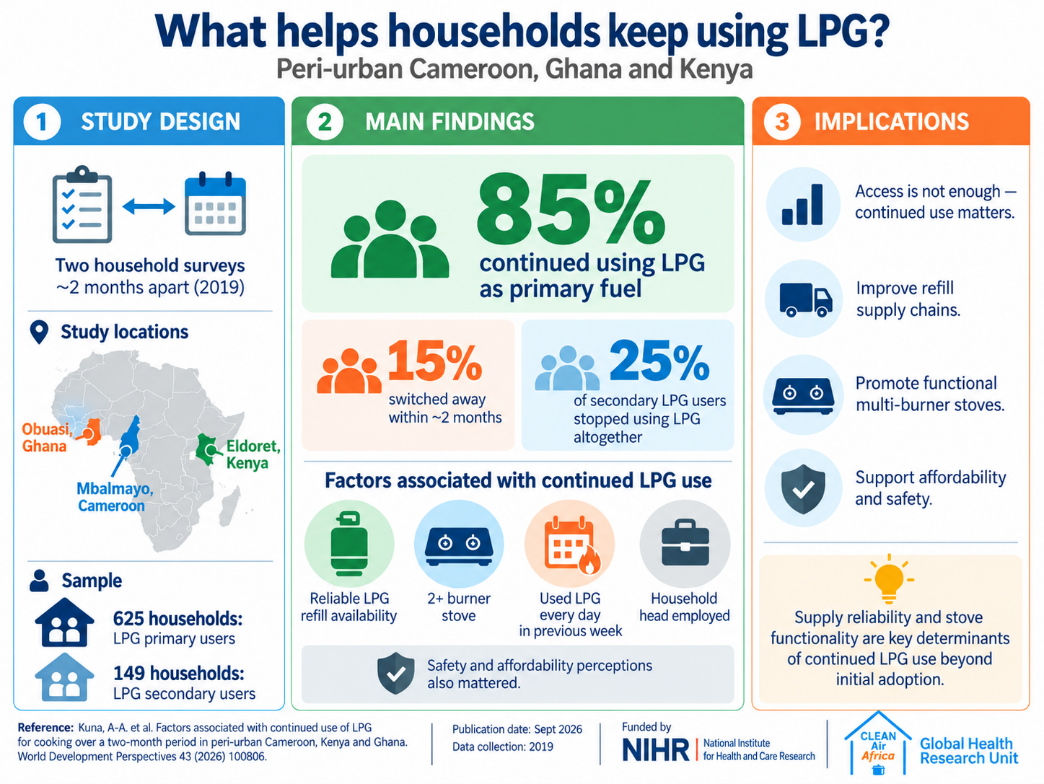
Among 625 households initially using LPG as their primary cooking fuel, 15% were no longer using it as their primary fuel roughly two months later. Among households initially using LPG as a secondary fuel, one quarter stopped using LPG altogether. That seems a lot of movement in a very short period. So ownership is not use, and use today is not necessarily use tomorrow. And this does echo India.
India’s Pradhan Mantri Ujjwala Yojana (PMUY) achieved good success in putting LPG connections into poorer households. But connections did not automatically translate into sustained consumption. Average annual refill consumption among PMUY households fell from 3.9 cylinders in 2016/17 to 3.0 in 2018/19, compared with 6.7 among non-PMUY consumers in 2018/19. The policy debate therefore shifted from connections towards continued use and refill affordability. PRS Legislative Research refill rates have since improved but they remain well below the roughly 6.5 refills for non-PMUY consumers. The issue in their case was laid at the feet of finances and affordability.
But is it about affordability only? Let’s unpack what the CLEAN AIR group have found. Perhaps the clearest finding from the multivariable modelling in the African study is focused on whether LPG is actually available when people need it. Households reporting consistent LPG availability had 1.34 times the odds of continuing to use LPG as their primary fuel compared with households experiencing shortages more than once a month.
I think from the start MECS research has always suggested that a household experiences a cooking system, not an appliance.
If the cylinder empties on Tuesday and a refill cannot be obtained until Friday, the family still has to cook on Wednesday. Charcoal or firewood returns. Repeated often enough, the “backup” becomes part of everyday cooking again.
And there is another important point. These surveys were conducted in 2019. They therefore pre-date the recent disruptions around the Strait of Hormuz. In 2026, Middle East LPG flows have been disrupted, Asian LPG prices have risen sharply, and Saudi Aramco raised its September benchmark prices to $625/tonne for propane and $660/tonne for butane amid renewed supply uncertainty. OPIS, A Dow Jones Company
So the vulnerability identified in this study, that continued cooking depended on an affordable cylinder being physically available, has not disappeared, perhaps it has only got worse.
One of the paper’s most intriguing results may actually be about the hardware. Households with two LPG burners were more likely to continue using LPG than households with one; those with three or more burners were more likely again. Among households that discontinued primary LPG use, 65% had single-burner stoves, compared with only 36% among continued users.
This finding echoes into eCooking. ATEC is now finding something strikingly similar in its electric cooking business: double-burner products are proving more popular than single-burner ones. A published case study also records single-burner ATEC customers considering upgrading to two burners. The Care Economy Knowledge Hub
Should that make us think harder about eCooking programmes built around distributing one appliance? An EPC is an extraordinarily efficient cooking device but is one EPC actually a cooking system? We have often argued that it is, because the typical East African meal is less complex than the Bangladesh meals, and you can fry the onions and then add the beans or posho. But the finding in the study paper slightly suggests this may not be sufficient….the study is all about African cuisine, and yet the data suggests the double burner of the stove was important.
Moving forward perhaps we should check that our relevant unit of access is therefore not an electric appliance, but a kitchen capable of delivering the household’s normal meal. That also echoes the emerging questions about electricity access per se – is it enough for a light or is it enough to give a quality of life in leisure and productivity to a household.
Of course though, the economics have certainly not disappeared. In the study, households whose head was unemployed were less likely to continue LPG use, and continued users were somewhat more likely to consider refills affordable.
I think when trying to relate these findings to the potential of eCooking, it might be worth noting that electricity changes the mechanics of affordability. When an LPG cylinder empties, the household has to find perhaps several days or weeks of cooking expenditure in one transaction, travel or arrange delivery, and hope the product is available. (And indeed smaller cylinders have been shown to have a place in the market). Electricity normally arrives continuously in much smaller increments. If there is a power outage, importantly, the electricity generally comes back; nobody has to travel to a shop carrying an empty electricity cylinder and find the cash for a complete refill. That is potentially a profound advantage for eCooking provided the grid itself has a basic reliability!
So what can eCooking learn from this?
Measure sustained use, not appliances distributed. Short-term usage frequency may itself be a useful warning indicator: in this study, households cooking with LPG every day, were more likely to remain LPG users later.
Treat electricity reliability as part of the cooking intervention. A cooker attached to an unreliable supply is no more a complete solution than an LPG stove attached to an unreliable cylinder supply chain.
And maybe; Design around the household’s cooking experience rather than the programme’s cheapest unit cost.
As we research modern energy cooking and undertake surveys maybe “Do you have an LPG stove?” is the wrong question and even “Are you connected for electricity?” is also the wrong question. What we really want to know is ‘can this household reliably cook the meals it wants to cook, every day, using the modern-energy system available to it?’
And well done Abdul-Azeez Kuna and colleagues for your helpful contribution, evidence, understanding and analysis.
*********************************************************************************************************
Featured Image: Created by AI to summarise the paper Abdul-Azeez Kuna et al . September 2026.
AI Disclaimer: AI used to create the blog infographic and to tighten the text.