- Date
- 18th July 2025
- Categories
- Gender, Inclusion & Disability
By Dr Amita Bhakta (Independent Consultant)
This blog is the first in a four-part series which shares stories about cooking and energy from people with disabilities in Ahmedabad, Gujarat, India. These stories are inspired by and are part of a new study led by Prabhat Education Foundation and myself. In this blog, I invite you to hear Arunaben’s story about her journey to independence in cooking and other life skills, in her own words:
“From a young age, my father taught me one invaluable lesson: “even if you find yourself alone in life, you must have the strength within to keep going. You must become your own support”. I took that as my life’s guiding mantra. That is why, even though I cannot walk and one of my hands doesn’t function, I manage all the housework and my personal tasks by myself.
As a child, I was late in learning to sit up and had difficulty performing even basic tasks. It was only through my father’s persistent efforts that I learned to sit and gradually became capable of doing things on my own. He constantly encouraged me to do things independently and prepared me to live a life of dignity and self-respect.
I must have been around twelve years old when my mother wasn’t home one day, and I wondered how I could prepare food for my younger siblings and father. That was the first time I tried cooking. I still vividly remember that day. My cousin came by and asked, “What are you doing? You’ve added way too much water to the dough—how will you make rotis?” She offered to teach me. I watched her knead the dough and learned. My curry turned out well, but making rotis took a long time, and they didn’t turn out great. Still, everyone ate happily. Even today, all these years later, I haven’t mastered the art of making rotis, but I can cook everything else on my own.
I love making jalebi, dal vada, and kheer. Cooking and feeding others gives me joy. I started learning to cook in my childhood and I have never looked back. From peeling garlic to cutting vegetables, I can do it all. Though I struggle with kneading dough, I manage everything else independently.
Of course, cooking comes with risks. There have been incidents—sometimes, it’s hard to light the gas stove, and if the gas is already on, it can flare up. Thankfully, nothing major has happened, and usually, someone is at home, which makes me feel safer. Still, I think it’s important to reflect on these risks.
I’ve noticed that my cooking tends to consume more gas—sometimes I forget to turn it off. And gas cylinders are expensive. So, I try to stay especially alert while cooking. I’m sure others like me must have faced similar situations.
Naturally, having trouble walking and having only one hand functioning, make things harder. But as I mentioned before, my father taught me early to face challenges head-on and keep learning. Except for rotis, I can cook everything. I can use a mixer and manage the gas stove. I do need help switching on the light, since the switchboard is too high. But I’ve arranged everything in the kitchen in such a way that I can access all I need and cook without help.
Speaking of my interests—I love cooking, and I also love getting dressed up. I like to go out looking my best. But ever since my father passed away, I’ve let go of some of those interests. Hobbies cost money, and without money, they aren’t easy to maintain.
I do have a mobile phone, which was gifted to me by my aunt’s daughter. I manage its recharge expenses from the pension I receive. I also buy clothes and other necessities from that money. I have made saving a habit—because sometimes the pension is delayed, and I still need to manage my expenses.
I enjoy going out, but I avoid it unless absolutely necessary because I need private transport. I do have a wheelchair, but not an electric one—my hand grip isn’t strong enough to operate it, so I’m not eligible for one. I also don’t know much about government schemes.
Technology is truly a blessing for people with disabilities. Thanks to my phone, I can watch videos or listen to devotional songs. Even if I can’t go out much, it provides entertainment and connection.
In all these things, financial stability plays a very important role. My brother too is not well-off financially. I had once opened a small shop, with the help of my sister. But after her death, I had to shut it down. Still, I wish to never be dependent on anyone.
I have just one suggestion: all electric switchboards should be installed at a lower height so that people like me don’t have to rely on others. This is the principle I live by—and I live a contented life.”
MECS full report by Prabhat Education Foundation and Dr Amita Bhakta, ‘Energy, Disability and Everyday Life in Ahmedabad’ is available here.
***************************************************************************************************************
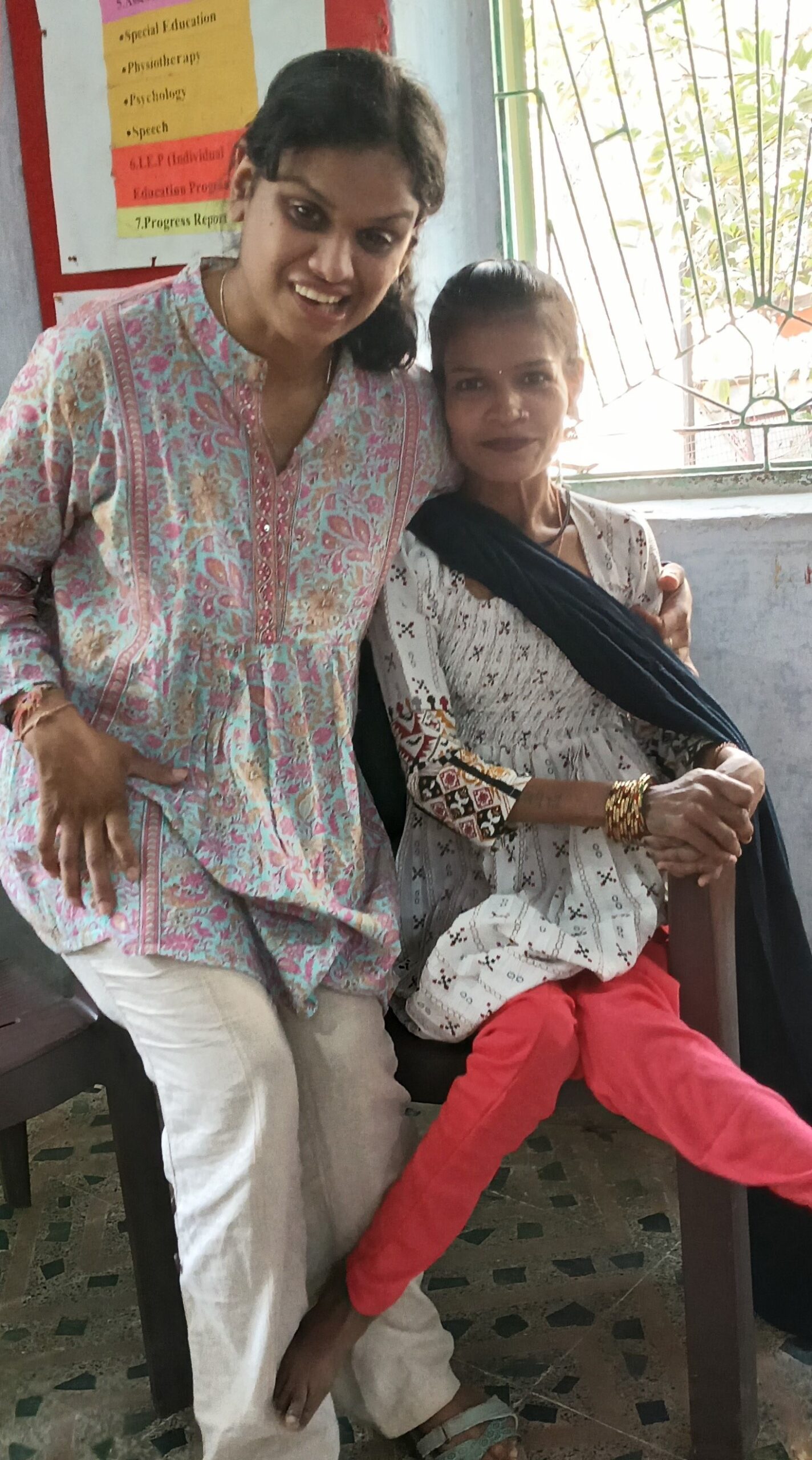
Featured Image: Dr Amita Bhakta (left) with Arunaben (right). Photo © Prabhat Education Foundation.