- Date
- 24th October 2025
- Categories
- Carbon Finance
By Dr Anna Clements (Gamos Ltd.)
We were delighted to recently attend the Tanzania Clean Cooking Retreat, from 19–21st August 2025 in London. Read more about our experience here. We were asked to give a quick overview of how carbon finance, with a specific focus on Article 6, can be used to support a transition to modern cooking. The carbon finance space is complex and evolving, and you can find our online in-depth guide on Carbon Finance for Clean Cooking Projects here, and our more recently released Resources for MPs on the topic. In this blog I will give a much more high-level overview of how carbon deals through Article 6 can be a win, win, win, win, and you can explore the presentation itself here. (For a more detailed account of a deal made earlier this year involving Malawi, ATEC, and Switzerland, see this blog post.)
We illustrate the shape of these deals by looking at how they work from the perspective of the four main actors involved: the country buying the carbon (‘Buying Country’), the country hosting the carbon project (‘Host Country’), the project developer, who is probably a private sector actor in the clean cooking space, and the end-user themselves. This example deal is of the approximate size of 85,000 eCooking appliances/households, approx. 1 million carbon credits over the deal timeline, and (assuming 2 tonnes saved per year per household) is worth approx. $20 million (remember that digitalised eCooking appliances allow use of metered methodologies, leading to high-integrity credits, which can attract premium carbon prices).
The first win is for the Buying Country:
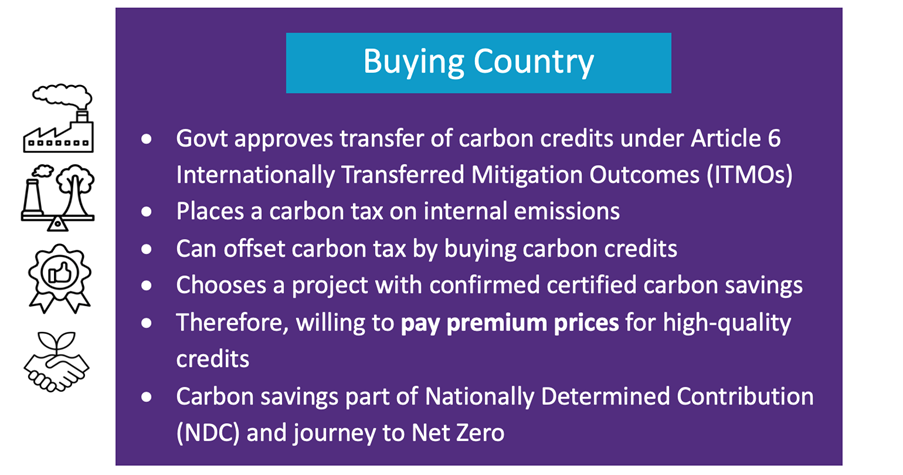
They benefit from being able to buy carbon credits and in the process may be able to avoid paying a domestic carbon tax, while offsetting their own emissions and making progress towards their NDC.
The next win is for the Host Country:
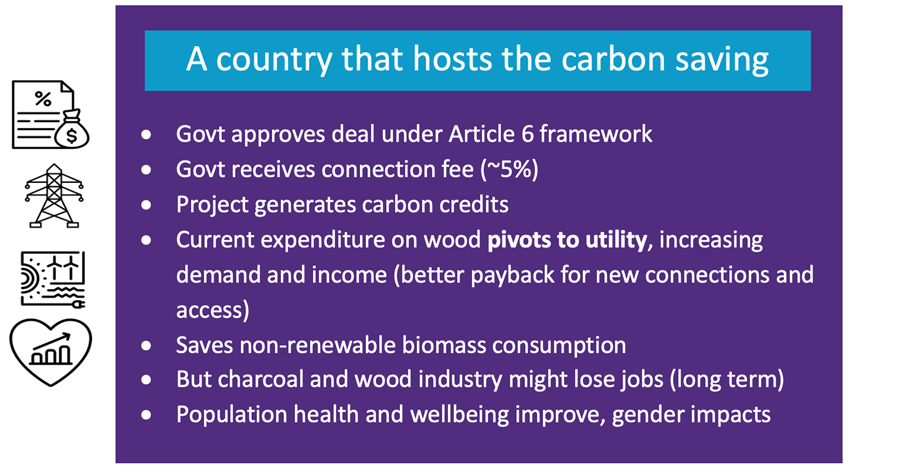
A connection fee, a healthier population, a healthier environment – and, crucially, pivoting existing spend on biomass fuels into the utility, where that additional revenue can support the financial viability of the utility and grid extension projects.
The third win is for the project developer, a private sector player who needs to be able to at least break even, or ideally profit, from supplying eCooking appliances:
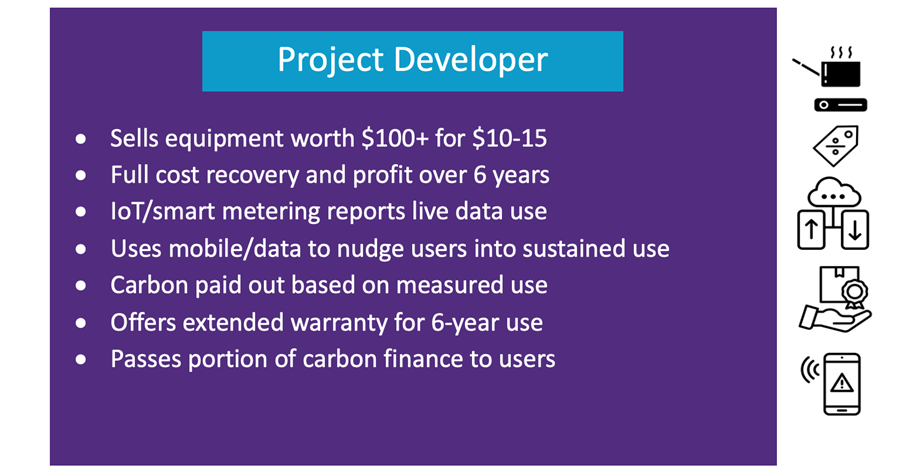
With carbon coming in at approx. $20/tonne, and each household saving between 1-2 tonnes/year, the carbon revenue stream can be between $120-240 for such a deal – part of which goes towards supporting the supplier to sustain, or even grow, their business. Suppliers can also ‘nudge’ users to encourage sustained use – an opportunity made possible by the data monitoring.
The final win is for the end user:

The cook themselves benefits from the full range of positive impacts of cooking with modern energy, including improved health, to saving time, money, and convenience. Over and above fuel cost savings they can even be paid to cook through cook-to-earn schemes that pass a portion of the carbon revenue directly to their (mobile-money) pockets.
The above paints a really exciting picture and can seem too good to be true – this is a real opportunity for the cooking transition. Of course, there are many pieces of the jigsaw that need to be in place to enable this – from finalised NDCs, Article 6 framework, cooking being on the positive list, smooth operations in-country so a developer gets the necessary documents to proceed – and more. But we at MECS think that deals of this shape have the potential to really accelerate the transition to modern cooking. We were asked to provide the Government of Tanzania some recommendations on how to move forward, and these are summarised here:
- Get bilateral agreements in place, and ensure cooking is on the positive list.
- Think carefully about revenue sharing across project stakeholders, and be ready with plans and procedures.
- Have a smooth process in place that supports the private sector project developers to get the documents they need to land these deals.
- Think about how to link this opportunity to Mission 300, last-mile electrification, and on-bill financing.
- And crucially, form a Task Force with all relevant stakeholders to get everything ready to take advantage of this opportunity.
We can’t wait to see more of these deals come about!
……………………………..
No AI was used in the production of this blog.