- Date
- 30th January 2026
- Categories
- Electric Cooking, Finance
By Dr. Simon Batchelor, OBE (Gamos Ltd. / Loughborough University).
This is the first of a two-part blog exploring the upfront cost of eCooking appliances.
In the UK, we’ve just finished ‘Boxing Day’ or ‘Black Friday’ sales, where retailers offer limited-time discounts to clear out stock before New Year restocking or to make way for upgraded models. Shoppers often queue overnight for these deals, as the sale prices end when the items sell out.
This set me to thinking about mechanisms for reducing the ‘upfront costs’ of eCooking. Over the lifetime of an electric cooking appliance, households typically spend far more on electricity than on the appliance itself often several hundred dollars over five years, even at modest daily energy use. In most contexts, that is a cheaper monthly spend than they were paying for the same cooking experience with (purchased) biomass or LPG. Yet the ‘upfront’ cost of the appliance is said to be holding eCooking back from going to scale?
I started to reframe the upfront cost as ‘who holds the risk’? At that moment of purchase, someone must take on the risk that this new appliance will deliver the promised savings, convenience, and reliability. The household benefits from a lower ticket price, but the full cost is still paid, and the risk has merely shifted. This familiar retail dynamic offers a useful lens for thinking about eCooking: price reductions matter, but they may only work because someone, somewhere, has agreed to absorb risk on behalf of the buyer. The key question is therefore not simply “how do we reduce the price?,” but who carries the financial risk of paying upfront.
Mechanisms like bulk procurement, tax exemptions, subsidies, or carbon finance shift costs and financial risk from households to firms, utilities, donors, or governments. Each method determines who bears uncertainty over future use and benefits. Small price reductions may help some users but rarely overcome household risk aversion alone. Wider adoption is more likely when actors with resources accept upfront risk, justified by public goods such as improved health, lower emissions, or better returns on infrastructure.
Paying less (blog 1) vs Paying later (blog 2)
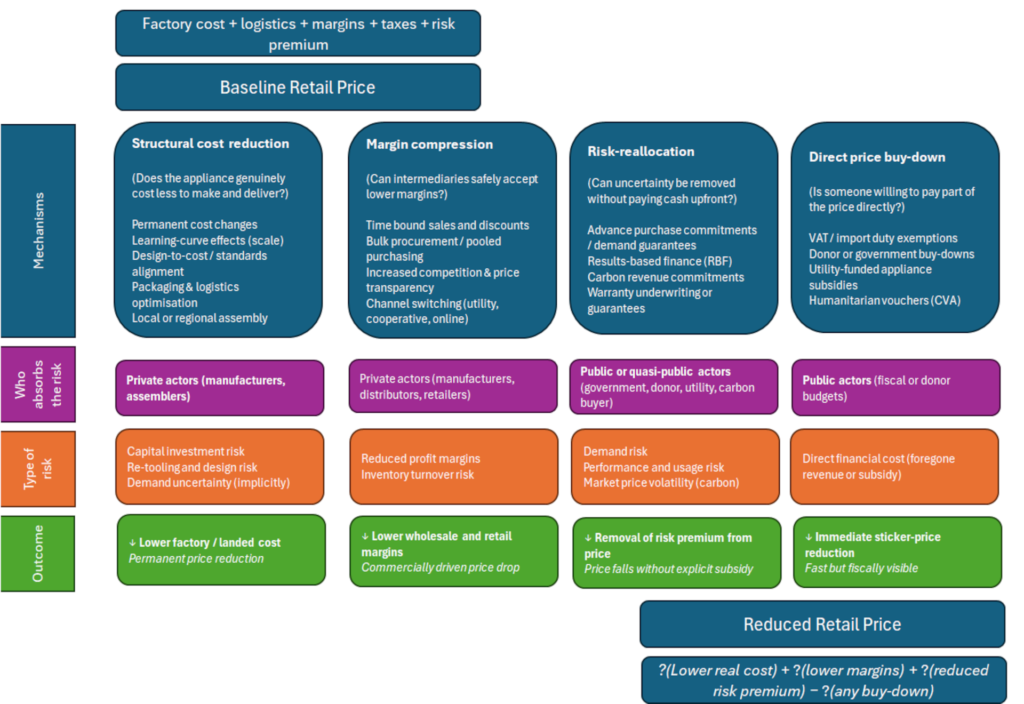
I felt I wanted to separate reducing the upfront cost from credit mechanisms, (paying later). Paying later often leads to an increased cost albeit in the longer term. So for this blog I would like to discuss only mechanisms for reducing the cost to the user and where the risk shifts to? I will tackle paying later in a later blog. That led me to identify four mechanisms for possibly lowering the price as captured in the figure.
1- Margin Compression. In the example of the ‘Boxing Day’ sales mentioned above; the retailer still paid full wholesale price to the supplier (unless the wholesaler was the origins of the discounts). This is ‘margin compression’ in the figure. In making this discount on the normal ticket price someone in the supply chain is reducing their profit margin. They calculate that this is worthwhile perhaps to increase the footfall in the shops and/or to clear the warehouse ready for the new stock.
So this is a time bound price reduction, which effectively the retailer or manufacturer is paying for by reduced profit.
We can also encourage this by signalling and ensuring that there will be strong cumulative volumes over the coming decade. One of the best examples of the potential for this was the EESL UJALA action on LED lightbulbs. Indeed MECS is seeking to signal to manufacturers that there will be an ongoing and growing cumulative volume, and has just announced an early market engagement on Sustainable Appliances Marketplace for Africa & Asia (SAMPA). This is a bulk purchasing platform that would enable manufacturers to be more assured of an increasing cumulative volume. The UJALA price reduction was extreme, and we do not expect that to apply to the more complex eCooking appliances. Nevertheless, even bulk purchase reductions could achieve 20 to 40% price reductions, more than the equivalent of removing of VAT or import duty.
However, that is still a margin compression. The manufacturers and suppliers are willing to reduce prices because of the reduced risk of holding stock for too long. A bulk order means the factory can work efficiently.
2- Structural Cost Reduction. Scaled use of an appliance often also leads to actual long term price reductions due to the learning curve (or structural cost reduction). Part of the savings prompted by the EESL bulk purchase was that manufacturing processes for the emerging LED lightbulbs in 2015 had plenty of room for improvement. eCooking appliances are already commonly used in developed economies where eCooking is a norm not a niche. Cumulative volumes are already quite substantial and some learning curve reductions have already been seen over the last 20 years. As eCooking gets to scale in Low and Middle Income countries (LMIC), we may or may not see further price reductions based on the ongoing learning curve.
3- Risk reallocation as a public good. In carbon projects such as the ATEC action, and Results Based Finance, as implemented by the Clean Cooking Fund and Endev’s RBF , we see an outside party willing to take up some of the cost of the appliance. I have conceived of this as risk reallocation. The carbon project developer is willing to offer the appliance at a very low price to the user, taking the risk that they will use it over a number of years. If the user stops using the device, it will be difficult for the carbon project developer to recover the full cost of the appliance – so the risk is effectively moved from the user/buyer to the ‘sponsor’ of the project, whether that be because of carbon, RBF or some other broader public good mandate.
4- Direct price buy down. Governments may use tax exemptions or subsidies, like removing VAT or import duties, to lower appliance costs and promote public benefits. Malawi has one of the most favourable tax incentives, with our partner Kachione able to bring in (solar PV) eCooking appliances tax free. However, eliminating these taxes reduces government revenue, effectively shifting funds from other services such as health or education to subsidize appliances. For example, removing VAT on eCooking appliances could lower prices by 15–20%, encouraging adoption and potentially improving health and reducing emissions. Still, this choice means reallocating budget resources, and the government ultimately covers part of the cost previously included in retail prices.
It is about shifting the costs from the user to government finance. The government is taking the risk that such an action will result in increased public good. Of course we have seen more direct subsidies in India and other countries, where both the initial appliance purchase and the ongoing fuel are subsidised.
Apart from public good, there are other reasons a direct subsidy might be worthwhile. Utilities might want to reduce the cost to encourage uptake and use of electricity.
Regarding this, we have been exploring with utilities, particularly in the light of Mission 300, how utilities might encourage the use of eCooking, to ensure sufficient electricity demand after connection. Investors in the grid infrastructure (Government, Finance Institutions, Utilities) often budget upwards of $1000 per household to connect a household to the grid. If the revenue for the utility from that house becomes only the consumption of a few lightbulbs, that cost is never recovered. While specific productive use of electricity is often considered in infrastructure planning, which requires new and transitioned businesses, eCooking provides a regular predictable demand that pivots existing expenditure on other fuels towards the utility. Investment returns are better if there is a managed increase in demand, which eCooking can achieve. We will discuss ‘on bill financing’ as a credit mechanism in the second blog, but it is increasingly obvious that a subsidy that reduces the appliance cost through or from the utility would make sense for their broader business plan. The eCooking appliance leads to greater long term revenue from the electricity use1.
Other subsidy mechanisms might include voucher schemes? This has been used in cases of water and sanitation (WASH) particularly in humanitarian contexts, and for access to LPG to prevent localised forest degradation. An example of a WASH Cash and Voucher Assistance (CVA). Could donors issue vouchers or buy-downs for appliances to encourage sales or distribution? This need not be a full RBF programme with verified impact, but could be based on the hypothesis that it benefits households. Part of the cost is therefore absorbed by the donor.
Who is actually paying the full cost?
These mechanisms reduce the cost for the consumer but the full cost is still being paid by someone. Others are sometimes willing to take on part of the cost because they either have mandate to help others (governments and donors), or it makes wider business sense (frees up warehouse space, encourages footfall and customer connections) or it makes good business sense to get someone started on an eCooker to generate future revenue (utilities, managed demand)?
Donors undertaking Results Based Finance ‘subsidise’ but take the risk of continued use, as do the carbon projects. Instead of asking households or retailers to carry the risk, these approaches pay after outcomes are verified, absorb uncertainty around performance, and stabilise business models that would otherwise be too risky. In effect, future climate or development benefits help pay today’s upfront costs. These mechanisms are not silver bullets but when combined with other approaches, they can unlock scale that pure market finance cannot. These schemes exist because someone, somewhere, agreed to carry risk on behalf of the household.
Price reduction is helpful to some segments of the market, as it brings the appliance upfront cost within a range where households use their existing finances to ‘jump in’ and take on the risk that this appliance is worthwhile. Again to absorb uncertainty around performance but from a user’s point of view. Paying less, reduces the amount of money required, but the household still has to take the ‘upfront’ risk that acquiring the appliance will actually enhance their lives, save on monthly expenditure, and improve time availability and convenience.
(Reducing costs can affect consumer trust, as price often signals quality. If users have bought low-quality items that break quickly, they may view cheap products as unreliable. ‘Black Friday’ ‘on sale’ discounts work because customers know the original price was higher, suggesting better quality. The key lesson is to explain clearly why prices drop.)
When we shift focus from appliance costs to who bears the financial risk, the main challenge emerges: someone must pay upfront, and different programs allocate this risk differently. Results-based finance (RBF), carbon-linked subsidies, and utility-led acquisitions transfer most of the risk to donors, carbon buyers, or utilities, while VAT exemptions shift a small portion to governments. Temporary discounts place the risk with suppliers, and households always face some risk by investing their own money upfront, hoping for future savings.
The real barrier to electric cooking is not long-term cost, households already spend significantly on fuel, but the initial investment amid uncertain returns. Price cuts help only if they reduce household risk; for instance, a 15–20% VAT exemption can help some consumers but won’t drive large-scale change where risk aversion stays high. Programs that absorb upfront risk are effective because they justify sharing costs today in exchange for future public benefits like health, lower emissions, or increased electricity demand. Ultimately, policy decisions hinge on who should shoulder the upfront risk and what benefits justify it.
The next blog will discuss credit and financing solutions that further help households adopt electric cooking without bearing all the risk.
***************************************************************************************************************
Footnote:
1This is of course one of the main drivers for other fuel suppliers. Briquettes, Ethanol and LPG all make their profits from ensuring a regular supply of the fuel. The upfront cost of the stove is often subsidized to tie in a household to using that fuel.
AI Disclaimer: AI was used to tighten the blog narrative.