- Date
- 19th August 2026
- Categories
- eCooking, Policy & Strategy, Technologies
By Prof. Ed Brown (Loughborough University / MECS Programme/CCG), Eng. Anne Wacera Wambugu (Strathmore SCES) and James Miano Wanjiru (Strathmore SCES)
Transitioning one million Kenyan households fully to electric cooking would add at least 1 GW of new load to the national system. For a utility whose central financial problem is low consumption per connection, that is the most attractive demand-growth proposition available: revenue from customers who are already connected, without the capital cost of new connections. However, it is also a proposition that arrives at the end of an infrastructure chain that is not currently measured with enough resolution to know whether it can carry it.
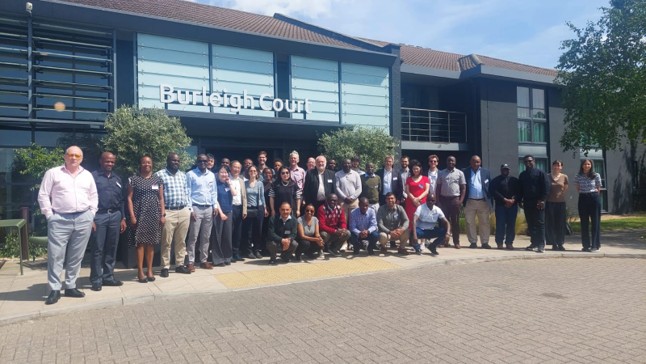
That tension framed the workshop Beyond Energy Access: Reliability, System Losses, and Utility Sustainability in African Power Systems, held at Loughborough University on 21–22 May 2026 and co-hosted by MECS, Climate Compatible Growth (CCG), Strathmore University’s School of Computing and Engineering Sciences (SCES), and the Yale Research Initiative on Innovation & Scale (Y-RISE). Participants included electricity utilities, regulators, researchers and investors from across Africa, the Caribbean and the United Kingdom.
The state of eCooking in Kenya
Kenya’s eCooking ecosystem has matured considerably over the past decade: Kenya Power’s awareness campaigns from 2017, the eCookBook in 2019, the first results-based financing programme for electric pressure cookers from EnDev and CLASP in 2020, and more recently the eCooking Capacity Building and Market Development Programme (eCAP), which has supported consumer awareness, technical training, tariff piloting and the development of the Kenya National eCooking Strategy.
Dr Jon Leary (Gamos East Africa / MECS) noted that this track record matters for financing: development finance institutions are generally not looking to build nascent markets, but to scale markets that have already demonstrated demand and an operational record. On that test, Kenya is well positioned.
Murefu Barasa (Loughborough University) discussed the potential role of eCooking tariffs in driving adoption and presented evidence suggesting that demand is relatively inelastic among the lowest-income households who are on lifeline tariffs (and that a tariff reduction is therefore more likely to drive adoption among middle-income households). He presented the methodology design considerations being taken into account within planned involving experimental piloting of different tariff reductions amongst different consumer segments in Kenya.
Dr Will Clements (Gamos / MECS) drew three conclusions from the Cooking Support on Mini-Grids (COSMO) project across Tanzania, Kenya, Haiti and Nepal: eCooking works best when built into planning from the outset, reliable supply is essential to consumer confidence, and the revenue benefits to operators are significant.
The network-side constraint
Kenya Power’s total system losses stand at 22.07%, improved from 24.08% but still well above the 16.50% regulatory threshold set by EPRA. Dr Eng. Fenwicks Musonye (EPRA) put the cost of that gap at approximately KES 7.8 billion — around GBP 44.96 million — in unrecovered costs each year.
Losses are not only a revenue problem but also a signal about the physical condition of the network that new cooking loads will sit on. Power factor degradation and harmonic distortion both cause thermal stress on conductors and transformers, accelerating equipment degradation and raising technical losses. A power quality analysis presented by Strathmore SCES found a facility with an average monthly power factor of 0.8 whose granular measurements collapsed to near zero during daytime operations. This pattern is entirely invisible in the monthly averaging on which billing is based. A separate commercial and industrial case study attributed GBP 14,953 per year in unbilled energy to harmonic distortion alone.
Timing compounds this. Eng. Hicks Waswa (KPLC) noted that peak demand falls between 6pm and 10pm, precisely where both eCooking and e-mobility load profiles are expected to sit.
Reliability beyond the meter
Utility-side reliability is necessary but not sufficient. An electric pressure cooker or induction hob does not connect to the grid alone. It also connects to an installation — the consumer unit, circuit conductors, terminations and earthing inside the building. Much of that installation work in Kenya’s residential and small commercial building stock has been carried out informally.
This was the subject of the session Reliability Beyond the Meter, presented by Eng. Anne Wacera Wambugu (Strathmore SCES) and Eng. Hicks Waswa (KPLC). Its argument is that appliances and the informal technician workforce can undermine the reliability that utility capital investment is intended to deliver. Discussions spanning Nigeria, Uganda and Kenya independently identified unsafe wiring practices as a live safety risk, alongside limited public awareness of eCooking safety as a constraint on adoption.
For eCooking programming, the consequence of this is direct. Where wiring cannot carry the load, the household experiences voltage drop, overheating, nuisance tripping, premature appliance failure and, at worse, a fire. Households do not know a wiring fault – they know a bad cooker or a bad utility. The same asymmetry applies to power quality. Harmonics and poor power factor originate behind the meter, in consumer equipment and consumer wiring, and travel into the network. This matters directly for eCooking, because induction cookers and inverter-based appliances are themselves non-linear loads.
Energy efficiency means lower energy bills, but the large-scale adoption of non-linear loads creates harmonics. Consumers do not understand their role in generating these distortions, and the blame tends to be placed on the utility.
Eng. Anne Wacera Wambugu, Strathmore SCES
The regulatory implication is the sharpest to emerge from the session: regulators oversee the price of a connection closely and the quality of it barely at all. A tariff can make eCooking affordable and a subsidy can place an appliance in the kitchen. Neither establishes that the circuit it plugs into can carry it. Therefore the enforcement of installation quality based on existing regulations is a prerequisite for scaling cooking load onto existing building stock, rather than a parallel safety agenda running alongside it.
With over 10 million electricity installations and only a limited number of enforcement officers, enforcement efficiency remains a challenge. Collaboration with academia is helping introduce more innovative and scalable detection and enforcement approaches.
Lee Okombe, EPRA
Sequencing, not just scaling
The workshop’s most immediately usable contribution for eCooking programming may be the emerging ability to tell one part of the network from another. Kenneth Mugo (Strathmore SCES) presented a satellite-based approach using temporal variation in night-time radiance as a proxy for reliability, distinguishing balanced growth zones (where infrastructure is absorbing demand well and can take additional load) from fragile access zones, which are grid-connected but where voltage stabilisation should precede significant new appliance load.
Harrison Mwaura (Strathmore SCES) presented load fingerprinting as a means of characterising consumer electrical behaviour at feeder level and observed that institutional eCooking introduces resistive demand that can improve system power factor and transformer utilisation. Both form part of a diagnostic initiative launched in April 2026, covering 19,612 transformers in the Nairobi region ahead of a planned national audit of approximately 83,626.
Taken together with the beyond-the-meter evidence, these point towards a more sequenced approach to eCooking scale-up: identifying where load can be absorbed today, where network reliability work must come first, where installation quality must be addressed before an appliance is delivered at all, and designing tariffs — including the institutional eCooking tariff under discussion in Kenya’s current review, following Uganda’s example. Interestingly, institutional cooking loads may actually be helpful to grid stability due to its provision of daytime loads.
Institutional eCooking can introduce additional resistive demand, helping improve overall power factor of the system, and improve network efficiency and transformer utilisation.
Mr. Harrison Mwaura, Strathmore SCES
Ultimately, what is clear is that,
Better load behaviour means reduced system losses, which means lower utility costs, which means fairer tariffs, which means higher consumer productivity.
Eng. Hicks Waswa, KPLC
The full workshop report is now available: Beyond Energy Access: Reliability, System Losses, and Utility Sustainability in African Power Systems.
Workshop Presentations:
We would like to share the PowerPoint presentations delivered by the experts during the workshop:
Will Clements:
Ginny Ip:
Mark Spratt:
Vivien Foster:
Patrick Tutembe:
Ed Brown:
Martin Cowsill:
Xiongwei Liu:
Peter Weston:
Murefu Barasa:
Eng. Hicks Waswa and Anne Wacera Wambugu
*********************************************************************************************************
Featured Image: Participants at the “Beyond Energy Access: Reliability, System Losses, and Utility Sustainability in African Power Systems” workshop at Loughborough University, UK. Photo courtesy of the hosts. 2026.