- Date
- 21st October 2026
- Categories
- Carbon Finance, Carbon Market, Clean Cooking
By Prof Matt Leach, Gamos and Modern Energy Cooking Services
Who will buy the credits that help finance the transition to clean cooking?
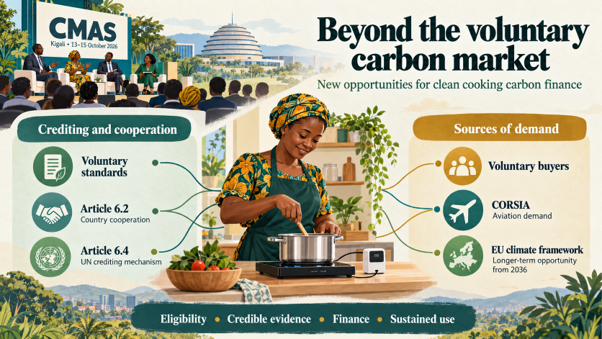
At the Carbon Markets Africa Summit (CMAS) in Kigali on 13–15 October 2026, that question connected developers, governments, investors and buyers. The voluntary carbon market remains important, but demand linked to national climate commitments and regulatory obligations is growing.
For clean-cooking developers, this could mean larger purchasers and longer contracts. The challenge is understanding which credits qualify and whether the additional revenue justifies the cost of accessing these markets.
The voluntary market remains a foundation
The voluntary carbon market has supported clean-cooking project development, methodologies, monitoring and relationships with corporate purchasers. At CMAS, developers described continuing voluntary sales while exploring other markets. BURN, for example, reported selling one million clean-cooking credits aligned with the Core Carbon Principles during the year.
For modern cooking, metering offers an advantage: appliance-use data can provide greater confidence in performance than household recall alone. But meters, communications and data management cost money, and stronger evidence does not automatically secure a premium. Buyers distinguish between technologies, methodologies, locations, delivery risks and the claims they want to make. Developers therefore need purchasers who recognise the value of robust evidence. The picture at CMAS was one of diversification, with voluntary sales remaining as just one part of the financing mix.
Article 6.2 connects cooking projects with national demand
Article 6.2 of the Paris Agreement enables countries to cooperate through internationally transferred mitigation outcomes. Some developers are building on voluntary-market experience to access this demand, but an existing project cannot simply change its label: government authorisation and buyer requirements must also be met.
Authorised transfers require corresponding adjustments to countries’ accounting towards their nationally determined contributions (NDCs). These prevent the same emission reduction being counted towards both the host and buyer countries’ climate targets.
ATEC’s electric-cooking project in Malawi illustrates the opportunity. Its agreement with the KliK Foundation sits within Malawi–Switzerland cooperation. ATEC plans to deploy 76,000 connected induction cookstoves to grid-connected households primarily using charcoal in Lilongwe and Blantyre.
At CMAS, developers were examining project structures and financing options. An identifiable purchaser and a multiyear agreement can strengthen the case for investment. Yet businesses must pay for appliances, distribution and customer support long before credits generate revenue. The timing and terms of government authorisation also affect financing risks. Participants discussed structures in which authorisation comes only after credit issuance, leaving developers to secure pre-financing and, in some cases, insurance. Understanding when each government decision is needed matters as much as understanding the eventual credit price.
The summit heard how BioLite’s Zambia project secured US$10.7 million in financing for cookstoves linked to KliK purchases under Article 6.2. Carbon insurance, including cover involving Kita, helped manage delivery and government-related risks, including the risk of the host government failing to honour its authorisation commitments. Such arrangements can unlock investment, but add costs and complexity.
Article 6.4 adds an UN-supervised route
Article 6.4, the Paris Agreement Crediting Mechanism, is also becoming relevant to cooking. In the week before CMAS, the UNFCCC announced two household-cooking methodologies: one for more efficient wood and charcoal stoves, and another supporting transitions to cleaner, lower-emission cooking.
Eligible projects can now seek credits through this UN-supervised mechanism. Developers were examining how the requirements would affect monitoring costs and credit volumes. Access will still depend on meeting the mechanism’s requirements and securing finance to implement projects. A methodology is an important step, but Article 6.4 is a crediting framework, not a purchaser: buyers still need a reason, and an eligible use, to buy the credits.
CORSIA brings aviation demand into the picture
Less familiar to many clean-cooking stakeholders is CORSIA, the Carbon Offsetting and Reduction Scheme for International Aviation. Under the ICAO framework, covered airlines must cancel eligible credits against calculated offsetting obligations, creating demand from regulatory requirements.
The potential scale is substantial. IATA estimates demand of around 200 million credits for 2024–2026, with cumulative requirements approaching two billion through 2035. These are forecasts, but explain why aviation buyers featured prominently at CMAS.
Participants quoted CORSIA prices around US$12.50–14 per tonne, above many lower-priced voluntary credits discussed at the event. This is not a universal premium: high-quality voluntary transactions can achieve more, and contracts are not directly comparable.
Access depends on programme, methodology, vintage and other eligibility requirements, including host-country authorisation and corresponding-adjustment arrangements. IATA’s guidance explains the accounting requirements. Certification under an approved programme does not automatically make every credit CORSIA-eligible.
For clean cooking, the question is the net value of aviation demand. Host-country contributions, insurance, monitoring and financing can absorb a substantial share of the headline price.
Europe offers a longer-term opportunity
The amended European Climate Law allows high-quality international credits, from 2036, to contribute towards the EU’s 2040 target, up to a limit equivalent to 5% of 1990 EU net emissions. This opens the door to significant future demand.
It does not automatically allow European installations to meet 5% of their EU Emissions Trading System (ETS) obligations with overseas cooking credits. Purchasing arrangements and eligibility rules are still developing. A European Parliament briefing describes a proposed central purchasing facility and links with the future ETS framework.
This is a longer-term prospect for clean cooking. References at CMAS to European allowance prices around €85 per tonne certainly drew interest, but developers should not assume international credits will command the same price.
Preparing clean cooking for a wider market
These opportunities are connected: Article 6 provides cooperation and crediting frameworks, while aviation and European climate policy create potential uses and buyers.
For MECS, the priority is helping developers assess eligibility early, build realistic financial models and demonstrate sustained appliance use without duplicating monitoring unnecessarily.
A broader, more dependable buyer base could help finance cooking services that households, schools and businesses will continue to use. Achieving that means keeping reliable, affordable cooking at the centre of project design.
*********************************************************************************************************
AI disclaimer: Plaud was used to transcribe sessions at CMAS and AI was used to structure the text and to create the blog infographic.