- Date
- 21st October 2026
- Categories
- Electric Cooking, Electrification
By Dr. Simon Batchelor OBE (GAMOS Ltd./Loughborough University)
Africa is investing heavily in electricity infrastructure, and Mission 300 aims to connect another 300 million people by 2030. But experience suggests that connecting households does not necessarily lead to much electricity being used. Bringing cooking into electricity planning could help improve household benefits while strengthening the economics of the electricity system.
Learning from earlier investments
In my previous blog, I looked at the experience of major African infrastructure investments over the last twenty years. Considerable progress has been made in constructing new electricity generation, transmission and distribution infrastructure. However, evaluations show that economic returns have sometimes fallen well below those anticipated when investments were approved. In several cases, governments and utilities have been left with substantial financial obligations that the new infrastructure has struggled to support.
Uganda’s recently completed 600 MW Karuma hydropower station illustrates some of these difficulties. The plant represents a substantial addition to Uganda’s generating capacity, but the Auditor General reported that only around 30% of its available generation was dispatched during the period examined. This has implications for the revenues available to cover financing and operating costs. The reasons include the interaction of generation, transmission, demand and electricity-system operations, but the broader point is that completing a generating plant does not automatically mean its capacity will be fully used.
In the blog I considered a sample of energy infrastructure investment and the evaluations after their completion, and a common story evolved. The key issues revolved around optimistic demand assumptions, and yet research suggested very low electricity consumption among newly connected households. There is then a need to find sufficient demand and commercially viable ways to use it and that involves a transformation in household economic activity that does not automatically follow. This, I propose, is where eCooking comes in. eCooking for households pivots existing spend on polluting fuels into the utility, and creates a range of opportunities in institutions such as schools and the formation of businesses for hot and pre-prepared food.
The past experience of energy infrastructure investment is relevant to Mission 300; the World Bank and African Development Bank initiative to bring electricity to 300 million additional people by 2030. The initiative is an important response to Africa’s continuing electricity access deficit, but there are lessons from earlier investments that need to be reflected in how success is measured and how investments are planned.
The experience of rural electrification in Kenya
As stated in the introduction, a particularly useful piece of evidence comes from Kenya. In 2020, Kenneth Lee, Edward Miguel and Catherine Wolfram published Experimental Evidence on the Economics of Rural Electrification in the Journal of Political Economy.
The researchers undertook a randomised experiment, offering electricity connections to rural households at different prices and examining the subsequent effects on electricity use and household outcomes.
They found that demand for connections was sensitive to price, which is perhaps unsurprising given the incomes of the households concerned. However, even among households that were connected, electricity consumption remained very low. The study found no statistically significant medium-term improvements in the economic and social outcomes measured.
The research does not suggest that electricity access is unimportant. Lighting, communications and convenience bring benefits, and some of the wider or longer-term effects of electrification may not have been captured by the study. Nevertheless, the findings challenge the assumption that once a household is connected to electricity, consumption will increase sufficiently to generate substantial economic benefits and utility revenues.
For an electricity provider, connecting a household involves investment in infrastructure, meters, billing systems and ongoing service provision. If the household subsequently consumes only a few kWh each month, the revenue generated may be very small relative to those costs.
The Kenya findings also suggest that the economic activities expected to follow electrification may require additional interventions, such as access to appliances, finance, markets and other productive resources. Electricity makes activities possible, but does not necessarily cause them to happen. This is where utility led On Bill Financing (example Tanzania), Carbon Finance (example ATEC) and Results Based Funding (example Uganda) for eCooking all have a role to play (and indeed other approaches).
Households already have an energy budget
There is an interesting aspect of this problem that is easily missed when looking only at electricity consumption.
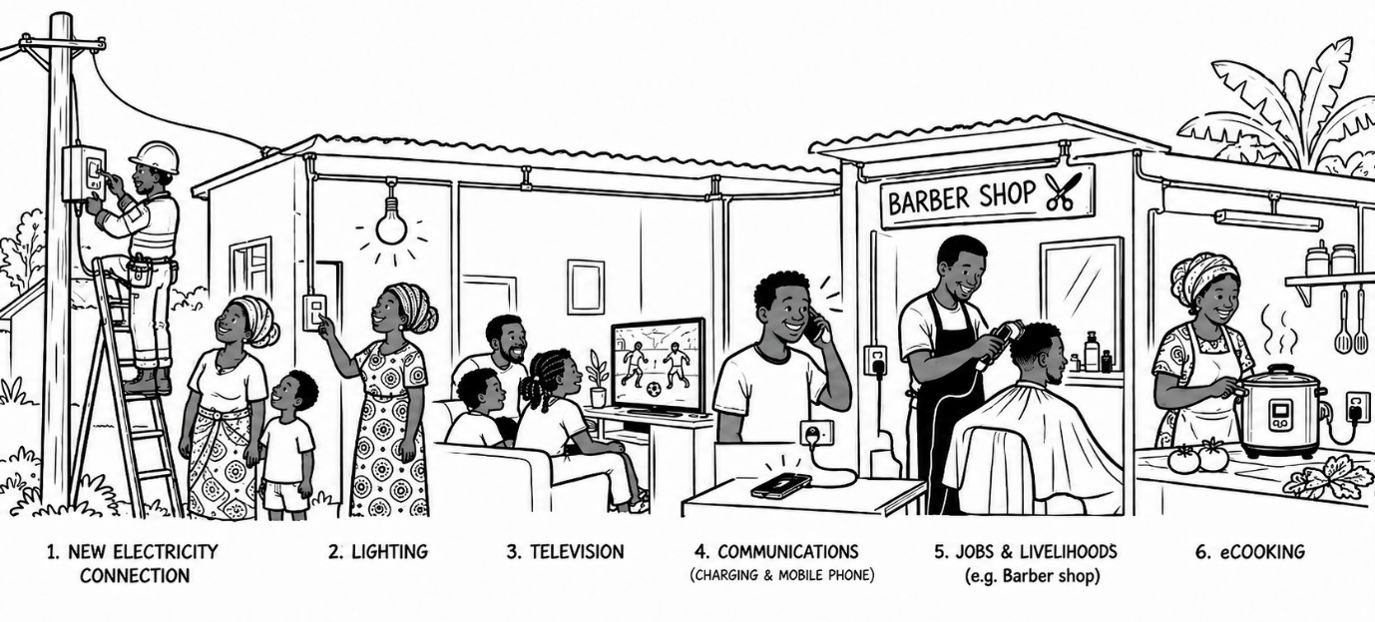
A household consuming 5 kWh of electricity each month appears to be a very small energy consumer. It may be using electricity mainly for lighting, phone charging and perhaps a television. Yet that same household is almost certainly using considerably more energy for cooking, much of it supplied by charcoal, firewood or LPG.
Recent MECS analysis of World Bank Multi-Tier Framework household data from Kenya, Rwanda and Ethiopia compared electricity consumption and expenditure with spending on cooking fuels.
In Kenya, households consuming less than 5 kWh of electricity per month had median electricity expenditure of approximately US$2, while their median reported spending on cooking fuels was around US$7. In Rwanda, households consuming 5–10 kWh were spending roughly US$2–3 on electricity but around US$9 on cooking fuels.
These are historical survey figures rather than current national averages, and they relate to particular groups of households. Nevertheless, they illustrate that household expenditure on cooking can be several times greater than expenditure on electricity, even among households with very low electricity consumption. Everyone has to eat, and so cooking energy is a predictable demand. (That comparison though did exclude the economic value of firewood collected without a cash payment.)
There is therefore an existing demand for an energy service, and in many households an existing cash expenditure, that is currently outside the electricity system.
Bringing cooking into electricity demand
Efficient electric cooking appliances create an opportunity to shift some of this existing energy demand onto electricity. MECS research has shown that electric pressure cookers, induction appliances and other efficient cooking technologies can often prepare meals at a lower monthly energy cost than charcoal or LPG, although the comparison depends on tariffs, fuel prices, appliance performance and cooking practices.
Consider a household currently consuming 5 kWh of electricity each month. If it begins using an electric pressure cooker and other electric appliances for a substantial proportion of its cooking, consumption might increase by another 20–30 kWh per month. Instead of purchasing 5 kWh, the household could be purchasing 25–35 kWh.
This is an illustrative calculation, and actual consumption will depend on household size, cooking patterns and the proportion of cooking transferred to electricity. However, it shows the potential significance for utility revenues. The additional consumption would not necessarily require an equivalent increase in total household energy expenditure, since electricity would be replacing expenditure on other fuels.
For the household, the potential benefits include reduced cooking expenditure, convenience and less exposure to household air pollution where polluting fuels are substantially displaced. For the utility, there would be additional electricity sales through a connection that already exists.
Whether this improves the utility’s financial position depends on the cost of supplying the additional electricity. Where there is spare generation and network capacity, the additional sales may be relatively inexpensive to serve. Where networks are already heavily loaded, or cooking coincides with evening peaks, additional generation, distribution or storage investment may be necessary.
This distinction matters. Increasing electricity consumption is not in itself a measure of success. The aim is to provide useful services to households at an affordable cost, while ensuring that the additional revenue makes a positive contribution to the finances of the electricity provider.
Implications for Mission 300
Mission 300 already recognises productive uses of electricity, utility reform and clean cooking in its National Energy Compacts. The opportunity is to bring these elements more closely together in investment planning.
Electrification programmes have traditionally focused on extending networks and increasing the number of connections. Productive-use programmes and clean cooking initiatives have often been developed separately, sometimes with different institutions, budgets and implementation arrangements.
There is a case for considering them as part of the same investment.
For example, a programme extending electricity to 100,000 households could include an assessment of their existing cooking energy expenditure, the proportion likely to adopt electric cooking, the appliances and financing required, and the additional electricity demand that could result. The implications for network capacity, electricity tariffs, utility revenue and household expenditure could then be included in the original investment appraisal.
This would provide a more realistic basis for forecasting demand than assuming that electricity consumption will grow naturally after connection.
There are also opportunities beyond the household. Schools, hospitals, restaurants and other institutions often spend substantial amounts on cooking fuels. Moving appropriate cooking activities to electricity could create additional, relatively predictable demand, particularly where institutions can schedule cooking to make better use of available generation.
The approach will not be suitable everywhere. Some Mission 300 connections will be provided through small solar systems or low-capacity networks that cannot support electric cooking. In other locations, affordability, reliability or appliance finance may limit adoption? These constraints should be incorporated into planning rather than assuming that every new connection will lead to substantial additional consumption.
The development of electricity demand in the design and financing of electricity access programmes is key, rather than treating it as something to be addressed after the infrastructure has been installed.
Measuring the benefits of electricity access
If I may go further, the Kenya research and the wider experience of infrastructure investment suggests that the number of connections should be accompanied by measures of what happens after households are connected.
Electricity consumption after one or two years would be a useful starting point, alongside reliability, affordability and the services for which electricity is used. Changes in household energy expenditure, productive activity and utility revenues would help establish whether the expected benefits are materialising.
For investments justified partly on the expectation of increased electricity consumption, actual sales could be compared with the original forecasts. Utilities and governments could also be able to assess whether the additional revenues cover the costs of supply and contribute to repayment of the original investment.
This does not mean that every electricity connection must be commercially self-financing. Electricity access provides important social benefits, and public subsidies may be entirely appropriate. However, those subsidies should be understood and planned for, rather than relying on optimistic assumptions about future electricity consumption.
Mission 300 offers an opportunity to apply these lessons at scale. By considering cooking and other useful applications of electricity alongside new infrastructure, investments could generate greater benefits for households and provide utilities with additional revenue from the assets they are constructing.
The earlier experience of African infrastructure investment suggests that this needs to be considered from the outset. Connecting 300 million people will be a major achievement, but the longer-term benefits will depend on how electricity is subsequently used, what households and businesses gain from it, and whether the electricity systems can sustain the costs of providing the service.
AI used for an enhanced internet search, summaries from key documents and creating the graphic
Figure, top – illustration of typical electricity consumption after new connections. Ai generated from prompt.