- Date
- 20th February 2026
- Categories
- Clean Cooking
By Dr. Simon Batchelor OBE (Gamos Ltd. / Loughborough University).
On 18th February 2026, ESMAP convened an open event webinar ‘Clean Cooking in Schools’. This blog is a summary by an AI LLM from the transcript of what people, humans, actually said, and mildly edited by a human.
On any given school day, an estimated 500 million children receive a meal at school. In much of Sub‑Saharan Africa and other low‑ and middle‑income regions, those meals are cooked over traditional biomass mainly firewood and charcoal, and sometimes kerosene. During this webinar on clean cooking in schools, practitioners, policymakers, and private sector actors shared how they are trying to change that reality, and what it takes to move from promising pilots to scalable, sustainable programs.
The session, part of a broader ESMAP / Clean Cooking Fund webinar series, focused on concrete experiences from East and West Africa and on emerging guidelines and business models that can help governments and partners design better interventions.
Why Schools Matter for Clean Cooking
In her opening remarks, the World Bank’s Global Director for Energy and Extractives framed schools as a strategic entry point for modern cooking:
- Schools are the second largest user of biomass after households.
- In Sub‑Saharan Africa alone, school kitchens burn an estimated 8 million tons of firewood per year, equivalent to the emissions of more than 2 million cars.
- The impacts are cross‑sectoral: Health: cooks and children are exposed to high levels of indoor air pollution; Gender: women and girls often collect firewood, losing time for education and income; Environment & climate: pressure on forests and significant CO₂ emissions; Education: smoke‑filled kitchens and unreliable fuels disrupt meal provision and learning.
Clean cooking in schools therefore sits at the intersection of energy, education, health, gender, climate and social protection. If done well, it can improve learning environments, reduce emissions, demonstrate modern cooking to communities, and provide a platform to scale clean cooking more broadly, including to households.
Designing Electric Cooking Solutions for Schools: The MECS Guidelines
Richard Seiff (MECS) presented newly developed guidelines for designing and implementing electric cooking in schools.
A key insight is that no two schools are the same. They differ in the number of students and meals per day, menus and cooking practices; kitchen space and layout; electrical infrastructure and grid reliability, etc
Because of this diversity, “off‑the‑shelf” solutions rarely work. The MECS guidelines propose an staged process that starts with careful diagnosis and ends with structured monitoring:
- Pre‑feasibility screening. Identify promising schools based on size, menu type, existing electricity, and basic infrastructure.
- Detailed site surveys. Observe cooking processes, service times, quantities, pot sizes, kitchen layout, wiring, metering, and school readiness.
- Baseline cooking study. Measure time, fuel use, and costs for common dishes (typically at least three measurements per dish for accuracy). Maintain a kitchen diary to capture sequences, quantities, and operational details.
- Design and installation. Match appliances (e.g., institutional induction cookers, electric boilers, pressure cookers) to actual cooking needs and space constraints. Plan and implement any required electrical and kitchen upgrades.
- Training. Provide hands‑on training for cooks who may have never used electric appliances. Allow time for iterative adjustment: appliance experts need to learn local recipes; cooks need to learn new techniques (e.g., different water use for pressure cooking).
- Monitoring and follow‑up. Conduct short monitoring campaigns immediately after introduction and again after 4–6 weeks, plus a qualitative follow‑up survey after about three months. Track not just energy use and costs, but also whether schools revert to biomass and why.
MECS has already applied these approaches in Uganda, Tanzania, Zambia, Nepal and through multi‑country baseline “school kitchen and cooking” (SKACS) studies. A Lancet paper drawing on case studies in Kenya, Lesotho, Guinea and Nepal shows that when designed well, school e‑cooking can:
- Reduce fuel consumption and costs
- Cut firewood collection time
- Enable co‑benefits: solar‑powered cooking systems can also power lighting, IT, and even irrigation for school gardens, closing small circular economy loops (surplus PV → water pumping → gardens → school meals).
Private Sector Innovation: Hybrid Solar–Electric Cooking in Kenyan Schools
Justine Abuga from Ecobora provided a grounded view from the private sector, working to scale solar‑powered electric cooking in Kenyan schools.
Ecobora’s solution is built around four elements: Solar PV to capture energy; Inverters to convert DC to AC; Lithium batteries to store energy for cloudy days and night cooking; Institutional electric stoves sized from 50 to 2,000 litres – large enough to serve anywhere from 50 to 7,000 learners per school.
This configuration allows schools to cook with zero on‑site CO₂ emissions, while also using the same system for lighting, computer labs, and water pumping. However, Justine emphasized that technology alone is not enough. Several practical challenges stand out:
- Kitchen infrastructure is often missing or inadequate
Electric stoves cannot be safely installed in open spaces. Many schools lack proper enclosed kitchens and compliant wiring. Upgrading or constructing kitchens frequently becomes the single biggest cost item, and has blocked many transitions. - Grid–kitchen mismatch
National “last‑mile” electrification often drops power at the school gate or head teacher’s office, while kitchens can be hundreds of metres away. Extending safe wiring to the kitchen can cost thousands of dollars and is rarely budgeted during initial grid rollout. - Cultural and menu diversity
African schools serve diverse dishes, often requiring boiling, frying and steaming. If an institutional stove is designed only for boiling, schools must acquire additional appliances, which is both costly and operationally complex. Ecobora therefore designs multi‑function stoves to preserve local menus and cooking practices. - Reliability concerns and hybrid systems
School managers routinely ask, “What happens when power goes off?” Because missing a meal is not an option. Ecobora complements solar e‑cooking with backup pellet stoves using biomass residues. This hybrid model (solar + pellets, or grid + biomass) reduces the risk that schools revert to traditional firewood. - Data and user‑friendly metering
Ecobora has developed simple digital dashboards that tell cooks and school managers: How many kWh were used per session?; How long cooking took? This helps managers to understand costs and savings, and helps cooks to plan cooking schedules.
On the business side, Ecobora is experimenting with multiple models:
- Upfront purchase with partial pre‑payment and a completion payment.
- Cooking‑as‑a‑service, with zero upfront cost but high capital needs on the provider’s balance sheet.
- A blended model, where schools pay roughly one‑third of capex, and the rest is covered by results‑based finance, subsidies and carbon revenues.
Justine stressed that scaling will also require local manufacturing and skilled labour especially youth and women, to fabricate, install and maintain systems across countries like Kenya, Somalia and Uganda.
Ghana: Integrating Clean Cookstoves into a National School Feeding Program
Sarika Gupta presented Ghana’s experience integrating clean cooking into the Ghana School Feeding Program (GSFP), the country’s largest safety net.
GSFP: Covers 13,000+ schools; Serves over 4 million children; Provides one hot meal per child per school day (around 200 days per year); Employs about 50,000 cooks and is managed by 14,000+ mostly women‑led catering businesses.
Early scoping revealed that a large share of meals were cooked, often with heavy smoke exposure. In some cases, meals were prepared off‑site and transported, raising concerns about food safety and temperature control.
To address this, the World Bank’s Ghana Productive Safety Net Project 2 (GPSNP2), together with ESMAP/SNAP co‑financing, is piloting clean cookstoves in 2,000 schools, targeting low‑income districts. The pilot aims to: Reduce exposure to smoke for 4,000+ caterers and hundreds of thousands of children, Test which stove and fuel combinations are viable in remote, low‑income settings, and learn how to effectively integrate clean cooking into an existing national program
The Ghana team followed a stepwise, data‑driven approach:
- Cookstove vendor mapping: A national expert conducted a market analysis to identify available clean stove models, suppliers, costs, and logistical feasibility (bulk supply, installation, after‑sales).
- Pro‑poor school selection: Using Ghana Statistical Service data, the team identified 2,500 candidate schools in poorer districts, then conducted detailed phone surveys (with an 80–85% success rate) on Current fuels and stoves, On‑site vs off‑site cooking, Kitchen facilities, Local availability of LPG, charcoal, firewood, electricity
- Technology–context matching: Schools are being matched with appropriate stove types (gas, improved biomass, etc.) depending on actual fuel accessibility, not theory. All models must meet minimum emissions standards confirmed through lab testing.
- Procurement and protective “mini‑kitchens”: Competitive procurement is underway to supply and install stoves. In parallel, the Labour‑Intensive Public Works (LIPW) program (another GPSNP2 component) will build small protective structures around stoves to guard against weather and theft.
- Training and documentation: The team is preparing training materials for caterers and cooks, and will roll these out via a training‑of‑trainers approach. A final implementation report will capture lessons learned, including how to scale within Ghana and inform other countries.
Rwanda: Lessons from Early Institutional Clean Cooking Projects
Clementine Umugwaneza (World Bank Group) shared Rwanda’s experience, where the country has achieved impressive electricity access (over 80%) but still has around 76% of households relying on traditional biomass for cooking. Rwanda has embarked on a series of projects to expand clean cooking, including: Large‑scale distribution of household stoves (mostly improved biomass and LPG) and institutional clean cooking components in two World Bank–supported projects, targeting dozens of schools.
A national school feeding policy adopted in 2019 aims for universal coverage of meals in pre‑primary to secondary schools. However, a feasibility study found that for roughly 500 public schools, about 70,000 tons of firewood were consumed annually, translating to significant carbon emissions and ongoing deforestation pressure.
The first institutional clean cooking project intended to equip 150 schools with clean stoves, supported by about $2.85 million in capex and $300,000 in technical assistance. Over time, however, policy changes and implementation realities forced a redesign:
- Biomass stoves were excluded from eligible technologies, leaving only LPG and electric solutions. This sharply increased unit costs and reduced the number of schools covered from 150 to 35.
- The initial tender bundled kitchen construction with stove supply and installation. No bidders could credibly cover both scopes, and the first procurement round failed.
- The project had to split tenders: Local contractors handle kitchen construction and specialized firms supply and install electric and LPG systems.
Despite delays, contracts are now in place for the construction of 35 kitchens in two lots, the supply of electric systems for some schools, the supply of LPG systems for most of the others, and all works are expected to be completed by mid‑2026.
Rwanda’s main lessons echo other speakers:
- Always include kitchens and infrastructure in the initial project design and costing.
- Size scopes to be attractive to qualified bidders; very small or very complex bundles reduce competition and increase prices.
- Unbundle civil works from technology supply where markets are not mature enough for integrated EPC‑style contracts.
Looking Ahead: From Isolated Pilots to Scalable Systems
Across the different country examples and technical presentations, several cross‑cutting themes emerged:
- Infrastructure readiness (kitchens, wiring, grid connection) is just as important as the stove itself.
- Training and local capacity—for cooks, technicians and administrators—determine whether systems are actually used and maintained.
- Business models must address high upfront costs, leverage results‑based and carbon finance where possible, and fit within public budget realities.
- Data and monitoring are key, both for improving designs and for demonstrating value to governments and funders.
- Procurement design can make or break implementation; aligning lot sizes and scopes with market capabilities is critical.
Perhaps most importantly, speakers repeatedly emphasized that clean cooking in schools is not just a technology swap; it is a programmatic transition that must be embedded in broader agendas of education quality, health, climate, and social protection.
…………………………………………….
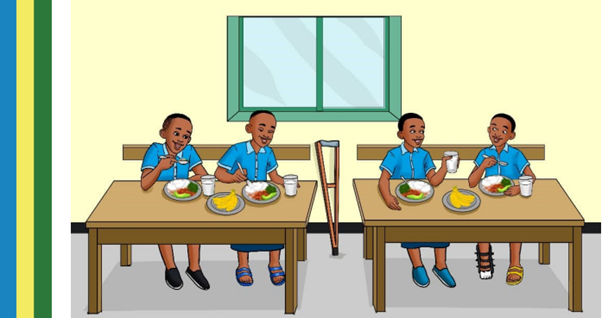
Image credit: Rwanda School Feeding Operational Guidelines Summary Min. of Education and WFP 2019 (used under Fair Use Act 2007).
As stated above, this was written by AI based on a transcript of the meeting, and edited by a human.