- Date
- 19th January 2026
- Categories
- Finance
By Dr. Simon Batchelor, OBE (Gamos Ltd. / Loughborough University).
In the blog ‘Tanzania’s Dual Strategy for Clean Cooking: Practical Lessons for MECS‘ our partner TaTEDO-SESO discusses Tanzania’s dual strategy approach. It discusses how in addition to the push for modern energy cooking, they propose that there needs to be a strategy for firewood and in particular charcoal. They propose that improving the sustainability of charcoal is a transitional and time-bound effort, designed to reduce harm while modern cooking solutions scale. In this blog I want to explore some of the cost accounting of this dual approach, challenge the idea of ‘free firewood collection’ and discuss the implicit subsidies for firewood and charcoal that are rarely accounted for.
For decades, cooking energy discussions in low- and middle-income countries have started from a deceptively simple assumption: that firewood for rural dwellers is free. From the household perspective, this often seems true. No cash changes hands; the cost is time, effort, and sometimes risk. Yet from a wider systems perspective, this assumption begins to fracture. Forests are not costless to maintain. Land is not free. And biomass does not regenerate without limits.
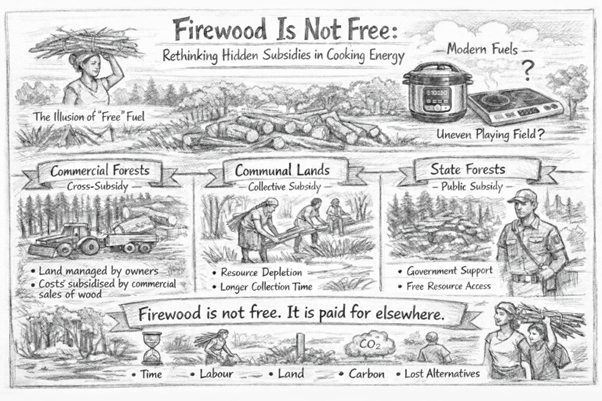
Three ideas are increasingly difficult to ignore. First, biomass cooking is widely perceived as cheap or free, particularly when compared to electricity or LPG. Second, forests and wooded landscapes do not exist without someone bearing the cost of land, management, or foregone alternatives. Third, where those costs are not explicitly recovered, they are absorbed, quietly and invisibly by landowners, communities, or governments. Put differently, biomass cooking is already subsidised, it’s just not on any balance sheet.
As MECS, we have historically not focused heavily on where people obtain firewood. Our mandate has been to enable a transition away from biomass altogether, towards modern energy cooking. In that sense, the provenance of firewood has often felt like a transitional detail rather than a structural issue. But in this blog I explore whether firewood for rural households is effectively subsidised, and whether that insight might change our approach to integrated energy planning. If biomass cooking is implicitly subsidised upstream, then clean/modern cooking is not competing on a level playing field. Integrated energy planning that ignores this implicit subsidy risks reinforcing it.
The illusion of “free” fuel
The idea that firewood is free rests on a narrow framing of cost. At household level, the logic is understandable. Firewood may be collected from nearby land, forest edges, fallows, or roadsides. No invoice is issued. The only visible costs are labour and time—costs that are often gendered, normalised, and undervalued. Yet energy economists have long recognised that the absence of a market price does not mean the absence of cost. It simply means the cost is borne elsewhere. When fuelwood is gathered without payment, someone else is absorbing the cost of maintaining the resource base—whether intentionally or not. This matters because energy planning, subsidy design, and carbon accounting typically compare fuels based on observed prices. Biomass appears cheap. Electricity and LPG appear expensive. The conclusion, implicit or explicit, is that modern fuels need subsidies while biomass does not. But this comparison collapses once the wider system is considered.
Commercial forests: an invisible cross-subsidy
In many parts of Africa and Asia, forests are commercially logged or managed, either as plantations or as natural forests under concession. These forests exist because landowners, private companies or the state, have invested capital and accepted long time horizons in expectation of timber revenues.
Firewood collection in these contexts typically comes from:
– branches and tops left after logging
– thinning operations
– damaged or non-merchantable wood
– residues along forest roads
From a household perspective, collecting such wood feels benign, even efficient. From a systems perspective, however, it represents an uncompensated withdrawal from a managed asset.
The forest owner pays for:
– land tenure or concession fees
– forest management and fire control
– access roads and infrastructure
– opportunity cost of alternative land uses
Firewood extraction reduces standing biomass, can slow regeneration, and may increase fire risk, yet the landowner receives no payment. In economic terms, this is a cross-subsidy: timber revenues support the existence of a forest that also supplies unpriced cooking fuel. This is not usually deliberate. But it is real.
Communal forests: collective subsidy and slow degradation
We think much biomass collection does not occur in formally commercial forests, but in communal or customary lands. Here, the subsidy logic shifts but does not disappear.
In these systems, firewood collection is allowed or at least tolerated, because:
– cooking fuel is a basic need
– exclusion is socially difficult
– enforcement is costly or politically sensitive
The costs of maintaining the resource are borne collectively:
– by the community
– by future users
– by the ecosystem itself
As biomass density declines, the cost reappears indirectly: longer collection times, increased labour burdens, and gradual encroachment into more distant or protected areas. What looks like “free fuel” is, in reality, the slow consumption of natural capital. Again, no line item appears in an energy budget. But the subsidy is there.

State forests and reserves: fiscal and ecological support
Where forests are owned by governments—whether protected reserves or production forests—the subsidy becomes explicitly public, even if unofficial.
When firewood collection is tolerated in state forests, governments are effectively:
– absorbing enforcement costs
– accepting ecological degradation
– forgoing alternative values (carbon, biodiversity, water regulation)
This is a form of fiscal-ecological subsidy. It persists because restricting access to cooking fuel carries political and social risks that few governments are willing to take. But the result is the same: biomass cooking is supported by public assets without being recognised as such.
Important nuance: shrublands, woodlots, and uncertainty
It is important not to overstate the case. There are contexts where the subsidy argument is weaker. Some firewood comes from:
– shrublands and degraded landscapes
– fallows and agricultural residues
– household-managed trees and agroforestry
In these cases, the opportunity cost of the biomass may be lower, and the “infrastructure” investment minimal. Short-rotation woodlots grown specifically for fuel blur the line further, as fuelwood becomes a primary product rather than a by-product.
The challenge is that we do not know the proportions. We lack robust, disaggregated data on where firewood and charcoal are actually sourced across different contexts. How much comes from commercial forests, communal lands, shrublands, or farms? Without this knowledge, energy planning defaults to simplistic assumptions. It is perhaps worth being a bit more precise about what the evidence does and does not yet tell us. There are well-established spatial tools that map woodfuel pressure and supply–demand balance, notably Nature, Bailis et al. (2015) and their UNFCCC endorsed model MOFUSS derived from FAOs work on WISDOM, which underpins many estimates of the fraction of non-renewable biomass (fNRB). These approaches are powerful for identifying where depletion risk and emissions are likely to occur, but they are much weaker at explaining who sources fuel from which land types. Some country studies do report collection sources (for example, government or community forests versus own land in Nepal), and FAO has issued guidance to strengthen woodfuel modules in national surveys, implicitly recognising current gaps. However, across Africa and Asia we still lack a consistently robust, disaggregated, and comparable evidence base that tells planners what share of household firewood or charcoal comes from commercial forests, communal or customary lands, shrublands, or farm-based trees. As a result, integrated energy planning often relies on simplified assumptions—treating biomass as a uniform, low-cost resource—when in reality its availability is shaped by land tenure, forest management, and unpriced ecological and capital costs that remain largely invisible.
Charcoal: monetising the hidden subsidy
I mention charcoal in the above and the Tanzania strategy focuses on charcoal. Charcoal deserves special attention because it transforms an implicit subsidy into a cash economy. Charcoal production tends to:
– converts wood into a tradable fuel
– creates income for producers and traders
– supplies rapidly growing urban markets*
*although tradeable firewood in peri urban and urban areas is also a phenomena.
Yet for purchased firewood or charcoal in many contexts, the forest input remains under-priced, informally accessed, or illegal. The value of the wood itself is rarely paid to the landowner or community in proportion to its ecological cost.
In effect, charcoal markets often allow private actors to capture the value of a subsidised biomass input, while the costs of forest degradation, enforcement, and regeneration remain socialised. This helps explain why charcoal remains competitive against LPG and electricity, even when conversion efficiencies are low and health impacts are severe.
Why this matters for integrated energy planning
This line of thinking is not an argument for managing biomass better instead of transitioning away from it. Nor is it a criticism of households who rely on the fuels available to them. Rather, it is a call for honest accounting. If biomass cooking is implicitly subsidised through:
– landholding costs
– public forest assets
– unpriced ecosystem services
Then clean cooking is competing against a distorted baseline.
From an integrated energy planning perspective, this has several implications:
– Electricity and LPG subsidies are not exceptional; they counterbalance hidden biomass subsidies.
– Carbon finance that ignores avoided biomass extraction undervalues clean cooking.
– Forest, land management and energy policies cannot be treated as separate domains.
Recognising implicit subsidies does not require perfect data. It requires acknowledging that current price signals are misleading.
Reframing the transition
For MECS and others working on modern energy cooking, this reframing may be uncomfortable but necessary. Back in 2010, the World Bank explicitly stated that “the implicit subsidy of biomass is due to the difficulties of pricing biomass and its environmental damage costs (including extraction and ecological impacts)” and are not reflected in market prices or energy planning. However I found few places where this has been brought to the foreground in the last 10 years.
By not asking where firewood comes from, we have implicitly accepted the narrative that biomass is simply “there”. In reality, it is supported by land, labour, tolerance, and ecological drawdown. If integrated energy planning is to be credible, particularly in the context of climate finance, carbon markets, and national energy strategies, it must confront this reality. The question is not whether clean cooking should be supported, but whether we are prepared to recognise that it already is—just unevenly and invisibly.
Firewood is not free. It has simply been paid for by someone else.
………………………………………
Featured image credit: AI created graphic summary based on prompts by S. Batchelor 2026.
AI LLM was used to correct grammar and tighten narrative.