- Date
- 24th February 2026
- Categories
- Finance, Modern Energy Cooking
By Dr Simon Batchelor OBE (Gamos Ltd. / Loughborough University).
In the early 2000s, when mobile phones were spreading across Africa at astonishing speed, I remember the quiet thrill in policy meetings when we would cite the now-famous headline: a 10% increase in mobile penetration was associated with roughly a 0.6 percentage point increase in GDP growth. It felt transformative, as if a small plastic handset could bend national income statistics. That estimate came from cross-country econometric work by Waverman, Meschi and Fuss (2005). Later work on broadband reinforced the idea that digital connectivity could support measurable growth effects (Qiang et al 2009).
Those were optimistic days. Mobiles were not just about calls; they reduced transaction costs, improved market coordination, strengthened remittance flows and connected labour to opportunity. Growth felt visible and measurable. We had a headline coefficient. We had a story.
Looking back on that period made me wonder: could modern energy cooking….. electrification leading to eCooking, (even LPG) ….ever claim a similar macro headline? Is there a “10% more modern cooking → X% GDP” story waiting in the data?
The answer, it turns out, is complicated.
Electricity and growth: powerful, but conditional
I went on to work with Mobile Money across the globe. The most famous of which is MPesa in Kenya. While no peer-reviewed study offers a universal “10% mobile money → X% GDP” elasticity, the Kenyan experience suggests something arguably more important than a coefficient (and more relevant to modern energy cooking). Policy analyses and structural modelling indicate that mobile money innovations such as MPesa contributed several percentage points to Kenya’s growth trajectory over the decade following its introduction, not through a marginal elasticity, but by reshaping the economy itself. Mobile money deepened financial inclusion, reduced transaction costs across sectors, expanded employment through agent networks, strengthened remittance systems, and enhanced consumption stability. Much like the effects of Broadband cited in Quiang et al. 2009.
In other words, while the early mobile phone literature gave us a clean elasticity i.e. 10% more penetration associated with ~0.6% higher GDP growth, the mobile money story was less about a regression line and more about economy-wide effects. It altered how markets functioned, how risk was shared, and how capital circulated.
Electrification has similar features. Electricity has long been associated with development. It powers factories, extends working hours, enables mechanisation and refrigeration, and supports digital economies. But the modern evidence is more nuanced than the old “energy equals growth” narrative suggests.
Connections alone do not automatically produce growth elasticities. But reliable electricity changes production possibilities: it enables machinery, extends business hours, supports cold chains, reduces outage losses, and anchors industrial activity. Its impact emerges through structural shifts in productivity and labour allocation rather than a single tidy coefficient.
South Africa’s rural electrification rollout provides one of the clearest causal findings. Dinkelman (2011) shows that electrification increased female employment by around ~9.5 percentage points alongside reductions in wood-fuelled cooking. Here, electricity translated into economic participation. It altered labour allocation and reshaped opportunity.
But electrification does not automatically “supercharge” development. In Kenya, Lee, Miguel and Wolfram’s experimental evidence shows that while households adopted lighting and small appliances after connection, there was little evidence of large short-run income or enterprise growth effects. Consumption patterns shifted to more lighting, more media use but measurable gains in earnings or business expansion were modest. Electricity improved welfare, but not immediate structural transformation.
Taking into account reliability sharpens the picture. In India, Allcott, Collard-Wexler and O’Connell 2016 estimate that electricity shortages reduced manufacturing plant revenues and producer surplus by 5 to10%. Power quality, not just access, shapes productivity. A grid that fails undermines growth just as surely as a road that collapses.
Systematic reviews reinforce this conditional story. Bayer et al. (2020) find that rigorous electrification impact evaluations are fewer and more heterogeneous than often assumed, with experimental studies typically reporting smaller economic effects than observational designs.
The lesson is increasingly clear:
Electricity contributes to growth when reliability, affordability and productive use align. A connection alone is not transformation it is a first step on potential pathways.
That distinction between access and use matters enormously for cooking.
Cooking: central to welfare, peripheral in GDP regressions
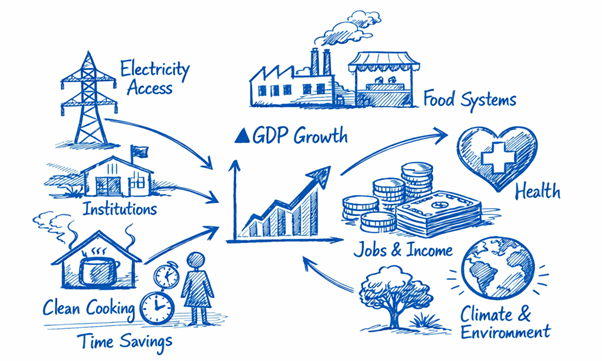
So this is where cooking enters the frame. Modern energy cooking may not yield a neat macro-economic elasticity either. But like mobile money and electrification before it, it operates through economy-wide channels, improvement in health, time use, institutional productivity, food systems and public finance. The question is not whether there is a simple “10% more clean/modern cooking → X% GDP” number. The question is whether cooking becomes embedded deeply enough in economic systems to shape how labour, capital and human capability interact.
Cooking despite being one of the largest household energy uses rarely sits at the centre of macro growth analysis. The strongest evidence on cooking’s economic relevance lies not in GDP coefficients but in human capital and resilience. The Lancet Commission on Pollution and Health (2017) estimates pollution-related welfare losses at $4.6 trillion annually about 6.2% of global GDP! Household air pollution from cooking is a substantial contributor to that burden. Reducing it strengthens long-run productivity.
Its logical but do we have any evidence? Indonesia’s large-scale kerosene-to-LPG transition is associated with measurable improvements in early-life health outcomes, including reductions in infant mortality and low birth weight (Imelda 2020). These are long-run productivity dividends, even if they do not appear immediately in national accounts.
Time-use studies reinforce the point. Evidence from LPG interventions shows that cleaner cooking can alter household time allocation (Williams et al. 2020). Time saved may shift into income-generating activity, education, childcare or rest. These are foundational economic assets but they do not generate instant GDP elasticities.
Cooking’s economic contribution is therefore real but indirect. It operates through improved health, labour participation, educational attainment and reduced vulnerability. These channels diffuse gradually through the economy and are difficult to isolate in macro regressions.
LPG is often positioned as the immediate and scalable alternative to electricity. Is there any related macro evidence? Peer-reviewed country studies modelling LPG consumption and economic growth, for example in Saudi Arabia and Cameroon report statistically significant long-run relationships in specific contexts. However, they do not converge on a stable cross-country elasticity of the form “10% more LPG consumption → X% more GDP.”
I am guessing the statistics is muddied by structural reasons. In hydrocarbon-rich economies, LPG consumption may proxy industrial expansion. In import-dependent economies, it reflects subsidy policy and household purchasing power. In low-income settings, LPG is predominantly a cooking fuel; in higher-income contexts, it may serve commercial and industrial roles. The estimated coefficient therefore captures very different mechanisms across countries?
Unlike the mobile revolution which plausibly functioned as a general-purpose technology shock, LPG typically operates within existing economic structures rather than reshaping them. Its welfare and health benefits are substantial. Its macro-growth signal is context-bound.
Beyond the household: institutions and markets
The growth conversation shifts when we move beyond household kitchens.
Electric cooking in schools, hospitals, prisons and large public kitchens operates at scale. A single institutional kitchen may serve hundreds or thousands of meals daily. Improvements in reliability, safety and meal quality influence attendance, learning outcomes and workforce health.
School feeding programmes, in particular, are well-established in the human capital literature as drivers of attendance and learning. Reliable, clean institutional cooking supports nutrition delivery at scale. In growth terms, that is an investment in cognitive capital — one of the strongest predictors of long-run GDP performance.
Institutional cooking also intersects with public finance. Switching from imported LPG or charcoal to domestically generated electricity especially where renewable generation is expanding can reduce fuel import exposure and stabilise operating budgets. That has macroeconomic implications beyond welfare.
The commercial sector deepens the story further.
Street vendors, restaurants, agro-processors, cold storage facilities and food preservation enterprises depend on controllable heat and reliable refrigeration. In many African and Asian cities, the informal food sector is a major employer, particularly of women and youth. Reliable electric cooking:
- Improves heat control and throughput,
- Reduces smoke-related illness among workers,
- Extends trading hours safely,
- Enhances food safety.
Cold chains and food preservation reduce post-harvest losses, stabilise prices and support export compliance. These are direct productivity gains within food value chains.
Once we include institutional and commercial cooking, electric cooking begins to look less like a household welfare intervention and more like economic infrastructure.
So where does this leave us — and what does it mean for Mission 300?
If mobiles gave us a neat headline, ‘10% more penetration, 0.6% more GDP growth’, modern energy cooking does not offer the same simplicity.
Electricity can contribute to growth, but only when quality and productive use align. Cooking delivers powerful welfare and resilience dividends, yet its macro footprint is indirect. LPG shows associations with growth in specific contexts, but no universal coefficient emerges.
For Mission 300, these distinctions matters.
If the ambition is 300 million new connections, then the likely outcome resembles much of the electrification evidence: improved lighting, better communications, welfare gains but limited structural economic transformation unless deeper complements are in place. If instead the ambition is 300 million people using electricity intensively and productively, including cooking, then grid planning, tariff reform and appliance finance become instruments of economic policy, not just energy access targets.
Electric cooking is not a marginal add-on. It is one of the largest household energy loads. Planning grids for lighting but not for cooking means designing systems that plateau at low productivity. Planning for cooking means designing for higher, more stable demand and therefore stronger domestic electricity systems. That has implications for investment, industrial development, and long-run fiscal resilience.
Mission 300 is unlikely to move GDP simply by counting meters. It will influence growth trajectories if it converts access into meaningful energy use; if households can cook reliably on electricity, if tariffs support rather than suppress demand, and if appliance markets scale alongside infrastructure.
There may never be a single “10% clean cooking → X% GDP” statistic.
But there is a strategic choice.
Mission 300 can deliver connections.
Or it can deliver structural energy transition.
Only one of those is likely to show up, over time, in the growth story.
………………………………………….
This blog was conceived by a human, AI was used for research and improving the flow of writing.
Image credit: Modern Energy Cooking and GDP, AI created sketch, Prompt by S. Batchelor.