- Date
- 7th November 2025
- Categories
- Appliance Quality, eCooking, Induction Stoves
By Richard Sieff and Nigel Scott (Gamos Ltd.)
Introduction
In a previous MECS blog, ‘Not all induction cookware is created equal’ , Nigel Scott highlighted the importance of quality induction cookware given testing had revealed different pots used on the same induction stove could affect energy consumption by over 25%. The performance of cookware was sensitive to the materials used, pot construction and the layering of different materials to gain the benefits of each one, and pot shape and dents. The blog concluded:
“it’s not just the stove that needs to be considered when assessing the energy consumption implications of cooking with induction stoves. Given that using the wrong kind of pots (i.e. materials etc.) can more than wipe out the efficiency benefits of induction stoves, attention needs to be paid to the pots to be used with induction stoves”.
This finding is becoming ever more important as induction stoves become increasingly common place, including at the forefront of leading national scale interventions such as the Nepali Government’s 500,000 induction stove rollout over the next five years. Indeed, evidence from Nepal (e.g. MECS collaborations with PEEDA in 2024 and Vikas Yatra in 2025) has highlighted that eCooking interventions which only focus on induction stoves and not compatible cookware can result in lower or non-usage of eCooking.
However, knowing what makes a good quality induction compatible pot is one thing; being able to easily assess and judge a pot’s quality is another as real world testing and cutting utensils apart to reveal pot construction is often not possible or impractical. To help address this challenge, this blog provides practical non-technical guidelines to inform customers and organisations involved in bulk procurement on what to look out for when selecting good quality induction cookware.
Understanding induction stove cookware: Compatibility ≠ quality
When selecting induction cookware, it is important to remember that induction stoves differ to other electric cooktop technologies such as infrared and hotplates as they do not work by thermal resistance. Instead, they create a rapidly fluctuating magnetic field that generates eddy currents in a ferromagnetic (magnetisable) pot when it is placed on the cooktop – a process that generates heat in the pot base.
Induction cookware therefore needs to have a base made of a ferromagnetic material such as iron or stainless steel to be compatible and using a simple fridge magnet and testing stickability provides a quick and practical compatibility test. However, the quality of induction cookware and how it affects the user’s cooking experience is also affected by the cookware’s heating performance and durability – prompting the development of these guidelines.
Developing the guidelines
The guidelines were developed using ChapGPT, primarily from the prompts listed below. An initial assumption of using magnets was first tested and when indicated to be unreliable as a measure of quality, alternative options requested, including those that could assess the main performance indicators identified by the earlier MECS blog. The findings were then discussed and refined within the MECS team, drawing on insights from previous MECS research.
- Is testing the stickability of a fridge magnet to the bottom of induction cookware a good way to assess the quality of an induction cookpot?
- What would be a good way to assess the quality of induction cookware when manufacturers do not usually provide information on the composition of cookware and real-world testing is often not possible?
- What would be a good way to assess the quality of induction cookware using only the parameters mentioned in the blog below and when manufacturers do not usually provide information on the composition of cookware and real-world testing is often not possible? https://mecs.org.uk/blog/not-all-induction-cookware-is-created-equal/
Induction Cookware Non-Technical Guidelines
The following provides a list of practical steps and guidelines which do not require specialised equipment for helping to assess the quality of induction cookware.
1-Compatibility
Cookware made of cast iron, most grades of stainless steel, and composite pans made of multiple layers of metal with a ferromagnetic outer layer are compatible with induction stoves. Copper, glass, ceramic, aluminium vessels won’t work. Using non-magnetic grades of stainless steel like the 300 series will also not work well.
How to check compatibility
- Use the magnet test to confirm the cookware works on induction (not as an indicator of heating performance).
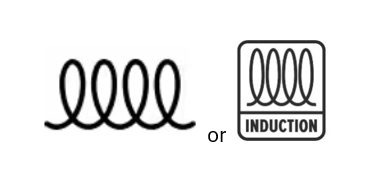
- The product box or webpage may also have information informing compatibility, such as the materials used – look for “Cast iron”, “Enamelled cast iron”, “Ferritic stainless steel”, “Stainless steel 430 / 409 / 400-series”, and/or induction compatible cookware symbols (see below).
2-Layered vs single material cookware
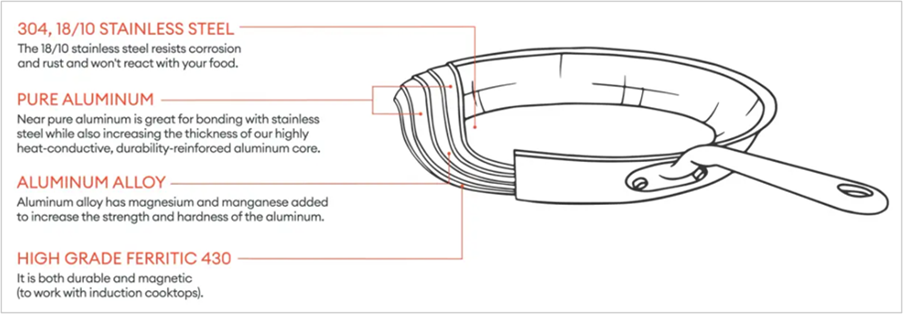
Layering or cladding is a cookware construction technique which involves layering different metals and bonding them together and can offer advantage over pans made of a single material. As different metals have different pros and cons, combining them enables cookware to offer the best performance characteristics of each material while mitigating disadvantages.
For example, a common layered construction sees aluminium or copper layered between sheets of stainless steel. Stainless steel is durable, retains heat well, is not reactive (e.g. with acidic foods), has high strength, and crucially for induction cooking, some grades are ferromagnetic. However, stainless steel does not heat quickly. In contrast, aluminium and copper are very responsive to temperature change but are not induction compatible and react to acidic foods.
The cookware industry used different terms to describe how pans are layered and understanding these terms can help inform the selection of quality cookware.
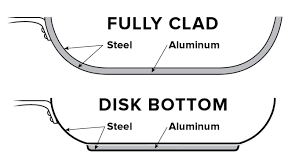
- Fully clad. The entire body of this type of cookware is layered, both the bottom and the walls. This construction is common in higher-end cookware and tends to give more even heating up the sidewalls—useful for frying/ sautéing where even heat spread and temperature stability beyond the very centre is particularly important. These qualities are not so important for saucepans / stockpots used mostly for boiling or simmering.
- Disc bottom/disc clad. This type of cookware has a disc of layered metals adhered just to the bottom of the pan (see image below). While these pots are cheaper than fully clad, they are typically not as durable and as the walls are not clad, food at the edges of the pot can cook faster and potentially burn. Generally these pots are fine for boiling or steaming, but less suitable for frying pans and sauté pans where even heating is more important.
- Single ply. These pans are made of one material (i.e. not layered) and therefore will have the particular strengths and weakness of the material used.
How to check pot composition (i.e. if a pan is layered)
- Layered pans. Check product box/webpage listing for any of the following phrases indicating layered compositions:
- ‘Fully clad’, ‘clad’, ‘tri-ply’ (i.e. three layers), ‘5-ply’ (note 5-ply is not necessarily better than tri-ply), ‘multi-ply’, ‘magnetic stainless exterior’.
- Disk bottom pans typically have a seam or ridge around the exterior of the pan where the base had been attached to the pan. Fully clad pans do not as the layering goes all the way up to the rim of the pan. Disc bottom pans may also be described as ‘tri-ply bottom’ or with “’a fully clad base’.
3-Flat bottom and size match
Induction stove cookware should have a flat, smooth bottom that makes good contact with the top of the induction stove for efficient, even heating. Where uneven pan bottoms cause gaps in contact, there is some drop off in performance although this issue has less of an effect with induction stoves compared to other electric cooktops, such as infrared stoves and hotplates.
The pan base should also be a similar size to the induction stove cooking zone. If the pan’s base is much smaller, the pan may not be detected by the stove. If it is much larger, uneven heating can occur due to magnetic coupling only occurring in the part of the pan in contact with (or very close) to the induction stove cooking zone.
How to check:
- Make sure the pan doesn’t rock or wobble on the induction cooktop glass
- Check the base of the pan for any dents or signs of warping.
- Measure the diameter of the induction stove cooking zone (often marked on the top of the stove) and then the cookware base
4-Other potential signals of build quality
The following are other potential indicators of good quality cookware which may be found through visual inspection.
- Check for solidly riveted or well-welded handles which can indicate durability
- Check any lid provided is snug fitting to minimise heat loss.
- Check if a warranty is provided and its length
- Check packaging has specific details on usage such as care instructions and the precise temperature the cookware is oven safe to use at. Packaging without instructions or with vaguer claims such as ‘oven-safe’ (i.e. without a maximum temperature specification) may indicate less rigorous testing or a sign of a manufacturer leaving themselves leeway in case performance is uncertain under different conditions (e.g. rough use).
- Where possible, check online reviews for brand service reputation and repeated buyer complaints – e.g. reports of warping, hot spots, or loud buzzing are usually strong negatives.
Conclusion and limitations
Overall, these non-technical guidelines for assessing the quality of induction cookware are intended to be a companion piece to the earlier MECS blog and help buyers with selecting good quality induction cookware and support the sustainability of broader, scaled eCooking interventions. While there are some limitations to the use of some of these guidelines, particularly as manufacturers often do not give details of cookware construction materials on websites or labels, it is believed that the guidelines as a whole should provide useful insights for customers and bulk procurers. The blog is intended to be a working document and feedback and any suggestions for refining the document are warmly welcomed.
***************************************************************************************************************
Featured Image (Top): Stainless steel pot on induction hob. Image by Freepik (www.freepik.com)