
By Dr. Simon Batchelor OBE (Gamos Ltd. / Loughborough University).
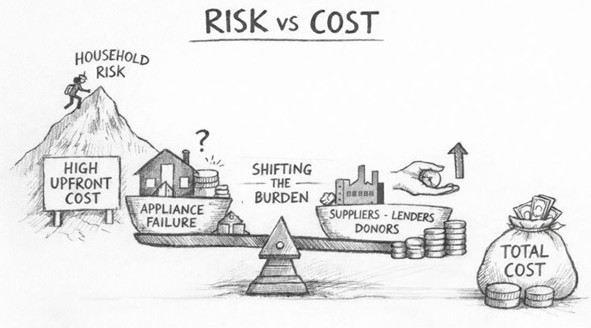
This is the second blog in a short series examining the challenge of upfront costs in electric cooking. In the first blog, I argued that the principal barrier to scale is not long-run affordability, but who carries the ‘risk’ at the moment of purchase. Price reductions matter only to the extent that they reduce this risk for households. In this context, risk is the chance that upfront payments do not translate into realised economic and welfare benefits for the household. Crucially, the same risk can be far more hazardous to a low-income household than to a supplier, utility, or donor, even when the likelihood and magnitude of loss are identical, because their capacity to absorb and recover from loss differs.
Credit mechanisms address the same challenge from a different direction: rather than lowering the price, they spread payment over time. However, credit does not eliminate risk; it reallocates it among households, suppliers, lenders, utilities, donors, and in some cases carbon buyers. Risk is shifted to another party when that party absorbs the financial loss or downside if the appliance underperforms, is not used as expected, or payments are not completed, rather than the household bearing those consequences. Understanding how different credit models price and distribute this risk is therefore central to designing financing approaches that enable adoption rather than merely deferring failure.
Where Blog 1 focused on lowering prices by shifting risk, this blog examines how credit can produce a similar effect although often at the cost of higher total expenditure through interest, fees, and enforcement. From an economic perspective, credit does help overcome the lump sum upfront payment, but discussions rarely make explicit who bears the downside risk if an appliance fails, is under-used, or under-performs. Different credit models allocate that risk in markedly different ways.
The diagram accompanying this blog frames consumer credit mechanisms along two dimensions: the level of risk borne by households at the point of adoption, and the effect on total lifetime cost once interest and fees are included. Credit reduces the upfront risk faced by households, but leaves them exposed to longer-term repayment obligations and debt risk. As a result, the same mechanism that unlocks adoption where cash purchases fail often does so by increasing total lifetime cost, reflecting the price of carrying and managing risk. Understanding this trade-off is essential for designing financing models that support households without imposing disproportionate long-term burdens.
Structurally, the diagram’s horizontal axis represents total lifetime cost, from lower cost on the left to higher cost on the right, while the vertical axis represents household risk at the point of adoption, from high risk at the bottom to lower risk at the top. Movement up the diagram reflects risk being shifted away from households and onto suppliers, lenders, utilities, donors, or governments. Each quadrant therefore represents a distinct answer to a single underlying question: who carries the risk when a household takes its first step into electric cooking?
PAYGO: supplier-led credit and concentrated risk
Pay-as-you-go (PAYGO) models place much of the upfront risk with the supplier. The provider finances the appliance, installs it, and recovers costs gradually through payments linked to usage or time. If the household stops paying, the supplier bears the risk of default, repossession costs, and asset depreciation. This risk is priced into PAYGO business models through higher effective interest rates, lock-in mechanisms, or control over the device itself. PAYGO has proven effective in accelerating access where households lack savings or formal credit histories, but it is capital-intensive for suppliers and vulnerable to shocks that disrupt repayment. Analysis of the solar product sector shows that repayment of PAYGO is challenging. In practice, PAYGO often requires concessional capital, guarantees, or blended finance to remain viable at scale, meaning that some risk is ultimately absorbed by investors or donors rather than eliminated. PAYGO 2.0 suggests focusing on the loan aspect of the product more than the appliance.
Similar to PAYGO but subtly different is Retailer-led hire-purchase and instalment sales which represent a more formal and regulated alternative to PAYGO. Like PAYGO the appliance retailer offers repayment in instalments and may retain ownership until the final payment is made, however there is no control over the device. In this model, credit risk sits with the retailer rather than a financial institution, and costs are often embedded in the retail price or margin rather than charged explicitly as interest, sometimes bundled with warranties and after-sales service. While total lifetime cost may still be higher than a cash purchase, the combination of trusted retail relationships and product support makes this mechanism economically and behaviourally distinct from PAYGO and worth treating separately in policy design.
Layaway or “save-then-buy” schemes offered by retailers provide a lower-risk alternative to hire-purchase, allowing households to make incremental payments while the appliance remains with the seller until fully paid. Unlike instalment sales, layaway avoids interest and credit risk entirely, but delays access to the appliance and leaves households carrying the risk that the eventual purchase will meet their needs.
Indeed Appliance leasing or service-based models take a different approach by separating access from ownership, with the provider retaining ownership of the appliance and households paying a regular service fee that typically includes maintenance and replacement. In this model, popular in India, technology performance and obsolescence risk sit largely with the provider rather than the household, reducing upfront and operational uncertainty but often increasing total lifetime cost. Leasing can be attractive in urban or rental settings and for households wary of appliance failure, but its viability depends on strong service delivery and clear regulation to prevent open-ended or opaque pricing.
Banks and MFIs: pricing risk into interest rates
Formal lenders approach the problem differently. Banks and microfinance institutions typically do not want technology performance or usage risk; they price borrower risk instead. Interest rates reflect expected default rates, transaction costs, and the absence of collateral. For many low-income households, this leads to high interest rates or exclusion altogether. From the household’s perspective, credit may ease the upfront payment but increase total financial exposure. From the lender’s perspective, electric cooking appliances are unfamiliar assets with limited resale value, making them unattractive without guarantees or subsidies. Where banks do lend, they are often responding not to the appliance itself but to external risk-sharing arrangements—credit guarantees, interest rate subsidies, or on-bill repayment mechanisms that lower collection risk.
Mobile-money nano-credit and other forms of digital credit offer short-term, algorithmically priced loans that can be accessed instantly through mobile wallets and are increasingly used to finance appliance purchases or top up existing repayment plans. While these products reduce transaction friction and bypass traditional collateral requirements, they often carry very high effective interest rates and opaque fee structures, shifting substantial risk back onto households. When layered on top of other finance mechanisms, digital credit can amplify repayment stress through credit stacking, making it a particularly important risk to monitor in electric cooking programmes.
SACCOs: social collateral and embedded trust
Savings and Credit Cooperative Organisations (SACCOs) sit somewhere between informal and formal finance. They rely on social collateral, peer monitoring, and long-term relationships rather than asset-backed security. In many contexts, SACCOs are better placed than banks to finance eCooking appliances because they understand household cashflows and can align repayment schedules with income patterns. The risk, however, is borne collectively: defaults affect the savings of other members. This makes SACCO-based finance politically and socially sensitive, but also potentially powerful where trust is high and technology performance is reliable. For donors and governments, supporting SACCOs may represent a relatively low-cost way to mobilise credit, provided technical risk is reduced through standards, warranties, and after-sales support.
Related to SACCOs are rotating savings and credit associations (ROSCAs), in which members contribute regularly and receive a lump sum in turn, funded entirely from group savings rather than interest-bearing loans. These arrangements do not increase lifetime cost but reallocate timing risk instead, and are particularly important in contexts where formal cooperatives are weak but women’s savings groups and informal collective finance are strong.
Utilities and on-bill finance: shifting risk through infrastructure
Utility-led credit and on-bill financing shifts risk again. By tying repayment to electricity bills, utilities reduce collection costs and default risk, but they also assume political and regulatory constraints on enforcement. In many jurisdictions, disconnection for non-payment is limited or socially contested, meaning that appliance finance can quickly become a quasi-fiscal obligation. Utilities may justify this risk where increased electricity demand improves asset utilisation and long-term revenue, particularly in the context of large public investments in grid expansion. From a policy perspective, this only makes sense where the present value of additional demand exceeds expected losses and where regulators recognise appliance finance as part of a managed demand strategy rather than a social subsidy by another name.
Donors, RBF, and carbon: absorbing risk that markets avoid
Results-Based Finance (RBF) and carbon-linked approaches address credit risk indirectly by reducing the amount households need to borrow in the first place. By paying after verified outcomes, continued use, emissions reductions, or service delivery, donors and carbon buyers absorb performance and usage risk that neither households nor lenders are willing to take. In effect, these mechanisms convert uncertain future public benefits into partial upfront capital. For credit markets, this de-risking can be decisive: smaller loans, lower default exposure, and improved affordability. However, RBF and carbon do not eliminate risk; they relocate it to donors, carbon buyers, and project developers, who must manage verification costs, delivery uncertainty, and price volatility. Their effectiveness therefore depends on careful design and realistic expectations about what can be monitored and claimed.
The upper-left quadrant shows a different route to lower household risk without increasing total cost: credit de-risked by public or donor intervention. Credit guarantees, concessional loans, and blended finance reduce the cost of capital faced by suppliers and lenders. Lower interest rates mean households can spread payments over time without paying significantly more overall. Results-Based Finance and carbon-linked approaches can play a similar role by reducing the amount households need to borrow in the first place. In these cases, donors and carbon buyers absorb performance and usage risk in pursuit of public goods such as health improvements, emissions reductions, or energy system efficiency.
Employer-based credit and payroll deduction
Employer-based finance offers another, often overlooked, credit pathway, in which appliances are financed through employers and repaid via payroll deduction. Because repayment is tied to employment income, default risk is anchored with the employer rather than the household, allowing interest rates to be modest or even zero and often resulting in a lower total lifetime cost than PAYGO or microfinance. This model is particularly relevant for public-sector and institutional workforces, such as teachers, nurses, and civil servants, and can have wider spillover benefits where cooking is also required in schools, clinics, or other public facilities. This was an approach that Umeme Uganda took to start encouraging eCooking appliances.
The danger zone: high risk and high cost
The lower-right corner of the diagram represents the worst outcome: high-cost, informal credit. Moneylenders and unregulated hire-purchase schemes offer rapid access with minimal checks, but at extremely high interest rates and harsh repayment terms. And they too have gone digital. Here, households face both high financial risk and high total cost. These arrangements may enable short-term adoption, but they undermine welfare and can damage trust in electric cooking technologies more broadly. From a policy perspective, this quadrant defines what should be avoided.
Credit works when risk is deliberately allocated, not ignored
The lesson from credit mechanisms is the same as from price reductions. Uptake depends not on whether finance exists, but on who carries the risk when something goes wrong. PAYGO concentrates risk with suppliers; banks price it into interest rates or avoid it; SACCOs socialise it; utilities internalise it as part of system planning; donors and carbon markets absorb it in pursuit of public goods. No model is inherently superior. Each reflects an explicit or implicit decision about which actor is best placed to bear uncertainty and why.
The policy challenge, therefore, is not to ask whether households should borrow, but whether the risks they face in doing so are proportionate to their capacity to absorb loss. Credit can enable the first step into electric cooking, but only where technology quality is assured and where risk is consciously shifted to actors with the mandate, balance sheet, or incentive to manage it. As with price reductions, the question that ultimately determines scale is simple but uncomfortable: who is willing to pay—or carry the risk—before the benefits materialise?
Credit is does not necessarily mean low cost. It is a mechanism for reallocating risk across actors with different capacities to absorb loss. When designed well—supported by guarantees, standards, and reliable technologies—credit can enable households to adopt electric cooking without bearing unacceptable risk. When designed poorly, it shifts risk back onto households through high interest rates and punitive terms, raising total cost and undermining trust.
Indeed as someone who talks a lot about the fuel stacking of households for cooking, a cross-cutting risk that cuts across all credit models is credit stacking, where households simultaneously draw on multiple finance sources such as PAYGO, SACCO loans, and mobile nano-credit. Because each lender typically assesses risk in isolation, total household exposure is underestimated, allowing repayment stress and default risk to compound invisibly.
Debates often focus on whether households can “afford” appliances, measured by monthly repayments. The more important question is whether households are being asked to carry risks that they are least able to manage. Effective interventions are those that align risk with capability: suppliers who understand technology risk, utilities that benefit from increased demand, donors seeking public goods, and governments managing long-term system outcomes.
Seen this way, credit is neither good nor bad. It is simply one tool among many for enabling the first step into electric cooking. Its success depends on where it sits in the cost–risk landscape—and on whether the long-term benefits justify who is asked to pay, and when.
………………………………..
Figure, top: credit mechanisms mapped for risk and total cost. (Author 2026).
AI used to tighten text and produce second figure.