- Date
- 13th May 2026
- Categories
- Scaling eCooking
By Dr. Simon Batchelor OBE (Gamos Ltd. / Loughborough University).
Our colleagues, Yesmeen and Matt, wrote a blog last week on how the global energy supply disruptions are exposing the vulnerability of clean cooking fuels. Also on the price spike our colleague Michelle Hallack wrote a piece back in late February about the price spike caused by the conflict involving Iran and the United States, and pointed to three key implications:-
- “The global liquid petroleum gas (LPG) price surge since late February 2026—driven by conflict and supply disruptions—has revealed vulnerabilities in access to clean cooking fuels, leading to fuel switching among households.
- Policy responses must balance short-term interventions like targeted subsidies and stabilization funds with long-term, resilient frameworks that ensure supply security, targeted technological neutral consumer support, and diversification of clean cooking technologies.
- A multifuel approach—including electric cooking and biogas—supported by robust regulatory and infrastructure ecosystems, is essential for building durable, affordable, and trusted clean cooking solutions capable of withstanding global market shocks.” (Hallack, ESMAP 2026)
Finally as part of this introduction, in the joint African Energy Commission–MECS report Sustainable Scaling: Meeting the Clean Cooking Challenge in Africa we explicitly pointed to India’s LPG programme as one of the most important global case studies, demonstrating how strong policy, distribution systems, and targeted support can rapidly scale access to modern cooking. That lesson, set in a multifuel strategy, is said in the report to be relevant to Africa and to show that scale is possible with enough financial commitment.
However, that financial commitment is now being tested. The case study success of India was built on a particular system of price control and India’s response to the recent LPG price spike offers a revealing window into how governments manage energy security. For India the political economy of cooking energy means that rather than allowing international price volatility to pass through to households, the Government of India has largely chosen a laudable approach to hold domestic LPG prices steady. On the surface, this looks like a continuation of the long-standing policy: LPG has been subsidised, in various forms, for decades as part of a broader strategy to promote cleaner cooking and reduce reliance on biomass.
This is great for the people but comes at a significant fiscal cost. Before the recent price spike, India’s LPG support was already substantial. When explicit subsidies, compensation for under-recoveries, and implicit pricing support are combined, the effective fiscal and quasi-fiscal support associated with LPG affordability may reach several hundred billion rupees annually. This reflects both direct transfers such as those linked to the Pradhan Mantri Ujjwala Yojana and implicit support through pricing decisions. Even in relatively stable global energy markets, maintaining affordability for over 300 million LPG consumers is a major fiscal undertaking.
The current price spike has added a new layer of pressure. India imports a large share of its LPG, and global benchmark prices have risen sharply amid concerns about supply constraints through the Gulf. In a fully liberalised market, this would translate into higher cylinder prices for households. Instead, India has opted to smooth the shock. Domestic LPG prices have remained broadly stable, while the gap between import parity prices and retail prices has widened. That gap has to be absorbed somewhere—either through the fiscal budget or through under-recoveries borne by state-owned oil marketing companies.
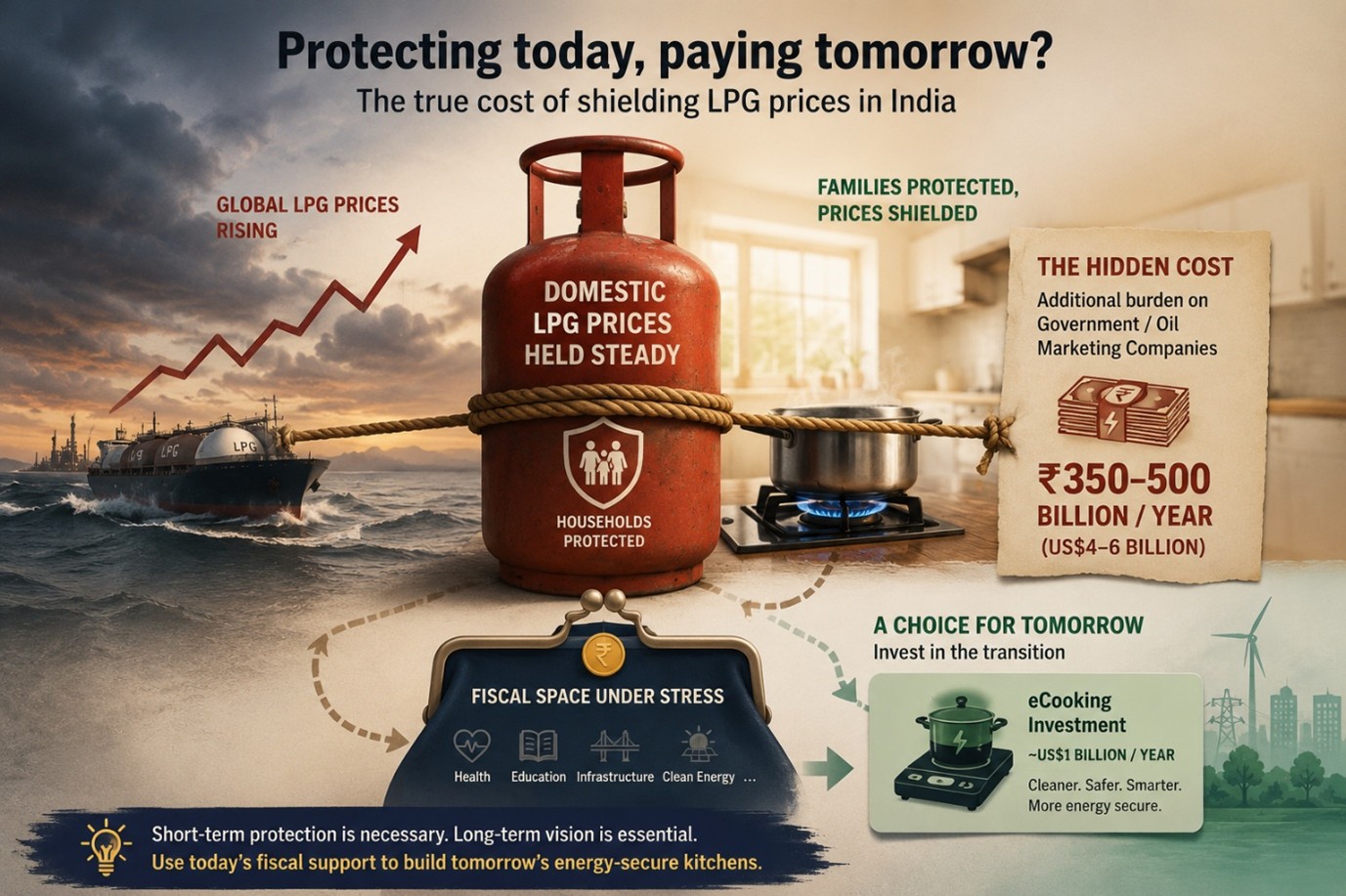
Some recent fiscal analyses and market commentary suggest that the total cost of holding fuel prices below market levels across petrol, diesel, and LPG, if it carries on for 12 months, could be on the order of US$25–30 billion annually (₹2.1–2.5 trillion) in the current environment. While LPG is only one component of this, it is a politically sensitive one, and therefore likely to receive a disproportionate share of protection. If LPG accounts for a similar share of this incremental burden as it does of baseline subsidies, a rough proportional estimate would imply the need for an additional ₹350–500 billion (US$4–6 billion) per year in LPG-related support. In effect, India may now be committing well over ₹1.1–1.3 trillion (US$13–16 billion) annually to keep LPG affordable.
Can African countries, even oil producing ones, afford to cover such fiscal commitments?
There is also an important structural nuance. Not all of this support appears as a line item in the government budget. A portion is absorbed by oil marketing companies as “under-recoveries” losses incurred when they sell fuel below cost. These losses may eventually be compensated by the government, but often with a lag, and sometimes only partially. In parallel, commercial LPG users, restaurants, hotels, and small businesses have seen in India much sharper price increases. This creates a form of cross-subsidisation, where non-household users bear part of the burden of protecting residential consumers.
From a policy perspective, this raises two sets of issues. The first is fiscal sustainability. Energy subsidies of this magnitude are not trivial, particularly in a context where governments are also trying to invest in infrastructure, social protection, and energy transition. The second is strategic direction. India has, in recent years, made significant progress in expanding electricity access, improving grid reliability, and promoting efficient electric appliances including induction cooking and electric pressure cookers. Yet the current response to global price shocks reinforces dependence on LPG, effectively insulating consumers from price signals that might otherwise encourage a shift toward alternative cooking solutions.
Proposition: As tensions in the Strait of Hormuz ease and oil prices hover around $100 per barrel, this may be an opportune moment for India to reconsider the scale of its fiscal exposure. Had prices remained above $100, India might have needed to find an additional US$4–6 billion per year to sustain LPG support. If that upper-end pressure now begins to recede, could the government instead consider allocating, say, US$1 billion annually, to accelerate the transition to eCooking?
This is not to argue that the government should change its approach of holding the price steady for the consumers and simply pass through price increases to households. Cooking is a basic need, and affordability matters. The situation perhaps cannot be adjusted during the immediate crisis. I also know that budget decisions within governments are not simple. But it does highlight a tension that is becoming increasingly visible across many countries: the more governments invest in shielding consumers from fossil fuel price volatility, the harder it becomes to create space, fiscally and politically, for a transition to modern, electricity-based cooking.
There are many ongoing initiatives taken by the Government of India and partners on eCooking in India even before the price spike. But even as the case for electrification strengthens from efficiency gains to climate considerations the immediate priority remains keeping LPG within reach. This price shock is a signal of the underlying inertia in modern energy cooking systems. If Africa wants to learn from India’s experience of getting to scale with LPG, Africa should perhaps not just consider their upfront investments but also consider the fiscal implications with the uncertainties of the oil price and prioritise building energy secure systems.
The question is about looking ahead. Moments like this can be used to reflect on the ‘what ifs’ and either accelerate a shift in that balance or continue to reinforce it?
…………………………….
Featured image credit: AI generated image from prompt by S. Batchelor.
AI disclaimer: Human led draft, AI used to tighten paragraphs.