- Date
- 1st June 2026
- Categories
- Announcement, electric cooking, General, Launch
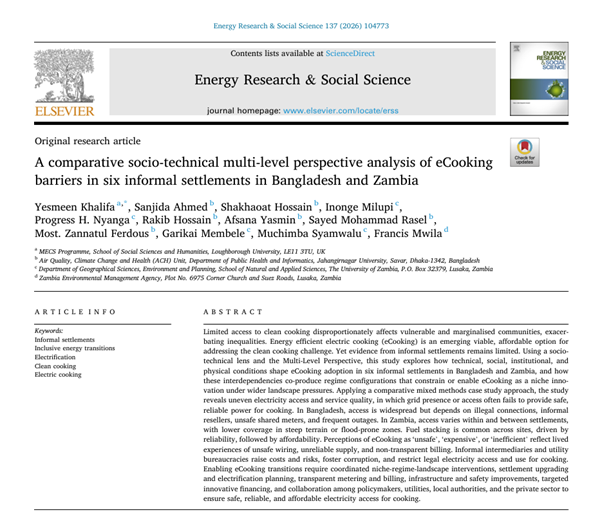
A new paper, ‘A comparative socio-technical multi-level perspective analysis of eCooking barriers in six informal settlements in Bangladesh and Zambia’, has been published in Energy Research & Social Science. This paper is a collaborative publication funded by UK-Aid FCDO, bringing together researchers from the Modern Energy Cooking Services (MECS) programme at Loughborough University, Jahangirnagar University (Bangladesh), the University of Zambia, and the Zambia Environmental Management Agency.
Achieving universal access to clean cooking depends on solutions that are clean, affordable, safe, reliable, and responsive to local realities. Energy-efficient electric cooking (eCooking) is increasingly recognised as a promising option for accelerating clean cooking transitions, yet evidence from informal settlements remains limited. This paper addresses this gap by examining eCooking barriers and opportunities in six informal settlements in Bangladesh and Zambia.
Using a socio-technical lens and the Multi-Level Perspective, the paper explores how electricity access, housing conditions, infrastructure, governance arrangements, cooking practices, and user perceptions interact to shape the feasibility of eCooking. The findings show that electricity access alone is not enough. In Bangladesh, many households have access to electricity, but this often depends on illegal connections, informal resellers, unsafe shared meters, and frequent outages. In Zambia, access varies within and between settlements, with lower coverage in areas affected by difficult terrain, flooding risks, or weak infrastructure. Across the study sites, fuel stacking remains common, mainly driven by reliability concerns and affordability pressures.
The paper highlights that perceptions of eCooking as unsafe, expensive, or inefficient are linked to people’s lived experiences of unsafe wiring, unreliable supply, and non-transparent billing. It argues that enabling eCooking in informal settlements requires coordinated action across policy, infrastructure, markets, and community engagement. Key recommendations include integrating informal settlements into electrification and clean cooking planning, improving safe and legal electricity access, strengthening transparent metering and billing systems, upgrading infrastructure, supporting targeted financing for energy-efficient appliances, building local repair and supply chains, and ensuring that women, people with disabilities, and marginalised groups are involved in decision-making from the earliest stages.