- Date
- 24th September 2025
- Categories
- Electric Cooking, Health, Metered Methodology
By Professor Matt Leach and Malcolm Bricknell (Modern Energy Cooking Services)
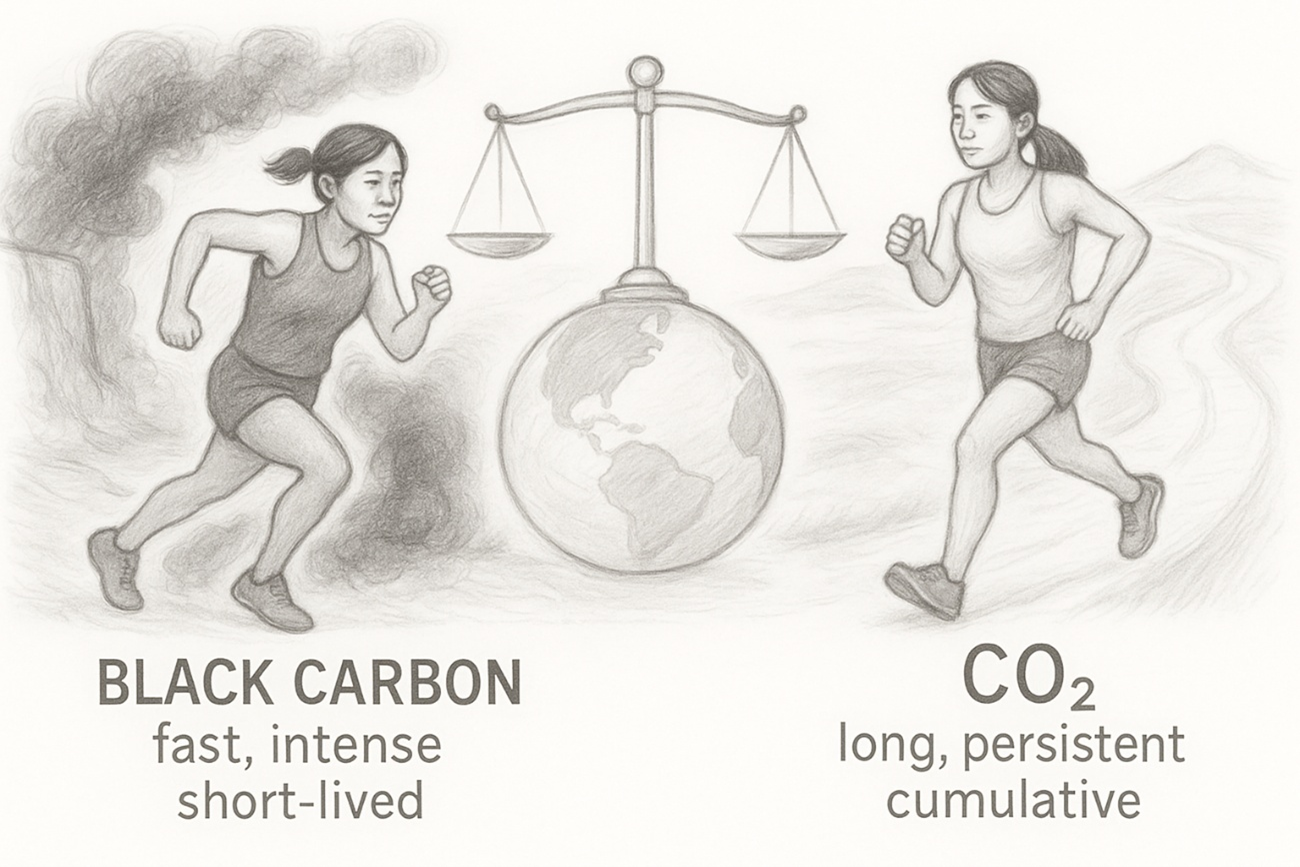
This blog is part of a body of work on black carbon. We think it’s an important contribution to future carbon finance, but in this particular blog we try to explain why black carbon as a short-lived climate forcer cannot simply be put in terms of equivalent CO2. Indeed BC is like a sprinter, while CO2 is a marathon runner – best not to compare their performances as they each have important but different impacts. Indeed, the core value of addressing BC is that as a super-pollutant it offers important ‘now’ benefits for avoiding climate ‘tipping points’.
MECS has just released a new draft methodology to include black carbon emissions reduction in clean cooking carbon credit projects, through work undertaken with us by Berkeley Air Monitoring and Orbis Consulting. Some readers may be surprised that the methodology doesn’t put BC into the common terms of carbon dioxide equivalent, or CO2e.
When we talk about climate change, carbon dioxide (CO₂) is usually the villain of the show. It’s long-lived, well-mixed in the atmosphere, and the central metric by which we track national targets, corporate footprints, and international agreements. To make comparisons easier, climate scientists and policymakers often translate the effect of other greenhouse gases into their “CO₂ equivalent” allowing methane, nitrous oxide, and others to be expressed in a common currency.
But when it comes to black carbon – the sooty particles released from incomplete combustion of fossil fuels, biomass, and biofuels, including from the use of traditional firewood and charcoal cookstoves – the story gets much more complicated. Unlike methane or nitrous oxide, black carbon does not fit neatly into the CO₂-equivalent framework. And trying to force it into that mould raises both scientific and policy concerns.
The Nature of Black Carbon
Black carbon is a short-lived climate forcer. It persists in the atmosphere for only days to weeks, far shorter than CO₂, which can linger for centuries. Yet during its brief lifetime, black carbon is extremely potent: it absorbs sunlight, warms the atmosphere directly, and darkens snow and ice when deposited, accelerating melting.
Unlike CO₂, which has global impacts because it spreads evenly, black carbon’s effects are highly regional and context-dependent. Where it is emitted – and where it settles -can dramatically change its climate consequences.
Why CO₂ Equivalents are problematic
Using “CO₂ equivalent” implies that a tonne of black carbon CO2e can be fairly swapped with a tonne of CO₂. But this assumption runs into problems:
1- Time Horizon Mismatch
CO₂ is a marathon runner; black carbon is a sprinter. Converting black carbon’s impact into CO₂ terms depends on what time frame you use (eg 20 years vs. 100 years), and that choice drastically alters the numbers. A tonne of black carbon may look enormously powerful on a 20-year scale. much less so over a century, and very weak in the long term .
2- Regional vs. Global Effects
CO₂’s impact is globally averaged. Black carbon’s warming depends on whether it lands on snow in the Himalaya, circulates over oceans, or hovers in the atmosphere. A “global equivalent” number risks erasing these crucial differences.
But surely the whole point of using a metric such as CO2 equivalent is all about integrating these differences so we can ‘fairly’ compare the impact of any specific emission of a substance with CO2 impact, on some standard basis? For the regional impact point, the key is to use scientifically rigorous models that can estimate the global impact of such localised effects, and this is a part of the new draft methodology we have developed.
The time horizon mismatch issue is more challenging. Yes, with suitable analysis of the relative effects over a stated timescale, eg 100 years, plus conservative assumptions to reflect uncertainty, a CO2 equivalent can be calculated. But the climate forcing effect of BC continues to fall with time, so even if we calculate that BC reduction efforts will give us an equivalent impact to CO2 over, say, 100 years, the benefits of the BC reduction beyond that 100 year point will be lower than for CO2. So, a climate mitigation plan relying heavily on BC and other short-lived pollutants could see a resurgence of climate heating in the longer term.
The flip-side of this short-lived effect is that BC and other so-called super-pollutants may offer enormously important benefits for avoiding climate ‘tipping points’: critical thresholds in Earth’s systems that, when crossed, trigger abrupt, large-scale, and often irreversible changes to systems like ice sheets, rainforests, or ocean currents, with potentially devastating global consequences. However, the science and modelling linking emissions to such tipping points is exceptionally challenging, and it’s not yet possible to quantify this benefit in a useful way.
In practical terms, this timing mismatch gives rise to:
3- Fungibility Concerns
Treating black carbon and CO₂ as interchangeable commodities may create perverse incentives. For example, a company could claim credit for reducing black carbon emissions in one place while continuing to emit long-lived CO₂ elsewhere. As another example, a project that reduces BC emissions by adding particulate ‘traps’ (ie filters) to the exhaust of diesel trucks might produce higher CO2e reductions (on the standard 100-year basis) than an alternative project of improving engine efficiency, although would release higher levels of CO2.
Treating short-lived pollutants and CO2 emissions as fungible in climate planning, in policy development and in carbon credit markets could undermine long-term decarbonisation efforts, since removing long-lived greenhouse gases (notably CO₂) remains the only way to stabilise global temperatures in the long term.
Policy Implications
There’s no doubt that reducing black carbon has major benefits: it cuts near-term warming and improves air quality and human health. But the challenge is framing those benefits responsibly. Instead of squeezing black carbon into CO₂-equivalent accounting, many experts argue for parallel metrics – reporting black carbon reductions separately while highlighting their climate and health co-benefits.
This approach avoids the risks of fungibility while still recognising that black carbon mitigation is urgent and valuable. It prevents the potentially dangerous illusion that tackling black carbon can substitute directly for cutting CO₂.
The Way Forward
Addressing climate change requires a portfolio approach:
- Cutting long-lived gases like CO₂ to stabilise the climate in the long term.
- Reducing short-lived climate forcers like black carbon to slow near-term warming and protect vulnerable regions.
But we shouldn’t pretend they are simply interchangeable. Black carbon and CO₂ operate on different clocks, in different spaces, and with different consequences. Clear, differentiated metrics can help policymakers design strategies, and help markets to value the range of a project’s benefits, respecting those differences, while still maximising climate and health gains.
So this is why our recently released report and draft BC methodology (and accompanying blog) does not pursue CO2 equivalence and instead presents temperature reduction as a metric. However, the analysis undertaken for that report did explore the CO2e values for the two illustrative projects; those can be found in a MECS policy brief discussing the issues raised here.
Our BC work has a second phase which has just started, and is due to complete in Spring 2026, aiming to refine the draft methodology so it is ready to submit for formal development as an adjunct to the Gold Standard metered methodology for carbon credits, with BC emissions reduction as an important SDG impact co-benefit. Phase 2 will include deeper consultation with both climate scientists and market participants, seeking to reflect the latest thinking and ensure that our new methodology fully reflects the value of black carbon in clean cooking transitions.
***************************************************************************************************************
Footnotes:
Featured Image in this blog is AI generated using ChatGPT.
AI was used to formulate the structure of this output.