These pages aim to assist a wide range of users, including policymakers, utilities, modellers, researchers, NGOs, and practitioners, in scaling access to electric cooking, by providing an overall guide to the different types of models and tools and making available a series of tools developed and offered by MECS.
There are a variety of quantitative models and tools available which either focus on or include clean cooking. The other pages in this folder present tools which MECS have produced or commissioned. Each of these has been designed to meet a specific need or fill a clear gap.
The Implications Model for eCooking (TIMeC):
- Bottom-up tool starting from dishes cooked, to explore effect of multiple parameters on costs, GHG emissions, polluting emissions, time spent and grid load
Visualisation of Key Data and Decision (VKDD):
- Rapidly develop a simple representation of a project for cost savings, time savings, health benefits, and climate impact
Cost-Benefit Model for Clean Cooking in the Carbon Markets:
- Help potential project developers explore project feasibility under different scenarios.
Metered and measured Energy Cooking Devices calculator:
- Produce inputs for Project Design Documents, and to explore the potential for carbon credits for clean cooking
Cooking With Electricity: A Cost Perspective:
- Report of a modelling study developing eCooking case studies, with input data and cost of cooking results.
Beyond MECS’ own tools, the blog Planning for Electric Cooking: How Energy Models Turn Ambition into Action sets out the wider range of types of model and their uses, from the bottom up to the very top down integration of cooking and energy access into national economic planning. The blog gives links to key examples of each type of tool, available open source.
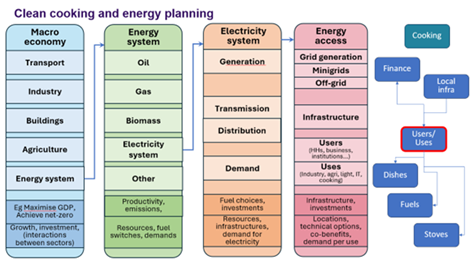
A Knowledge brief Integrating Clean Cooking into National Energy Access Planning Knowledge brief. Tools and Considerations for Planning and Implementing eCooking written by SEforALL and MECS delves more deeply into tools that inform energy access planning in low- and middle-income countries, addressing the integrated planning of clean cooking and electricity access.