- Date
- 10th June 2026
- Categories
- Behaviours
By Dr Rihab Khalid.
How do people cook, in practice? What dishes do they prepare, at what times of day, using which fuels and appliances, and under what everyday constraints? These questions may sound straightforward, but they have often been difficult to answer in cooking-energy research. For decades, clean cooking evidence has tended to sit between two methodological traditions. On one side, technical tests have produced valuable data on stove performance, efficiency and emissions, often under controlled conditions. On the other, surveys and qualitative studies have helped explain preferences, behaviours and social norms around cooking. What has often been missing is the link between the two: evidence that connects the details of how and what people cook with measured energy use.
This is the gap that the MECS Cooking Diaries Methodology (CDiM) was developed to address. My recently published paper, Measuring how people cook: A critical review of the MECS cooking diaries methodology, reflects on the development, application and evolution of CDiM across the MECS programme and related projects. The study draws on a structured scoping review and document analysis of CDiM protocols, reports, guidance notes and associated studies, alongside interviews with MECS researchers, country partners and field coordinators who were involved in designing, implementing and adapting the methodology.
From stove testing to everyday cooking
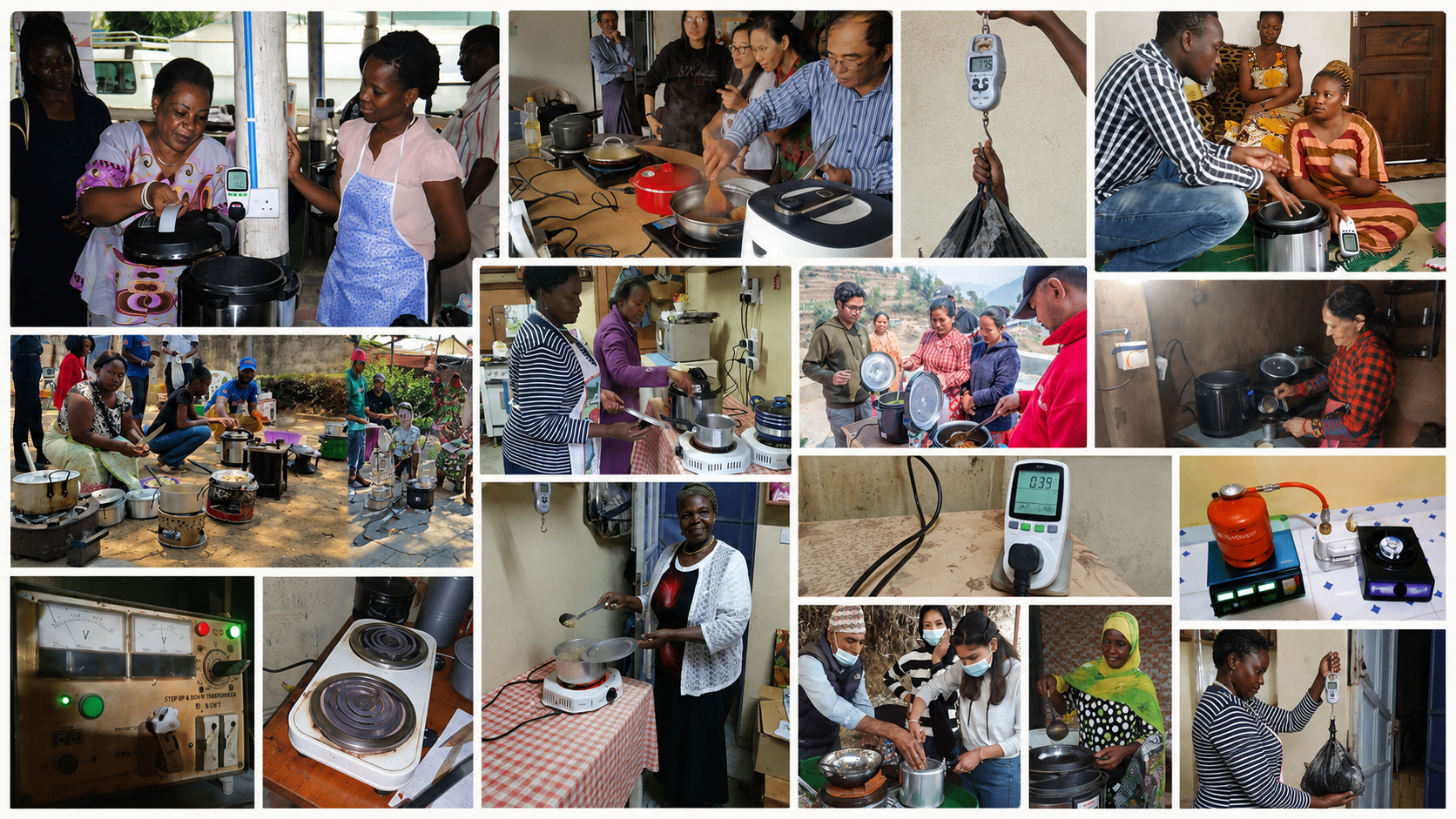
At its core, CDiM is a mixed-methods approach for capturing cooking as it happens in everyday life. It combines structured diary records of cooking events with direct measurements of fuel and electricity consumption. Participants record what they cook, how they cook it, which appliances and fuels they use, when cooking takes place, and how long it takes. These records are then linked to energy data, collected through actual weighing of fuels or through plug-in meters or dataloggers connected to cooking appliances, creating a meal- or dish-resolved account of cooking practices and energy demand.
This makes CDiM distinctive. It moves beyond asking whether a stove or appliance performs well in controlled test settings, such as laboratory-based evaluations or Controlled Cooking Tests (CCTs), towards understanding whether it fits into actual cooking routines. While CCTs provide valuable insights into stove performance under standardised conditions and Kitchen Performance Tests (KPTs) estimate fuel consumption under real-world use, CDiM links energy measurements directly to specific meals, dishes and cooking events. It also moves beyond general accounts of fuel choice by showing how choices vary across dishes, meals, appliances, household circumstances and infrastructures. In doing so, CDiM has helped make visible the relationship between cooking practices and energy systems.

The paper traces how CDiM evolved from early small-scale pilots into a more structured methodological framework over eight years of MECS research. Early applications of the methodology, including the eCook Cooking Diaries studies conducted across countries such as Kenya, Tanzania and Zambia, tested whether electric cooking could accommodate local cuisines and whether households could record detailed cooking data over time. These studies generated some of the first meal-resolved evidence on how people integrated electric appliances into everyday cooking practices, while also providing insights into energy consumption, cooking costs and appliance suitability for local dishes. Related outputs, including country-specific Cooking Diaries reports and studies on electric cooking compatibility, fuel stacking and cooking load profiles, helped demonstrate the value of capturing cooking at the level of individual meals and dishes.
These early applications generated important evidence, but they also revealed practical challenges: paper diaries were burdensome, transcription was time-consuming, metering could be difficult, and attributing energy use to specific dishes was not always straightforward. Later versions of the CDiM protocol responded to these lessons through more structured forms, clearer definitions, improved enumerator roles, digital data collection, stronger training, and more systematic use of metering and datalogging.
CDiM’s contribution to MECS and the clean cooking transition
Across MECS, CDiM has generated a rich socio-technical evidence base. It has supported realistic cooking load profiles, appliance- and fuel-specific energy and cost comparisons, and grounded evidence on fuel stacking and transition dynamics. It has shown how electric cooking compatibility depends on dishes, cooking processes, appliance combinations, reliability, tariffs, household routines and wider infrastructures. This rich evidence-base is critical for households as well as for utilities, policymakers, appliance designers, mini-grid developers and clean cooking programmes seeking more realistic evidence on cooking demand.
The methodology has also informed public-facing and practical outputs, including the MECS eCookbooks, which translate evidence on local dishes, energy use and cooking costs into accessible resources for cooks, practitioners and decision-makers. It has also underpinned a range of MECS publications on topics such as the state of access to modern energy cooking services, e-cooking appliance adoption, mini-grid demand assessment, and national cooking-energy transitions. In this sense, CDiM has helped bridge research, implementation and engagement. It has created a way of speaking across technical, policy and social domains without reducing cooking to stove performance or individual behaviour alone.
My interviews with key informants involved in the design, implementation and adaptation of the methodology also highlighted that CDiM should not be treated as a simple monitoring tool. Its strengths come with demands. It requires careful study design, motivated participants, trained enumerators, robust data management and context-sensitive interpretation. It can generate large and complex datasets, and its findings need to be read with attention to sampling, participant burden, measurement reliability and the limits of comparability across sites. The methodology is strongest when used as an intensive, case-based socio-technical method rather than a light-touch survey instrument.
A key lesson is that the future of CDiM depends on strengthening both sides of its mixed-methods design. The quantitative outputs have been especially influential in producing energy-use estimates, cost comparisons and load profiles. The qualitative potential of the diaries deserves further attention, particularly for understanding gendered labour, intra-household decision-making, skills, convenience, risk, meanings attached to dishes, and the social organisation of cooking. These dimensions are essential for explaining why transitions unfold unevenly, even where a technology appears technically compatible.
Looking ahead
Looking ahead, CDiM has relevance beyond household electric cooking. MECS is already exploring adaptations for institutional and commercial kitchens, where cooking is organised around larger volumes, production cycles, staff roles, procurement systems and service times. More broadly, the logic of CDiM could inform energy planning, demand management, appliance design, nutrition research and social policy. It may also become increasingly important for carbon financing and carbon crediting in clean cooking, where credible claims depend on accurate energy measurement. By linking cooking events to measured fuel and electricity use, CDiM can support more transparent monitoring, reporting and verification, particularly where carbon methodologies need to move beyond assumptions about primary fuel use or average stove performance. Future development will also depend on stronger digital systems. The move towards digitised data collection, smart metering and datalogging already points in this direction.
For MECS, CDiM is one of the programme’s most significant methodological contributions. It offers a practical and rigorous way to capture cooking as a socio-technical practice, linking what people do in kitchens with the energy systems that support them. As clean cooking transitions continue to gain policy attention, CDiM provides a foundation for better evidence: evidence that measures cooking without stripping away the practices, meanings and conditions that make cooking what it is.
Read the full open access paper here.
………………………………………
AI disclaimer: ChatGPT was used to support the preparation of this blog, including assistance with language editing. All substantive claims, interpretation and final editorial decisions remain the author’s own.
Featured image, top: Collage of images from MECS Cooking Diaries and ECO project reports: Leary et al. (2018, 2019) and Sieff (2022).