- Date
- 10th November 2026
- Categories
- eCooking
By Dr. Simon Batchelor OBE (Gamos Ltd. / Loughborough University).
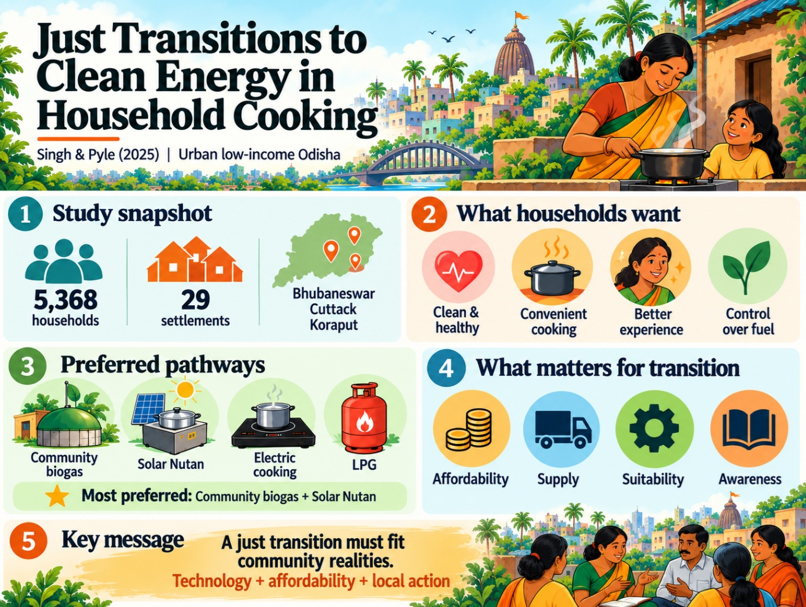
A 2025 paper by Neha Malhotra Singh and Katie Pyle provides an unusually detailed picture of cooking among low-income urban households in Odisha. Just Transitions to Clean Energy in Household Cooking draws on a survey of 5,368 households across 29 low-income settlements in Bhubaneswar, Cuttack and Koraput (India), alongside focus groups and co-creation exercises.
What makes the study particularly interesting is that these are not households waiting to enter the modern-energy cooking system. LPG is already deeply established. 67.5% of surveyed households reported cooking entirely with LPG, with others stacking LPG and firewood. Around 30% of LPG users were PMUY beneficiaries. The authors explain that 68% already had an LPG connection before PMUY began in 2016. Since households with an existing LPG connection were ineligible, many of these low-income households had entered LPG through the ordinary market before PMUY existed.
That prompted us to ask: having successfully moved onto LPG, might some of these households now be financially better off moving much of their cooking onto electricity?
There is of course more than one kind of LPG household. At the time of writing we did not have the underlying Singh–Pyle household database, although they have been kind enough to share on request. But for this blog, what follows is not a re-analysis of their survey. It is an illustrative calculation combining what can be extracted from the published paper with current Odisha tariffs, LPG prices and evidence on the energy consumption of electric cooking. The published findings reveal some complications when trying to understand the economics of LPG. PMUY status and receipt of an LPG subsidy are not the same thing.
Among the 1,299 PMUY households in the survey, 35% said they were receiving a subsidy. Among 2,418 non-PMUY LPG households, 26% also reported receiving one. Of the non-PMUY households able to state an amount, most reported only ₹1–16 per cylinder, (which seems very low?), while many PMUY recipients reported around ₹196–211. DBTL (“PaHaL”) is the direct benefit transfer system for LPG subsidies, launched earlier and “available to all LPG consumers”. The survey showed that of the non PMUY users 26% said they received a subsidy; 44% said they never received one; 4% said they had given it up; 12% were unaware that a subsidy might be credited to their bank account; 12% were unsure. We note that this tiny non-PMUY subsidy is very much a 2023–24 phenomenon (date of survey). Before 2020 ordinary PAHAL/DBTL consumers often received meaningful subsidies of roughly ₹100–300/cylinder, and in 2019–20 the difference between ordinary subsidised LPG and PMUY LPG was actually quite small. The general subsidy then largely disappeared around May 2020; the distinctive ₹200/₹300 PMUY refill subsidy came later, from 2022.
So while it could be argued that we should consider four groups of LPG user: PMUY households receiving the targeted subsidy; PMUY households not reporting receipt; non-PMUY households receiving a small subsidy; and non-PMUY households receiving none, the subsidy is so small that we are leaving it to one side. Also among the 1,299 PMUY users, only 460 (35%) said they were receiving a subsidy. So we consider two groups – households paying the prevailing retail LPG price and PMUY users with subsidy.
For illustration we model an established LPG household using eight 14.2 kg cylinders per year. This is deliberately a relatively intensive LPG user, consistent with a household doing nearly all its cooking with LPG, rather than the lower national average consumption among PMUY households. The national average is 4.47 refills a year for PMUY, and that perhaps reflects the stacking with fuelwood. Given our assumption the following results should not be generalised to all PMUY households: at the national PMUY average of around 4½ refills a year, the avoided LPG expenditure is much smaller and appliance payback correspondingly longer. The strongest initial market is therefore likely to be relatively intensive LPG users.
At current prices, that household (8 refills a year) spends around ₹7,700–7,800 per year on LPG before targeted PMUY support. In 2026 the additional PMUY subsidy is ₹300 on each of the first four refills, worth ₹1,200 per year to a household using four or more cylinders. Press Information Bureau
What happens to household expenditure if the intensive LPG users start cooking with electricity?
Odisha’s FY2026-27 domestic tariff is telescopic: ₹2.90/kWh for the first 50 units, ₹4.70 for 51–200, ₹5.70 for 201–400 and ₹6.10 thereafter. For the calculation we use ₹4.70/kWh as the marginal cooking tariff, representing a household whose existing electricity use already takes it above the first low-price block.
The recent India multi-fuel work gives us a much better empirical basis than just comparing nominal stove efficiencies. Across the tested Indian dishes, induction used roughly 59% of the input energy of LPG, infrared about 72%, while EPCs can save around 54% of the LPG energy requirement for suitable dishes. mecs.org.uk
We then apply three deliberately simple appliance packages to the modelling: an infrared hotplate at US$25 (about ₹2,400); an EPC at US$50 (about ₹4,800), assumed to prepare 70% of meals while LPG remains for the other 30%; and an induction package including suitable cookware at US$100 (about ₹9,600). 71 kWh/month for full induction, 88 kWh/month for infrared, and around 39 kWh/month of electricity for the 70%-EPC case.
Using that empirical evidence on the relative energy requirements of LPG, induction, infrared and EPC cooking, our central calculated monthly spend gives approximately:
| Existing LPG household | LPG now/month | Induction | Infrared | EPC 70% + LPG |
| PMUY + subsidy | ₹545 | ₹333 | ₹411 | ₹317 |
| Non-PMUY, no subsidy | ₹645 | ₹333 | ₹411 | ₹377 |
On fuel costs alone, therefore, all three electric options save money.
For the PMUY household actually receiving its subsidy, the saving is about ₹212/month with induction, ₹134 with infrared and ₹228 with an EPC covering 70% of meals. Against unsubsidised LPG, those savings rise to roughly ₹312, ₹234 and ₹268 per month respectively. Interestingly, Singh and Pyle themselves use an indicative ₹400/month electricity cost for induction cooking for a family of four, so these estimates are in the same broad range.
However, all these modern energy cooking users already have their LPG kit, does it make sense for them to pivot to electricity? They have to find the cash or borrowing for the appliance.
Odisha has a striking range of borrowing costs.
At one end is Mission Shakti, Odisha’s extensive women’s self-help-group system. Eligible SHG bank borrowing can attract an effective 0% interest rate, conditional on prompt repayment, because the state reimburses the interest. Mission Shakti That does not mean every individual member automatically receives a zero-interest household loan, but it demonstrates that subsidised financial infrastructure already exists at considerable scale.
A conventional bank borrower who qualifies might face something nearer 10–15%. SBI, for example, quotes personal-loan rates of roughly 10.05–15.05%, with a mean of 12.68% in its published data. State Bank of India
At the other extreme, microfinance is considerably more expensive. Sa-Dhan’s district data put weighted average microfinance rates at approximately 24.2% in Cuttack, 23.9% in Khordha—which includes Bhubaneswar—and 24.0% in Koraput: almost exactly the three geographies covered by the study. Sa Dhan
If the three appliance packages are financed over two years, their monthly repayments are approximately:
| Appliance | Price | 0% finance | 12% finance | 24% finance |
| Infrared | $25 / ₹2,400 | ₹100 | ₹113 | ₹127 |
| EPC | $50 / ₹4,800 | ₹200 | ₹226 | ₹254 |
| Induction + cookware | $100 / ₹9,600 | ₹400 | ₹452 | ₹508 |
If we now compare those repayments with the fuel savings….
Infrared is remarkably robust. Even the PMUY household receiving an LPG subsidy saves about ₹134/month. At a typical 24% microfinance rate, its loan repayment is about ₹127. The household can therefore be slightly better off from almost the first month. For an unsubsidised LPG household the margin is much larger.
The EPC is close to the boundary. At 12%, its ₹226 repayment is almost exactly matched by the ₹228 monthly saving of the subsidised PMUY household. At 24% finance the repayment rises to ₹254, making that household temporarily slightly worse off, although an unsubsidised LPG household remains close to cash-neutral.
The US$100 induction package is different. Its long-run economics are attractive, but two-year finance does not work from household fuel savings alone. Even at zero interest, the ₹400 monthly repayment exceeds the ₹212–312 monthly LPG saving. Induction therefore needs either a lower purchase price, some capital support or, probably most realistically, longer-duration low-cost finance.
PMUY itself offers an interesting precedent. PMUY was never simply a fuel subsidy. It was designed to overcome the capital barrier to entering modern cooking. Under the programme, an eligible household receives a deposit-free LPG connection, while the first refill and the LPG stove are also provided free. PMUY Government and the oil marketing companies therefore recognised that asking a poor household to finance the whole transition upfront could prevent adoption, even when the cleaner technology delivered substantial benefits thereafter.
Could the same logic now be applied to the next transition?
At today’s PMUY targeted refill subsidy of ₹1,200 per household per year, five years of future subsidy is ₹6,000, about US$62. That is already more than our assumed US$50 EPC. Ten years is ₹12,000, about US$125, more than enough to pay for our US$100 induction-and-cookware package.
Indeed, at the present subsidy level the equivalence is roughly:
| Continued PMUY refill subsidy | Equivalent appliance investment |
| 2 years: ₹2,400 | $25 infrared appliance |
| 4 years: ₹4,800 | $50 EPC |
| 5 years: ₹6,000 | EPC plus additional transition support |
| 8 years: ₹9,600 | $100 induction + cookware |
| 10 years: ₹12,000 | Induction package with funds remaining |
This is deliberately a simple equivalence, not a prediction of future subsidy expenditure. PMUY subsidy rules have changed repeatedly, and future LPG and electricity prices will change too. It also excludes the wider public cost of holding domestic LPG prices below supply cost, which means the comparison above is conservative from the government’s perspective. In September 2026 the Government reported a further implicit subsidy on domestic LPG associated with selling it below cost. (Of course, 2026 has been a turbulent year for the oil price; the implicit subsidy for September 2026 is around ₹210 per 14.2 kg cylinder but in June 2026 it had reached ₹721 per cylinder). Press Information Bureau
LPG has already helped these Odisha households to move cooking away from firewood and establish expectations of clean, convenient modern cooking. The next transition does not necessarily require abandoning LPG. Households could retain the cylinder as backup while moving much of their everyday cooking onto efficient electricity.
The economics suggest that infrared may require almost no intervention, EPCs may need access to modestly priced finance, while a full induction-and-cookware package requires patient finance or some capital support.
And Odisha may already possess much of the institutional machinery needed to do this through its SHG system.
The question may therefore be shifting from “How do we subsidise LPG so that poor households can keep using it?” to could some of the public money currently used to subsidise repeated LPG consumption instead finance an appliance once, allowing the household thereafter to cook for less each month?
………………………………………
AI disclaimer: blog outlined by human, AI used to fill in details, then asked to tidy up text.
Full reference for citation: Malhotra Singh, N., & Pyle, K. (2025). Just transitions to clean energy in household cooking: Bottom-up creation of pathways for low-income urban settlements in Odisha. Journal of City Climate Policy and Economy, 4(2), 340–379. https://doi.org/10.3138/jccpe-2024-0057
Postscript: It is worth noting that while the above focuses on price, the respondents, like almost all communities we deal with, had opinions about cooking with electricity which will influence possible uptake. They noted in the paper positive views ‘Quick and easy cooking: fast heat up and cool down’ and ‘Portable’, and negative views (which might form a behavioural barrier?) ‘Fear of high electricity bill, unpredictable electricity bill’, ‘Cannot cook without electricity (fear of power cut especially during rain and cyclones)’ , ‘Requires purchase of special costly flat bottom utensils’, ‘Single burner = long cooking time; difficult to cook for a large family’, ‘Safety issue: fear of electric shock’. All of which have an element of truth, but also a exaggerations which could be addressed in behaviour change communication.
Featured image credit: Summary of the Just Transitions to Clean Energy in Household Cooking paper created by AI 2026.