By Eva Idugboe, MECS Programme
COP31 continued in Antalya, Turkiye, on 10th November MECS attended four sessions across the Blue and Green Zones: the launch of Somalia’s National Clean Cooking Strategy, a Global Clean Power Alliance session at the UK Pavilion, a Beko session on appliance efficiency, and the first anniversary meeting of the Platform for Clean Cooking in Schools, where MECS spoke on the panel. Day one, at the UN SDG Pavilion, is covered in Simon Batchelor’s blog.
The day showed how firmly clean cooking is now part of national planning and international finance discussions. It also showed where the gaps remain: money for power generation and grids is still largely discussed apart from how people will use that electricity, including to cook.
Somalia launches its National Clean Cooking Strategy


The day began at the UNDP Pavilion with the launch of Somalia’s National Clean Cooking Strategy 2026 to 2031. The Strategy was developed by the Ministry of Energy and Water Resources with support from UNDP under its Climate Promise initiative, and with the support of the NDC Partnership. It sets out a nationally owned plan for a country where most households still cook with charcoal and firewood, and where clean cooking access is estimated at just 5% in the 2026 Somalia Energy Compact baseline (UNDP Somalia announcement).
The targets are ambitious: 22% access by 2031, at least 40% by 2035 and universal access by 2050. The Strategy is aligned with the Somalia Energy Compact and the country’s NDC 3.0, and includes differentiated approaches for urban, rural, nomadic and vulnerable households. MECS will be reading the full document closely to understand the role it sets out for electric cooking within the fuel mix.
Regional learning was a clear theme. Kenya’s Climate Change Envoy, Dr Ali D. Mohamed, spoke at the launch and praised the Somali team for producing the Strategy, and the Somali team thanked Kenya’s Ministry of Energy for its advice and support throughout its development. Kenya’s own national clean cooking and eCooking strategies were developed through a coordinated process that MECS helped to lead.
Clean power finance, and the question of demand
Next was the Global Clean Power Alliance (GCPA) Finance Mission session at the UK Pavilion, “Powering Progress: Mobilising Investment in Clean Electrification”, opened by Katie White, Minister for Climate Transition at the UK Department for Energy Security and Net Zero (DESNZ). The session looked at the GCPA’s role in fostering international collaboration in support of highly ambitious clean energy finance. Its approach is to respond directly to requests from partner countries, helping them to strengthen energy investment planning, develop investment-ready pipelines and mobilise private finance.
Following the Minister’s opening, speakers included Sir Jonathan Taylor, Chair of the Board of the Green Finance Institute, and the World Bank’s Demetrios Papathanasiou. Presentations covered three strands of work: the recently launched Project Preparation Facility aligned to Brazil’s Investment Platform, developed with the Green Finance Institute; support for expanding renewable energy finance in the Eastern Caribbean; and strengthening the regulatory and investment conditions for clean power and cross-border electricity trade in East Africa. The GCPA finance mission update (November 2026) is available on GOV.UK, and the full session can be watched on YouTube.
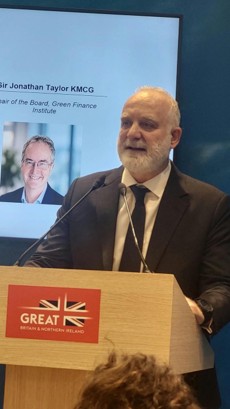
The session was informative and laid out several ways in which the international community is accelerating sustainable energy development. What stood out, however, was the disconnect that sometimes exists between these finance-focused sessions at COP and those that look at how communities, industries and institutions actually use the electricity these investments produce. Finance could be better targeted at supporting demand and growing consumption alongside the financing of generation and distribution. Cooking is one of the clearest places to start, and a recent MECS blog on Burundi shows how including eCooking can improve the return on large electricity investments. The sooner that disconnect is bridged, the better.
Appliances, efficiency and quality
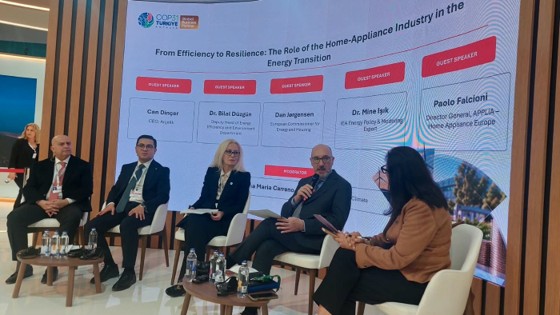
The third session, organised by Beko in the Green Zone, was titled “From Efficiency to Resilience: The Role of the Home-Appliance Industry in the Energy Transition” and was moderated by Ana Maria Carreno of our partners CLASP. Speakers included Can Dincer, CEO of Arcelik.

The discussion focused on energy efficiency in the domestic appliance sector. At the close, MECS asked the panel what they saw as the major challenges, highlighting questions of efficiency and quality in places undergoing rapid electrification, where the appliances people buy will shape both household costs and demand on the grid, and invited participants to join us at the Standards Pavilion on 12th November. After the session, the MECS team met Arcelik’s CEO and several members of the Beko and Arcelik team with whom we have been in conversation and who will join that event.

Clean cooking in schools, one year on
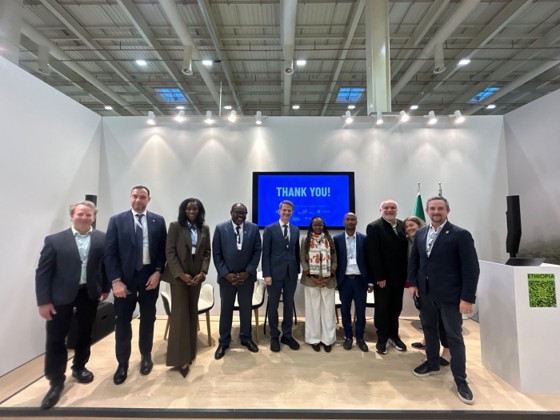
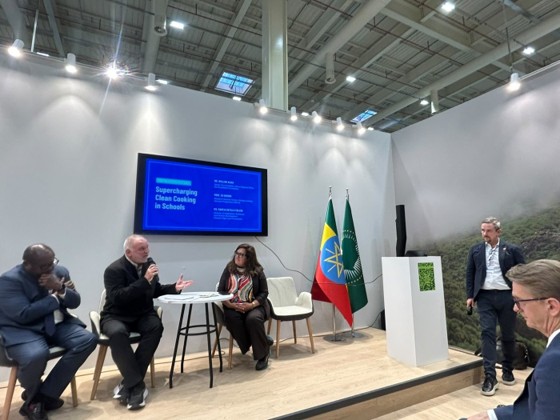
The final event of the day, at the Ethiopia Pavilion, was the meeting of the Platform for Clean Cooking in Schools, one year after its launch at COP30 in Belem. The Platform supports the objectives of the School Meals Coalition and aims to enable sustainable school meal preparation for an additional 100 million students by 2030. Moderated by Mikael Melin of Sustainable Energy for All (SEforALL), the session included updates from the World Food Programme and SEforALL on progress over the past year, and a presentation on progress and strategy development in Indonesia.
Prof. Ed joined a panel alongside Marcia Sotillo Toledo, Director of Adaptation, Resilience and Human Development at the Climate High-Level Champions, and William Asiko, Senior Vice President of the Rockefeller Foundation’s Africa Regional Office. When MECS started in 2018, the clean cooking sector had almost no engagement with electric cooking, there was little discussion of cooking beyond the household, and cooking did not feature in the main strands of energy planning. The picture today is very different, with institutional electric cooking emerging as a key part of a growing eCooking movement.
MECS is innovating in this area in three ways. The first is the CCAC-funded ACUASA project (Accelerating eCooking Uptake in Africa and South Asia), which is embedding the lessons from MECS work on school transitions in India, Kenya, Uganda, Tanzania, Lesotho and elsewhere into a growing engagement with institutional eCooking across the World Bank’s Mission 300 and ASCENT programmes. The second is the role of CLASP in supporting innovative African eCooking companies through the MECS Venture Building programme. The third is the emerging role of the School Kitchen and Cooking Study (SKACS), which is building a library of energy consumption data across many institutional eCooking experiences. This is being turned into a tool for utilities, project developers, schools, planners and others to support financial planning, investment portfolios and programme development.
Looking ahead
The common thread across the day was that strategies and finance only deliver when they reach the cooking pot, whether in a Somali household, a school kitchen in East Africa or the appliance aisle of a fast-electrifying market. The conversations started on day two continue on Thursday 12th November at MECS’s event “Enabling Access to High Quality, Efficient eCooking Appliances for Emerging Economies”, from 10:15 to 11:45 (TRT, UTC+3) at the Standards Pavilion in the Blue Zone. We hope to see you there.
*********************************************************************************************************
Featured Image: Prof. Ed Brown speaks at the Platform for Clean Cooking in Schools session, Ethiopia Pavilion, COP31 (photo credit: Ayse Demir).
Photo Credits: Ayse Demir and Ed Brown.
AI disclaimer: Drafted with AI and edited by the MECS team.