- Date
- 13th March 2026
- Categories
- eCooking, Institutional Cooking, Technologies
By Joseph Kariuki, Research Associate, Gamos East Africa
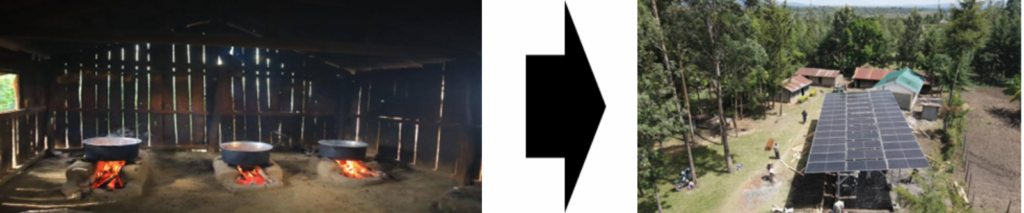
In early January of this year, catalysed by MrBeast*, the world’s most popular YouTuber, the MECS Kenya team embarked on a mission to prove that the cycle of firewood dependency can be broken with speed and scale. This initiative was not a standalone experiment; rather, it was the next phase of the Learning Labs project funded by the Rockefeller Foundation, where we transitioned 3 schools to modern cooking solutions over the course of a year. In this two-part blog series, I am sharing how we used the experience we are gaining to quickly transition two schools in Bomet to clean cooking, making their kitchens modern, cleaner and much easier to work in.
Background
The Rockefeller Foundation has committed to an ambitious goal to scale school meals to 100 million children by 2030. However, a safe and nutritious meal is only as good as the energy used to prepare it. You cannot truly nourish a child if their food is cooked over toxic wood or charcoal smoke, or the school’s budget is drained by the high cost of biomass fuels. Perhaps most importantly, the burden of sourcing the fuel often falls on the parents and students, a hidden tax on education.
Building from the lessons we are learning during of our initial implementations in Kajiado County under the Learning Labs initiative, where we are testing various cooking technologies for stakeholders to visit and learn, the Bomet mission aimed to take those lessons and apply them to a rapid-deployment model.
We set out to transition two schools in less than two weeks: one from traditional firewood to a solar-electric cooking system, and the other to a forced-draft biomass gasifier system. By leveraging the evidence gathered from our Kajiado sites, we demonstrated that these technologies are no longer just in the testing phase; they are ready for immediate, high-impact rollout across Kenya. On paper, the coordination of such a transition – the audits, renovations, fabrication, and installation – looked impossible within a 14-day window.
However, we proved it possible by successfully enabling the transition. Supported by the Rockefeller Foundation, Gamos East Africa brought together a consortium of experts: Ecobora (solar electric cooking systems), Burn Manufacturing (forced-draft biomass systems) and Contec Solutions (kitchen infrastructure). Together, we demonstrated that the future of school feeding is clean, efficient, and rapidly deployable.
Part 1: The Science of the Shift: The Energy Audit
Transitioning an institution to solar electric cooking is not a simple “plug-and-play” task; it begins with an intensive energy audit to ensure the system meets the school’s specific load profile. With the introduction of school feeding programs, government support, and well-wishers to build more classrooms, student enrollment is rising. This growth must be accounted for to ensure the system is not undersized.
School Profile:
When we design these systems, we do not just use a “one size fits all” approach. We must look closely at how each school runs. First, we check if it is a day school or a boarding school. This is important because day schools mostly need power for mid-morning porridge or tea and lunch. Since this happens while the sun is out, they can use power directly from solar panels. Boarding schools are different; they need much more battery storage to handle additional breakfast and dinner, which are cooked in the early morning and late evening when the sun is not shining. We also look at what is on the menu; cooking heavy meals like githeri (maize & bean stew) takes much more energy than something light like rice.
For Nyakichiwa Primary, we first sized everything specifically for a day school setup. Their main energy needs are for the porridge and githeri at lunch, which are provided to the students through the support of Legacy Plus, an organization funded by Beast Philanthropy*. By matching the technology to these specific meals, we make sure the school has exactly what they need to keep the kitchen running smoothly every day.
Population Trends:
We audited Nyakichiwa Primary’s 520 students while also projecting future enrollment growth. Since every student receives their meals at school, this data was critical for determining the specific cookstove capacities required during the fabrication phase.
Precise sizing is a non-negotiable factor for long-term success. If a school receives a cookstove that cannot support the full volume of food required for the entire student body, they will inevitably seek alternatives, such as returning to three-stone fires, to ensure meals are ready on time. To prevent this, we ensure that new cookstoves exceed the previous capacity the school is already using, guaranteeing a seamless transition and accounting for a growing student population.
Fuel and Logistics:
At Nyakichiwa, 20 to 25 parents were previously required to bring 20kg of firewood each, every Sunday. The headteacher divided them into residential areas, keeping records to ensure compliance. Parents either purchased this wood or sourced it from the surrounding forested areas, with students also required to bring more to ensure there is enough for cooking. At Tarakwet Primary (229 students), the school was purchasing 30kg of firewood every three days, while still requiring students to bring more firewood. At roughly 10 KES per kg, the economic drain on these communities was undeniable.
At an average cost of 100 KES per day, the school is projected to spend 2,000 KES monthly and 18,000 KES annually on firewood, an expense that covers only a fraction of their needs while leaving the community to bridge the gap.
The Hybrid Necessity:
To ensure lunch is never late; these new electric cooking systems are designed with built-in redundancies. Typically, they are electric hybrids that use the national grid to “boost” batteries during days with low sunlight. However, at Nyakichiwa, we added a secondary layer of security: the Burn Manufacturing forced-draft system. This ensures a clean backup that relies on neither the grid nor the sun. This redundancy is critical; it prevents the school from reverting to three-stone fires and old routines if the primary solar system requires maintenance or faces weather-related downtime.
The forced-draft system, which served as the primary installation at Tarakwet Primary, is a versatile hybrid. While its primary fuel source is high-efficiency briquettes, the technology is adaptable. In the event that a school’s briquette supply is interrupted, the stoves can switch to traditional firewood while still maintaining a smoke-free kitchen environment. This flexibility ensures that the transition to clean cooking remains permanent, regardless of supply chain fluctuations.
The speed of this initial phase was driven by the desire and unwavering support of the school and the local community. Their recognition of the urgent need for a transition made them proactive partners; by being welcoming and forthcoming with data -ensuring relevant information was provided exactly when needed – preventing any bureaucratic delays. This community-led approach proved vital, as the school administration was available throughout the holidays, allowing unrestricted access for extended energy audits. This level of local ownership and communal goodwill is not just a benefit; it is the essential foundation for the success and speed of any school transition.
With a comprehensive data set in hand, the manufacturers moved into fabrication and procurement. The project’s success relied on a rigorous timeline, where every objective was met with technical precision. Leveraging the experience gained from dozens of installations across the country, the team had optimized the deployment process, significantly reducing the time required for a full setup.
Our prior experience in the Learning Labs initiative and Ecobora’s previous installations enabled us to move beyond the learning curve to a place of strategic foresight; for instance, by identifying that solar mounting structures are one of the most time-intensive components to fabricate, we initiated their construction the moment the project was greenlit. This allowed the structural framework to be standing and ready by the time the solar panels arrived on site, a level of synchronization that only comes from years of refining the process.
The experiences we have gained are in the report, “Making the Switch: The Deployment Handbook for Institutional E-Cookers,” conducted by Efficiency for Access in partnership with the CLASP and the Modern Energy Cooking Services (MECS) programme.
With the audits complete and the logistics synchronized, the groundwork was officially laid. But a plan on paper is only the beginning. In Part 2, we will go inside the construction zone to see how we overhauled the kitchen infrastructure, integrated the solar powerhouse, and finally served the first smoke-free meals to the students.
***************************************************************************************************************
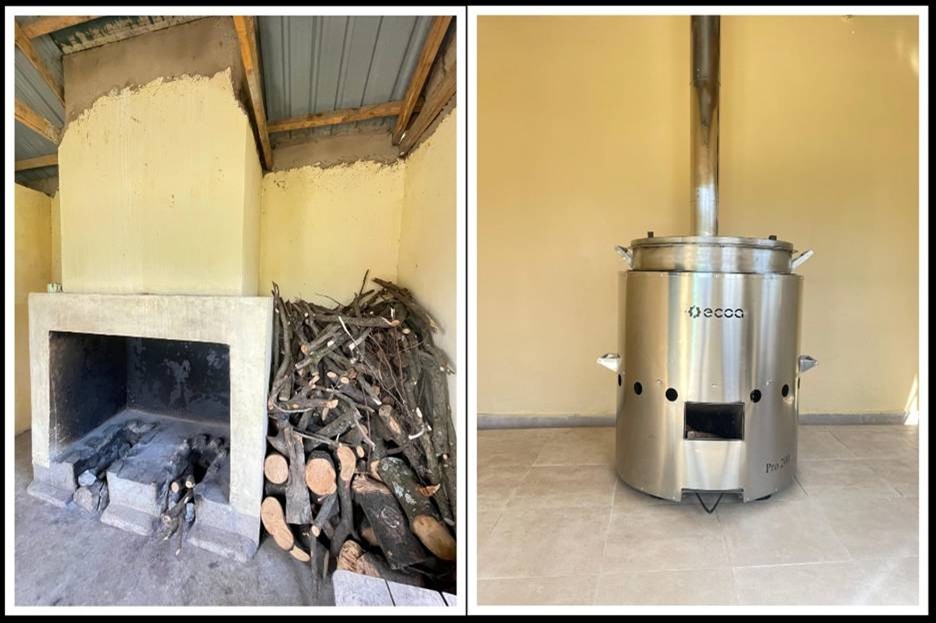
Featured Image: (left) The original three-stone firewood setup at Tarakwet school; (Right) The new Burn Manufacturing forced-draft biomass cookstove. Photo Credit: Ezra David, Mediaq Production.
*We appreciate the philanthropy of MrBeast. We note that he has earned his wealth through a particular business model of monetising high-paced, outrageous and engaging videos hosted by an energetic Mr Beast (Jimmy Donaldson). This style of video has been brought across into the communication of his philanthropic work, which involves significant expenditure within each context, engaging children to make sure they are enthusiastic, and a focus on Jimmy and his team and what they have done. While he does give credit to the community of the school and local community for their role, the presentation sometimes reflects an older style of development aid that relies on benevolent outside intervention and guidance. We note that in this case Rockefeller Foundation, MECS, local partners and local community worked to ensure local capacity. There was a lot of behind the scenes planning and work by Kenyans for Kenya. That said though, we reiterate that we appreciate the philanthropy of MrBeast.