- Date
- 17th April 2026
- Categories
- Commercial Cooking, eCooking
By Aine Pollesel and Jacob Fodio Todd
Between September 2025 and January 2026, through technology accelerators, MECS worked with three pre-cook businesses keen to update their existing cooking processes and innovate with eCooking: Nyumbani Greens in Kenya, DeliMush in Ghana and ATMANCorp in Nigeria. Given the short project duration, we expected companies to acquire some eCooking appliances and carry out initial testing on how they could be integrated into existing food preparation. However, the results were better than we anticipated: in only five months, companies fully integrated eCooking, eliminated or significantly reduced LPG and charcoal usage, increased production capacity and projected strong growth trajectories.
Nyumbani Greens: Nairobi-based start-up offering African Indigenous Vegetables (AIV)
The start-up tackles urban household cooking time and energy usage by offering eight types of precooked and fermented AIV, precooked beans, githeri and indigenous kienyeji chicken. Different types of AIV and ways to prepare them (e.g., the amount of boiling water required) were introduced in our previous blog.
Before this project, Nyumbani Greens used LPG, charcoal and inefficient immersion water heaters to prepare their products. Their ambition during the five-month project was to demonstrate that eCooking can support a commercially viable, inclusive and climate-smart food business, while reducing reliance on charcoal and LPG. Through its business case, Nyumbani Greens was keen to generate evidence to support wider eCooking adoption in Kenya’s pre-cook sector.
As mentioned in the previous blog, the main production operation for Nyumbani Greens is water boiling: their team needs to boil around 1000 L of water per day for blanching AIV. With guidance from our commercial and institutional cooking expert, Jacob Fodio Todd, Nyumbani Greens identified the need for large-capacity specialised water boilers. The company acquired a 200 L solar water boiler and a 100 L eBoiler for periods of insufficient sunlight. With adequate solar irradiation available up to 80% of the year, this setup ensured near-zero electricity costs during these periods. Having large amounts of boiling water readily available reduced cooking and preparation times for AIV by over 70%, enabling production capacity to double from around 10000 to 20000 packs per month. To improve production of other products – beans and githeri – the company purchased three 10 L electric pressure cookers (EPCs) and an additional four 6 L EPCs for precooking chicken. Beans and githeri processing times dropped by 62%, while kienyeji chicken now takes 79% less time to cook compared with previous charcoal cooking.
Shorter production cycles mean Nyumbani Greens can now offer on-demand production for all their products: e.g., customers can use WhatsApp to order precooked chicken, which takes 25 min to cook, with total cooking plus delivery time reduced to 1 hr compared with 3 hrs before the EPCs. To accommodate the doubled production and demand, the company later acquired six 80 L freezers.
During the project, the site of Nyumbani Greens experienced frequent interruptions in grid electricity supply, making it unreliable for consistent daily operations: as production scaled, unreliable electricity became a critical operational risk. This highlighted the importance of a solar backup system. The team of Nyumbani Greens is already planning to fully solarise its operations, including food preparation, cold storage and increased distribution using electric scooters.

DeliMush: Long shelf-life mushroom products from Tamale
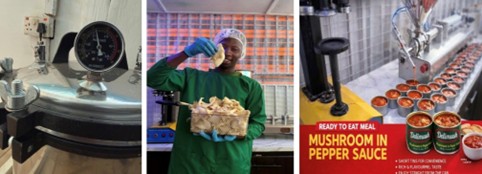
The company was founded in 2020 to tackle post-harvest spoilage of mushrooms and vegetables in Northern Ghana and has since grown into a nationally recognised producer of nutritious, shelf-stable foods. DeliMush produces canned mushroom sauces (tomato, pepper, onion and shito hot sauce variants), fortified mushroom biscuits and mushroom powder.
Before the project, their production depended on charcoal and handmade LPG appliances, while manual processes, long cooking times, high fuel costs and poor sterilisation control limited production capacity and quality. DeliMush had an ambition to upgrade its existing facility, install electric and semi-automated appliances, train staff and test the new system across core products.
During the project, the company acquired 14 new electric appliances, including a 3-tray electric oven, two steam sterilisers, two induction cooktops with compatible cookware, a 10-tray dehydrator, a deep fryer, and a range of mixers, blenders and other machines supporting biscuit and sauce preparation and packaging. To install these appliances, DeliMush had to renovate its existing facilities and upgrade the electrical wiring, improving overall hygiene and food safety. The results were impressive: weekly canned mushroom production increased from 40 to 240 cans, while biscuit production rose from 150 to 900 boxes. Energy costs per product unit fell by over 80%, and unit production costs dropped significantly, improving profit margins to around 38-40%. Production times were reduced by 60% for canned products and 73% for biscuits. The greatest time and energy savings came from electric steam sterilisers: previously, a handmade LPG system required 40 cans to be sterilised in three batches, taking over 400 min, whereas the electric steriliser completed the same process in just 40 min. The company expanded sales to five regions in Ghana, signed 13 agreements with vendors, created 8 direct jobs and supplied food to more than 800 urban consumers.
Aside from having to upgrade the electrical wiring, the company had to overcome the limited local availability of suitable electric equipment and import delays. While sterilisers, induction cooktops and other equipment were available locally, the electric oven had to be air-freighted from China, which took three weeks.
DeliMush is already thinking of expansion and has the ambition to double its existing production by the end of 2026. The company is currently testing two new products, including canned mackerel in mushroom sauce. They look forward to installing solar panels with battery storage to address occasional power outages, create additional jobs and expand partnerships.
ATMANCorp: Cassava flour facility introducing cassava crisps in Ibadan
Unlike Nyumbani Greens and DeliMush, who used the project to shift their existing production to eCooking, ATMANCorp chose to introduce a new product and cooking process. With over 10 years of experience in cassava-based products of flour and garri, ATMANCorp realised its plan to introduce oil-free cassava crisps – a healthy and affordable snack for urban consumers.
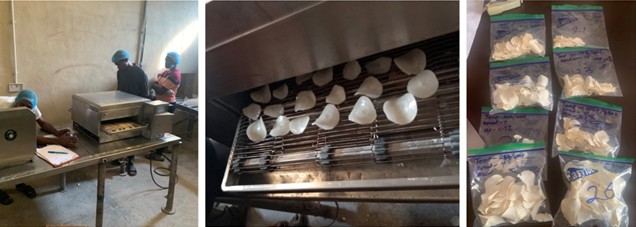
Through this project, ATMANCorp was hoping to produce cassava crisps using an electric air fryer and demonstrate that eCooking could replace oil-based processes and produce an affordable snack, particularly as oil is the most expensive ingredient in snack production. Successful trials with domestic air fryers led the company to see the opportunity to do it at scale, however ‘air-frying’ at scale required exploring other technologies. After extensive research, ATMANCorp found out that an impingement oven – a high-speed conveyor oven that directs hot air onto the food – could reproduce, at scale, the performance of domestic air fryers. Impingement ovens were not available in Nigeria, and the company had to search for international suppliers. The team ordered a 26-inch Baker’s Pride impingement oven from China, which was shipped by sea due to exorbitant air freight costs during the Christmas period. To be able to progress with the project and test their hypothesis of cooking oil-less crisps in an impingement oven, ATMANCorp bought a smaller, second-hand 16-inch Lincoln electric impingement oven from the UK. Additionally, the team bought all the necessary equipment for producing and packaging cassava crisps, including an adjustable cassava slicer, a moisture analyser, a 3-bay electric deep fryer repurposed for blanching and a sachet packaging machine.
The company carried out multiple trials cooking cassava crisps in their newly acquired oven: they tested different slice thicknesses, cassava types, moisture levels and cooking times. The results were surprisingly positive: the crisps were consistently high quality, evenly cooked and most importantly, cooked without a drop of oil. During early pilot trials, 500g of crisps were produced in around 20 min, with predictable throughput and stable energy use of approximately 41 kWh over a nine-hour production day. While crisps were delicious without salt or additional seasoning, the company still needs to figure out how to apply seasoning to dry oil-less crisps.
Operating large electric ovens was expected to be energy-consuming. And while electricity tariffs in Nigeria are relatively high, 210 naira per kWh, they are still lower than many other countries MECS is working in. With eCooking, energy costs became more transparent and predictable compared to the volatility of pricing and quality of diesel, which the company uses for flour and garri processing.
ATMANCorp is now going to transition from trialling to sustained commercial production of cassava crisps. The company is keen to make their production fully consistent and transparent by using LoRaWAN-enabled temperature sensors and electrical current meters to monitor oven performance, measure energy use per batch and identify deviations. Its ambition is to be able to produce 200kg of cassava snacks per day by 2027. As a result of the project, the company is exploring potential uses of electricity in other production areas, such as the heating element of its garri production line.
Working with Nyumbani Greens, DeliMush and ATMANCorp, MECS learned a great deal in a short time. All three companies were highly motivated to identify the most suitable eCooking appliances, upgrade existing facilities, train staff and test production within a tight project timeline. eCooking was new to most of them, yet impressive results were achieved in a very short period. MECS will follow up with these three pioneers over the next six to twelve months and hopes to build further studies and establish new partnerships to strengthen eCooking in the pre-cook sector.
***************************************************************************************************************
AI Disclaimer: No AI was used to produce this blog.