- Date
- 22nd May 2026
- Categories
- Finance
By Dr. Simon Batchelor OBE (Gamos Ltd. / Loughborough University).
In this blog I reflect on other strategies for LPG scaling. This price spike is a moment to look closer and learn how such differing strategies affect ‘energy security’. What I find is that the systems that enable rapid expansion of clean cooking are not necessarily the systems that manage volatility well.
In my last blog, I pointed to our colleague from ESMAP Michelle Hallack’s blog, which was a comment on the global LPG price spike, and drew attention to our joint report with AFREC that pointed at India as an example of how LPG has been taken to scale. I noted that India seeks to stabilise the price for its citizens and if the price spike persists, this strategy will likely cost India an additional ₹350–500 billion (US$4–6 billion) per year in LPG-related support. In their A Vision for Clean Cooking Access for All the IEA states that $8 billion a year from now until 2030 is required to underpin universal access to clean cooking solutions. The additional fiscal commitment forced on India by a war it has nothing to do with, is of the same order. I noted that if the price spike does settle back to oil being below $100 a barrel, then perhaps India could conceive of spending at least $1 billion a year on more intentional enabling of eCooking to create greater energy security. (I believe at time of writing the oil price is hovering around $100).
But India is just the case study a lot of people cite to put forward how LPG can go to scale, and they often suggest this can be done quickly. Certainly the modelling of the IEA and ESMAP have previously suggested LPG takes the major role in the run up to 2030 and fulfilling SDG7 access for clean cooking. But the Indian model is not the only possible approach. The current crisis also reveals the underlying logic of other country systems, and shocks such as the current one have different effects.
A shared shock, but diverging responses
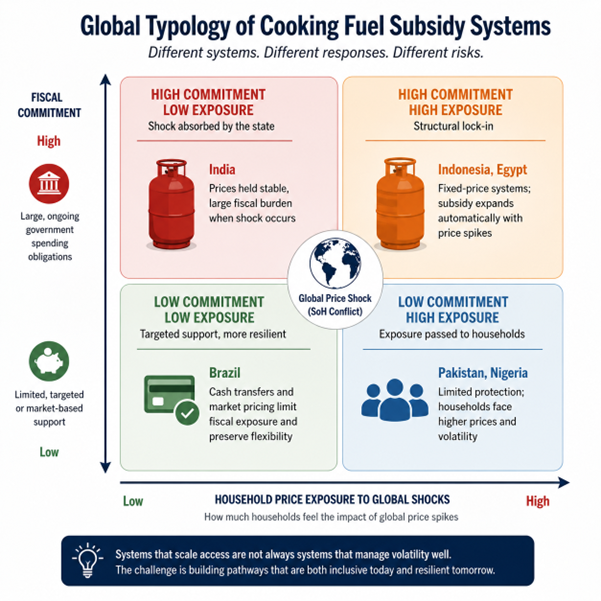
The conflict affecting the Strait of Hormuz (SoH) has created a common external pressure: higher global fuel prices, tighter supply chains, and heightened political sensitivity. Yet countries are not converging in their responses. They are diverging because the (LPG and Natural Gas) systems they built to expand clean cooking now shape how they manage risk.
The contrast becomes clearer when viewed side by side:
| Country | System archetype | Pre-shock structure | Response to Iran war | Fiscal effect | Implication for transition |
|---|---|---|---|---|---|
| India | Shock absorption | Large LPG system, partial price control | Holds prices, expands support | Additional +$4–6bn/year | Weakens incentive to shift |
| Indonesia | Structural lock-in | Fixed-price LPG for mass population | Automatic subsidy expansion | Additional +$2–4bn/year | Deepens LPG dependence |
| Egypt | Reforming lock-in | Long-standing LPG price controls | Reform vs protection tension | Risk of subsidy rebound | Reinforces lock-in |
| Pakistan | Constrained retreat | Gas subsidy for minority | Pass-through + targeted relief | Fiscal stress, not expansion | Fragmented pathway |
| Nigeria | Misaligned support | Petrol subsidised, LPG not | Price exposure | Household burden rises | Weak transition signal |
| Brazil | Targeted support | Market pricing + cash transfers | Limited fiscal expansion | Contained (<$1bn) | Greater flexibility |
So let’s look at those in more detail. I won’t repeat India.
Indonesia: the logic of lock-in
Indonesia takes the subsidy dynamic of India a step further. Its system is not merely large; it is structurally fixed. The subsidised 3 kg LPG cylinder is embedded in everyday life, and prices are held far below international levels.
In such a system, there is no real mechanism to pass through global price increases. Instead, higher prices translate directly into higher government spending.
The SoH conflict does not change the structure, it simply exposes it. The more successful the system has been in reaching households, the more difficult it becomes to adjust when external conditions shift.
Egypt: reform under pressure
Egypt sits somewhere between the India/Indonesia two models, but with an added layer of complexity: it has been trying to reform its subsidy system.
For years, Egypt has reduced energy subsidies as part of broader fiscal restructuring. Yet LPG remains politically sensitive, and the Iran shock places that reform agenda under strain.
Higher global prices mean:
- maintaining subsidies becomes more expensive
- reducing them becomes more contentious
The result is not a clear policy shift, but a tension, between fiscal discipline and social protection. The war, in effect, reopens a reform debate that had not yet fully settled.
Pakistan: constraint as policy
If India and Indonesia show what happens when governments can absorb shocks, Pakistan shows what happens when they cannot.
Rather than expanding subsidies, Pakistan has largely allowed prices to rise, supplementing this with targeted support for specific groups. At the same time, legacy subsidies, particularly for piped gas, remain in place.
This creates a system that is neither fully market-based nor fully protective. Instead, it is fragmented:
- some households are protected
- others are exposed
- price signals are uneven
The result is a transition pathway that is not so much managed as constrained by fiscal reality.
Nigeria: exposure without insulation
Nigeria presents a different kind of contrast. Despite being an oil producer, it does not systematically subsidise LPG for households. Instead, its subsidy history has focused on petrol.
As a result, when global LPG prices rise, households feel the impact directly. Even though Nigeria is not physically dependent on the Strait of Hormuz, it is still exposed to global price dynamics.
Here, the SoH shock translates not into fiscal pressure, but into household affordability pressure, with implications for continued reliance on biomass.
Brazil: a quieter resilience
Brazil’s approach is less dramatic, but in some ways more revealing. By allowing LPG prices to reflect global markets and supporting households through targeted transfers, it separates price formation from social protection.
This does not eliminate political pressure as rising prices are always sensitive but it avoids the automatic fiscal escalation seen elsewhere.
In this sense, Brazil’s system is not immune to shocks, but it is less structurally exposed to them.
From expansion to exposure
What links all these cases is a deeper insight that the AFREC–MECS work hints at but that the current crisis makes stark:
- the systems that enable rapid expansion of clean cooking are not necessarily the systems that manage volatility well.
India’s experience shows how powerful policy can drive adoption. But Indonesia and Egypt show how those same systems can become rigid. Pakistan and Nigeria show what happens when fiscal space is limited. Brazil shows that alternatives exist but often at the cost of greater exposure to price signals.
Looking ahead: from Paris pledges to Nairobi realities
We hope that the SoH conflict will eventually recede from the headlines. Prices will stabilise, shipping routes will reopen, and the immediate sense of crisis will fade. But the deeper questions it has exposed about how countries structure and sustain cooking energy systems will not go away. Prices will still be volatile.
That makes the timing of the upcoming Clean Cooking Summit in Kenya particularly significant.
Over the past two years, the international narrative has gathered momentum around scaling clean cooking, culminating in the pledges mobilised at the Paris summit. A substantial share of those commitments both explicit and implicit, have centred on expanding access to LPG, often drawing on the same logic highlighted in the AFREC–MECS work: that rapid, large-scale transitions are possible when policy, finance, and distribution align.
That logic remains compelling. The experience of India demonstrates that governments can reach hundreds of millions of households within a decade. For many countries, particularly in Africa, LPG still seems to represent the most immediate route to reducing biomass use and its associated health and environmental burdens.
But the current moment complicates that narrative.
What the SoH shock has shown is that scaling LPG is not just a question of infrastructure and affordability, it is also a question of long-term exposure to global volatility. Systems built on imported fuels, particularly those supported through price controls or subsidies, carry an inherent fiscal and political risk. When prices are low, that risk is largely invisible. When prices spike, it becomes unavoidable.
For import-dependent economies, LPG volatility is also a foreign exchange risk, not merely a fiscal one.
The issue is therefore not whether LPG has a role, but whether systems are designed with sufficient flexibility to evolve beyond dependence on imported fossil cooking fuels over time.
This does not invalidate the Paris pledges. But it does suggest that the next phase of the conversation, likely to unfold in Nairobi, needs to be more nuanced.
Three reflections seem particularly relevant.
First, scale and sustainability are not the same thing. The Paris commitments have been successful in mobilising ambition and resources. But the experience of countries like Indonesia and Egypt shows that once systems are built at scale, they are difficult to adjust. The question is not only how to reach households, but how to do so in ways that remain fiscally and politically sustainable under stress.
Second, subsidy design matters as much as subsidy size. The contrast between India, Indonesia, and Brazil illustrates that there are multiple ways to support households. Some approaches smooth prices; others transfer income. Some create long-term fiscal exposure; others contain it. Brazil’s approach contains fiscal exposure and preserves market signals, although households remain more directly exposed to international price volatility. As countries consider how to use pledged resources, these design choices will shape not just uptake, but resilience.
Third, the AFREC–MECS analysis and the IEA data positions LPG as one possible step away from biomass. It has always been positioned as an intermediate or transitional step, touted as more deployable than eCooking. However, most long-term decarbonisation scenarios anticipate a substantially larger role for electricity in cooking by mid-century. So the current crisis highlights that for energy security it really does need to be deployed with a transitional mindset. Energy planners need to design with future secure energy mixes in mind, that alleviate fiscal pressure on the government’s budget and on foreign exchange.
In that sense, the Nairobi summit is not just an opportunity to accelerate delivery on existing commitments. It is also an opportunity to ask a more forward-looking question:
- how can today’s investments in clean cooking avoid becoming tomorrow’s structural constraints?
That question does not have a single answer. It will look different in India than in Nigeria, and different again in Brazil or Pakistan. But the underlying challenge is shared.
The SoH conflict has made visible what is often hidden: that LPG modern energy cooking systems are deeply intertwined with global markets, fiscal systems, and political priorities. As countries gather in Kenya, the task is not only to reaffirm commitments, but to ensure that the systems being built are robust enough to withstand the next shock, whatever form it takes, to enhance energy security.
…………………………
Image credit – AI created from prompt by S Batchelor.
AI disclaimer: Human led search for information, blog drafted, AI tidied and created graphics.