- Date
- 22nd October 2026
- Categories
- Alternative Fuels, Clean Cooking, Policy & Strategy
By Dr Simon Batchelor OBE (GAMOS Ltd./Loughborough University)
More than a decade ago, when I was seconded to IDS, I spent quite a lot of time thinking about evidence-influenced decision making. I was interested in a deceptively simple question: when a government official, programme manager or other decision-maker is presented with good evidence, what actually determines whether that evidence changes what they do?
I ended up producing a formula. It was never intended to be real mathematics. In fact, the absurdity of trying to reduce human decision-making to an equation was partly the point. But I found the formula useful because it forced us to put on the page some of the things that tend to disappear when we talk too casually about “evidence-based policy”.
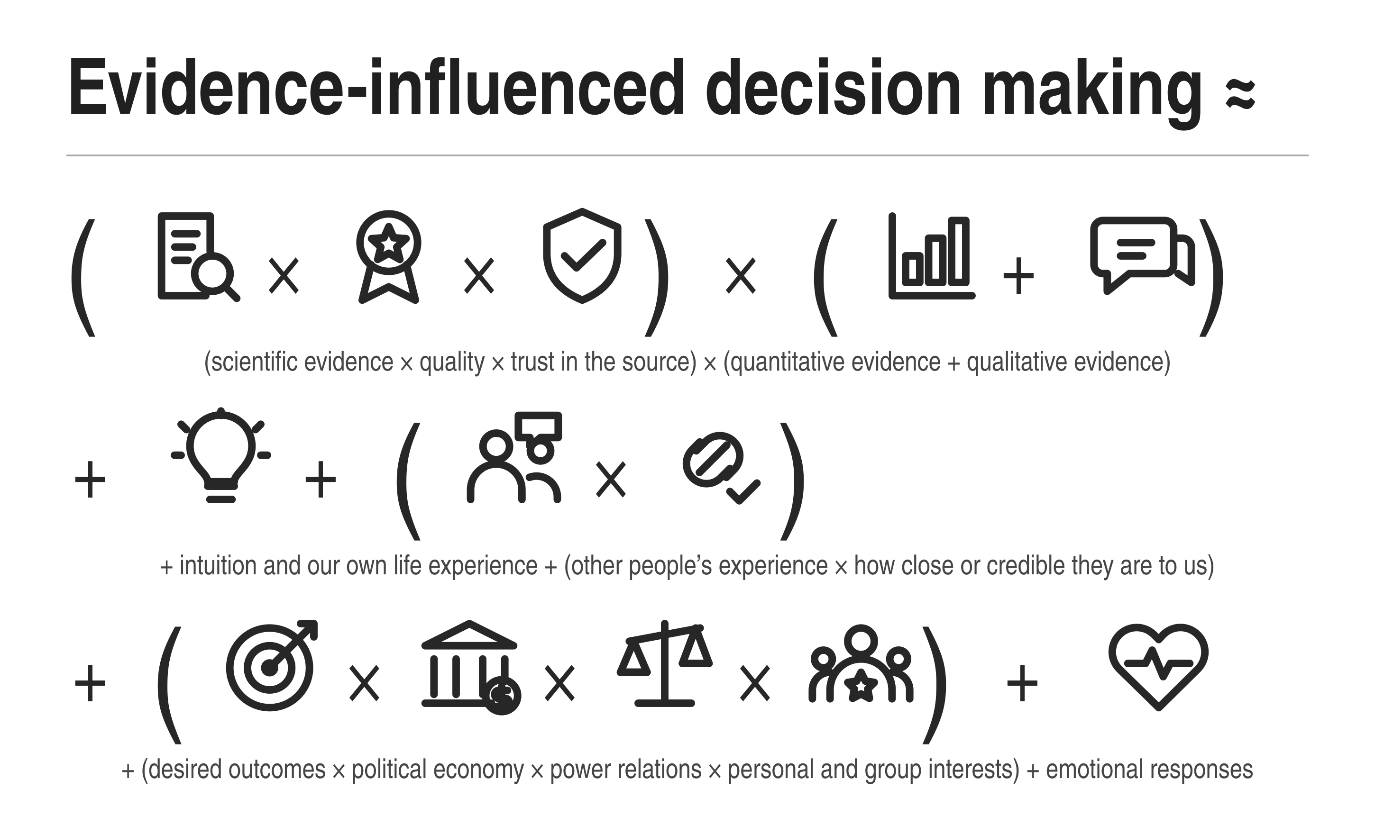
A simplified version looks something like this:
Evidence-influenced decision making ≈
(scientific evidence × quality × trust in the source) × (quantitative evidence + qualitative evidence)
+ intuition and our own life experience
+ (other people’s experience × how close or credible they are to us)
+ (desired outcomes × political economy × power relations × personal and group interests)
+ emotional responses
The formulation subsequently appeared in work Jonathan Smith and I did on energy proficiency and decentralised governance. We stressed that it was not a mathematical model, but a reminder that access to information is only one part of how decisions get made.
A decade later, working through MECS, I find myself coming back to it.
MECS has generated a lot of evidence. We have measured appliances, meals and cooking practices. We have looked at energy efficiency in laboratories, but also at what happens when an appliance enters a real kitchen. Cooking Diaries and other mixed-method approaches have deliberately brought together measured energy consumption with what people actually cook, when they cook, what they like, what they dislike and why an apparently efficient technology sometimes fits everyday life and sometimes does not.
That cooking ‘system’ matters. A technically excellent appliance is of limited value if it cannot cook the food a household wants to eat. Equally, asking people whether they “like” an appliance tells us only so much unless we also know what energy it used, how often it was used and what other fuels it displaced.
Quantitative and qualitative evidence are not competitors, they answer different parts of the question
But MECS is now being drawn into government strategies, utility programmes and much larger investment discussions. eCooking is moving beyond pilots into national energy planning: how much electricity demand it creates, where that demand falls on a network, what it does to utility revenues and reliability, and how governments might plan for millions rather than thousands of electric cookers.
At that point, having good evidence is necessary, but it is plainly not sufficient.
Take trust. A methodologically excellent study may have little influence if decision-makers do not trust its source. Conversely, weak evidence can travel remarkably far when it comes through a trusted institution, colleague or adviser.
Work on science-policy interfaces has long made this point. Evidence needs to be credible, relevant to the decision and regarded as legitimate. Even evidence-based medicine was never about blindly following studies. Sackett and colleagues described it as integrating the best external evidence with professional clinical expertise.
That feels very familiar within MECS.
Influence does not only happen through reports, papers and presentations. It happens through relationships built over years, through a phone call to somebody in a ministry, a utility working group, or increasingly a WhatsApp group. A ministerial adviser asks a question; someone shares a tariff calculation; somebody challenges it; a utility engineer explains the network; another person offers experience from a pilot. By the afternoon, the framing of the problem has shifted.
That is not a corruption of evidence-based decision making. It is often how evidence becomes socially usable.
Then there is experience.
Experience has two faces: accumulated wisdom and accumulated prejudice. Intuition may allow somebody with twenty years’ experience to see why an elegant proposal will fail. It can also make them reject something genuinely new because “we tried that before”. We hear people say eCooking “won’t work here,” sometimes without ever having tried it.
We also give greater weight to the experience of people we know, respect or identify with. That is why networks matter, and why evidence communities can become echo chambers.
Then we come to the least comfortable part of the formula: desired outcomes, political economy, power and interests.
Clean cooking provides a particularly good example.
It is perfectly reasonable for a national clean-cooking strategy to be multi-fuel. Indeed this is what AFREC as part of the AU is encouraging. Countries, economies, grids, incomes and cooking cultures differ. LPG has delivered major health benefits and clean-cooking access at scale but at a cost to governments; electricity will not immediately be reliable or affordable everywhere. Bioethanol, biogas and advanced biomass may also have roles. The IEA’s present pathway for accelerating clean cooking in Africa is explicitly multi-fuel: LPG supplies most new access in the near term, alongside substantial and growing roles for electricity and other fuels.
But multi-fuel does not mean interest-free.
The LPG industry has a commercial interest in expanding LPG consumption. That is not an accusation; it is how markets work. The World Liquid Gas Association describes its Cooking for Life Africa Task Force as the principal vehicle through which the LPG industry supports the IEA clean-cooking agenda. It explicitly aims to increase LPG access and to communicate industry information, feedback and “policy asks.” Its participants include major LPG and energy businesses, and it is chaired by TotalEnergies’ Vice President for LPG and Clean Cooking. Natacha Cambriels is focused on achieving one main goal: accelerating access to cleaner and safer solutions for cooking in Africa by switching from traditional biomass to LPG as cooking fuel.
The market is substantial. The IEA estimates that in its accelerated-access pathway LPG cooking consumption in sub-Saharan Africa could approach one million barrels per day by 2040, around 8% of today’s global LPG market. Electricity also grows strongly, but LPG expansion on that scale has obvious commercial significance.
Governments have interests too.
The United States currently provides a particularly visible example. In September 2026, the US Department of Energy described its G20 energy agenda in terms of “energy abundance”, explicitly affirming the role of hydrocarbons alongside nuclear and advanced technologies. In the same process, G20 energy ministers endorsed a clean-cooking declaration which while mainly talked multi fuel and context specificity, nevertheless made a first call to action – “Ensure access to financing for all qualifying clean cooking solutions, including projects that deploy LPG, in accordance with national circumstances, needs, and priorities”. The United States is also one of the co-chairs of the next major Summit on Clean Cooking in Africa.
None of that suggests or demonstrates that evidence surrounding LPG is not being considered, or that US participation in clean cooking is somehow skewing the agenda. That would itself be poor evidence use.
But nor should we pretend that governments, industries and institutions enter these discussions without economic and political interests. A country with a large hydrocarbon industry, an LPG company, an electricity utility and even an organisation such as MECS will each enter a supposedly “technology-neutral” discussion from somewhat different starting points.
MECS has interests too.
We exist because modern energy cooking, particularly eCooking, had been systematically overlooked. We hypothesised, and have now shown, that eCooking can leverage other investments: utilities can gain demand and revenue, appliance supply chains can support growth, and carbon developers can generate high-integrity emission reductions. Governments may favour the option that fits existing infrastructure, budgets or commitments.
We claim to be technology agnostic and are following the evidence, but we believe that Climate Change is a real manmade issue, and we would like the world to move to a net zero position by 2050. These assumptions influence what we ‘read into’ the evidence. Recognising those interests does not disqualify anybody’s evidence. It tells us to examine it carefully.
This is why political economy belongs inside the evidence formula, rather than being treated as an embarrassing externality.
Power matters because evidence does not reach the table with equal resources behind it. A multinational energy company can fund studies, attend meetings, maintain relationships and produce polished policy materials. Women cooking on unreliable electricity in a secondary town generally cannot. Both have knowledge relevant to a decision. Their ability to turn it into influence differs radically.
Justin Parkhurst makes a similar argument in The Politics of Evidence. Political interests influence which evidence is selected, how problems are framed and which questions are considered legitimate. Invoking “the evidence” can even present fundamentally political choices as purely technical ones. Sometimes the most important exercise of power is not choosing between two answers. It is deciding which question gets asked.
For MECS, I think this leads to a slightly different understanding of our job.
We should not produce less evidence. Quite the opposite: we need stronger evidence on costs, energy use, emissions, grid impacts, cooking practices and sustained adoption. And we should give voice to the wisdom of those women cooking on unreliable electricity.
But we should also be realistic about what evidence can and cannot do on its own. As MECS moves further into government planning, utility programmes and large investment decisions, our role is increasingly not just to produce evidence, but to help it travel. That means understanding who needs to trust it, who needs to hear it from whom, what interests are already in the room, and where the real decision is being made.
We must also recognise when technical debates are not entirely technical. The balance between LPG and eCooking is one example: evidence matters, but so do commercial interests, institutional histories, and political relationships.
So perhaps the useful lesson from my old formula is simply this: evidence matters enormously, but evidence rarely decides.
What matters is the combination of good evidence, trusted relationships, practical experience and a clear understanding of the political economy around the decision.
For MECS, that is increasingly where our work is.
*********************************************************************************************************
AI Disclaimer: AI was used only for internet searching and tidying the grammar of the blog.
Featured Image: Image was generated by the author from royalty free icons.