- Date
- 11th May 2026
- Categories
- Behaviours, eCooking
By Dr Aine Pollesel
In 2026, cooks in the Global South have no shortage of eCooking appliances to choose from, with markets saturated by options of different types, shapes and sizes: 1 to 2 burner induction hobs, 2–12L electric pressure cookers (EPCs), cheap hotplates, sophisticated air fryers, specialised ugali makers, subsidised multifunctional rice cookers, electric pans and many more.
To understand which of these appliances users actually find most attractive, and to help businesses make better choices when designing, tweaking, promoting and supporting eCooking products, MECS ran a market research study with existing eCooking users in Kenya, Nepal, Tanzania and Uganda. With support from local partner organisations, we surveyed 900 participants across the four countries using discrete choice modelling (DCM) choice cards (Figure 1).
DCM is a way of mimicking real-life decision-making: participants are shown a set of options with different attributes and asked to choose between them. In our case, participants were shown three descriptions of hypothetical appliances, each with different levels of same attributes, and were asked to choose one. Each user made 12 choices between cards, adding up to 10,800 choices overall about attributes and giving us strong statistical insight into user preferences.
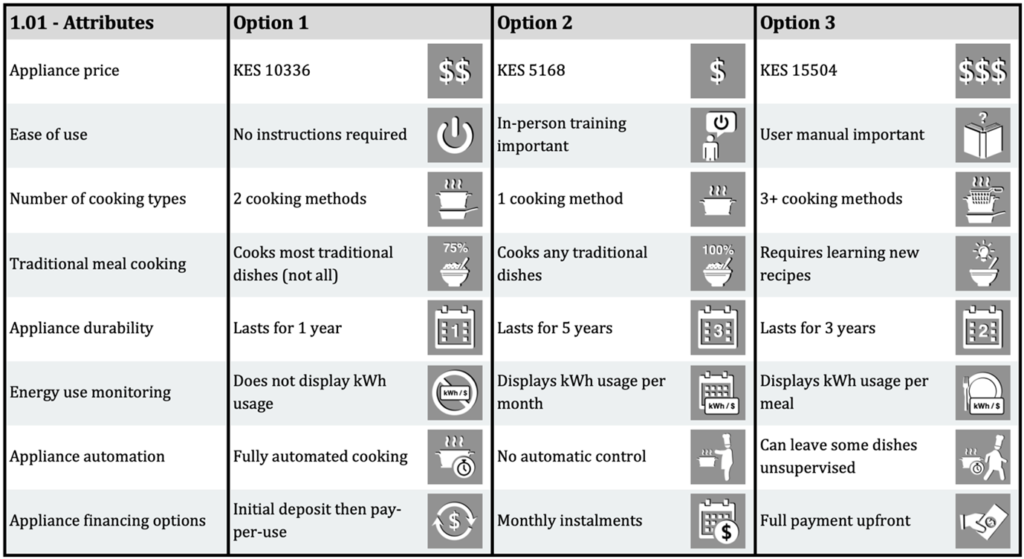
Instead of evaluating specific eCooking appliances, we focused on understanding user preferences for 16 different attributes that apply to various appliances (Table 1). Each attribute was defined by three levels, and these levels, mixed and matched in different combinations, formed the three options that users were asked to choose between. The attributes and their levels were identified through desk research, interviews and a co-design workshop.
| Attribute | Level 1 | Level 2 | Level 3 | |
| 1 | Appliance price | *lowest price in country* | *mid-range price in country* | *highest price in country* |
| 2 | Cooking cost | 50% cheaper than *other most popular cooking fuel in country* | 25% cheaper than *other most popular cooking fuel in country* | Same as *other most popular cooking fuel in country* |
| 3 | Appliance safety | Basic safety features | Improved safety features | Advanced safety features |
| 4 | Ease of use | No instructions required | User manual important | In-person training important |
| 5 | Dish capacity | Heats 1 pot at once | Heats 2 pots at once | Heats 3 pots at once |
| 6 | Supported cooking methods | 1 cooking method | 2 cooking methods | 3+ cooking methods |
| 7 | Traditional meal cooking | Cooks any traditional dishes | Cooks most traditional dishes (not all) | Requires learning new recipes |
| 8 | Appliance size | Sized for 2 people | Sized for 5 people | Sized for 8 people |
| 9 | Maintenance and repair | Repairs at home | Repairs by local technician | Send to manufacturer for repair |
| 10 | Brand reputation | Unknown brand | Familiar local brand | Famous international brand |
| 11 | Appliance durability | Lasts for 1 year | Lasts for 3 years | Lasts for 5 years |
| 12 | Energy use monitoring | Does not display kWh usage | Displays kWh usage per month | Displays kWh usage per meal |
| 13 | Appliance automation | No automatic control | Can leave some dishes unsupervised | Full automated cooking |
| 14 | Appliance warranty | No warranty | 1-year warranty | 2-year warranty |
| 15 | Cookware compatibility | All pots and pans work | Comes with compatible pans and pots | Requires special pans and pots |
| 16 | Appliance financing options | Full payment upfront | Monthly instalments | Initial deposit then pay-per-use |
Table 1: eCooking appliance attributes used in the DCM study, each defined by three levels: minimum, maximum, and intermediate.
The results were analysed using a multinomial logit (MNL) model. While more detailed information on the DCM design and data analysis will be presented in a journal article, Table 2 summarises the eight most and least preferred attributes and levels, as well as those with no clear preference, in each country.
The results show that across Kenya, Nepal, Uganda and Tanzania, large and durable appliances with low cooking costs were consistently preferred by users. Same attributes with opposite characteristics and appliances with no warranty were broadly disliked. While the average household size in the studied countries was 4.5 people, users preferred larger appliances (sized for 8 people), possibly because they need to cook in batches or prepare for times when guests visit, as seen in our previous study on the kitchen behaviours. This shows that one multifunctional appliance is highly valued. Durability also matters, because cheap, low-quality appliances so common in the studied countries often fail, while power fluctuations make this even worse. Keeping cooking costs lower than other fuels is important, given the high and rising prices of biomass and LPG, which force users to stack fuels and deal with complexities that come with this behaviour.
The preference for one multifunctional appliance rather than multiple specialised ones was clear across all countries. Overall, users preferred appliances with greater dish capacity and support for a wider range of cooking types, while respondents in Tanzania showed a strong preference towards appliances that support more than three cooking methods. This may be because users can afford, or choose to afford, only one appliance that must meet different cooking needs. The importance of cookware compatibility was seen in Kenya and Nepal, likely due to the higher uptake of induction cooktops in these countries, which require specialised cookware. Appliance automation was ranked among the top three preferences in the East African countries but not in Nepal, likely due to the higher uptake of fully automated appliances such as EPCs in East Africa.
Unlike users in the other countries, respondents in Nepal strongly prioritised appliances with a 2-year warranty, suggesting that long-term confidence in the technology is especially important, as found in the previous study by MECS. Preference for lower price appliances was also unique to Nepal, perhaps because a lower upfront cost leaves households with more money available for repairs later in the product’s life. Interestingly, there was also a strong preference for in-person training on how to use a new appliance, which suggests that users in Nepal want reassurance that appliances will be used correctly. Surprisingly, users in Tanzania particularly disliked appliance repair by local technicians, showing lack of trust in local maintenance service provision.
The attributes with no clear preference were brand reputation, energy use monitoring and financing options. This may be because function matters more than brand or image in developing contexts; energy monitoring may be expected to add complexity and cost without offering immediate benefits, while the specific type of financing may matter less than whether it makes the appliance accessible.
| Country | No | Most preferred attributes and levels | Least preferred attributes and levels | Attributes with no preference |
| Kenya | 1 | Appliance size – Sized for 8 people | Appliance size – Sized for 2 people | Ease of use |
| 2 | Appliance durability – Lasts for 5 years | Appliance durability – Lasts for 1 year | Brand reputation | |
| 3 | Appliance automation – Fully automated cooking | Appliance warranty – No warranty | Energy use monitoring | |
| 4 | Appliance warranty – 2-year warranty | Cookware compatibility – Requires special pans and pots | Appliance financing options | |
| 5 | Traditional meal cooking – Cooks any traditional dishes | Maintenance and repair – Send to manufacturer for repair | ||
| 6 | Dish capacity – Heats 3 pots and once | Traditional meal cooking – requires learning new recipes | ||
| 7 | Cooking cost – 50% cheaper than LPG | Cooking cost – Same as LPG | ||
| 8 | Cookware compatibility – All pots and pans work | Number of cooking types – One cooking method | ||
| Nepal | 1 | Appliance warranty – 2-year warranty | Appliance warranty – No warranty | Dish capacity |
| 2 | Appliance durability – Lasts for 5 years | Appliance price – NRs. 40000 (highest price) | Traditional meal cooking | |
| 3 | Appliance price – NRs. 3100 (lowest price) | Appliance durability – Lasts for 1 year | Maintenance and repair | |
| 4 | Appliance safety – Advanced safety features | Appliance size – Sized for 2 people | Appliance financing options | |
| 5 | Cooking cost – 50% cheaper than LPG | Brand reputation – Unknown brand | ||
| 6 | Cookware compatibility – All pots and pans work | Number of cooking types – One cooking method | ||
| 7 | Appliance size – Sized for 8 people | Cooking cost – Same as LPG | ||
| 8 | Ease of use – In-person training required | Cookware compatibility – Requires special pans and pots | ||
| Uganda | 1 | Cooking cost – 50% cheaper than charcoal | Cooking cost – Same as charcoal | Appliance safety |
| 2 | Appliance durability – Lasts for 5 years | Appliance durability – Lasts for 1 year | Ease of use | |
| 3 | Appliance size – Sized for 8 people | Appliance automation – No automatic control | Cookware compatibility | |
| 4 | Appliance automation – Fully automated cooking | Brand reputation – Unknown brand | Appliance financing options | |
| 5 | Energy use monitoring – Displays kWh usage per meal | Appliance size – Sized for 2 people | ||
| 6 | Number of cooking types – 3+ cooking methods | Maintenance and repair – Send to manufacturer for repair | ||
| 7 | Dish capacity – Heats 3 pots and once | Appliance warranty – No warranty | ||
| 8 | Traditional meal cooking – Cooks any traditional dishes | Dish capacity – Heats 1 pot at once | ||
| Tanzania | 1 | Appliance durability – Lasts for 5 years | Appliance size – Sized for 2 people | Appliance safety |
| 2 | Number of cooking types – 3+ cooking methods | Appliance automation – No automatic control | Ease of use | |
| 3 | Appliance automation – Fully automated cooking | Appliance warranty – No warranty | Energy use monitoring | |
| 4 | Cooking cost – 50% cheaper than charcoal | Appliance durability – Lasts for 1 year | Cookware compatibility | |
| 5 | Appliance size – Sized for 8 people | Cooking cost – Same as charcoal | Appliance financing options | |
| 6 | Maintenance and repair – Repairs at home | Number of cooking types – One cooking method | ||
| 7 | Appliance warranty – 2-year warranty | Maintenance and repair – Repair by local technician | ||
| 8 | Appliance price – 50,000 TZS (lowest price) | Brand reputation – Unknown brand |
Table 2: User preferences for eCooking appliance attributes and levels, identified through the DCM study and ranked by strength of preference and dislike.
The DCM results can be used in many ways to design and promote eCooking appliances and support services, whether by clean cooking companies or by policymakers setting quality standards and offering financial incentives. To help more households switch to eCooking, it is important to focus on building durable and versatile appliances while also tailoring approaches to each region, like offering better warranties in Nepal or ensuring trust in repair services in Tanzania.
***************************************************************************************************************
*Information to be specified by partner organisations based on the local context.
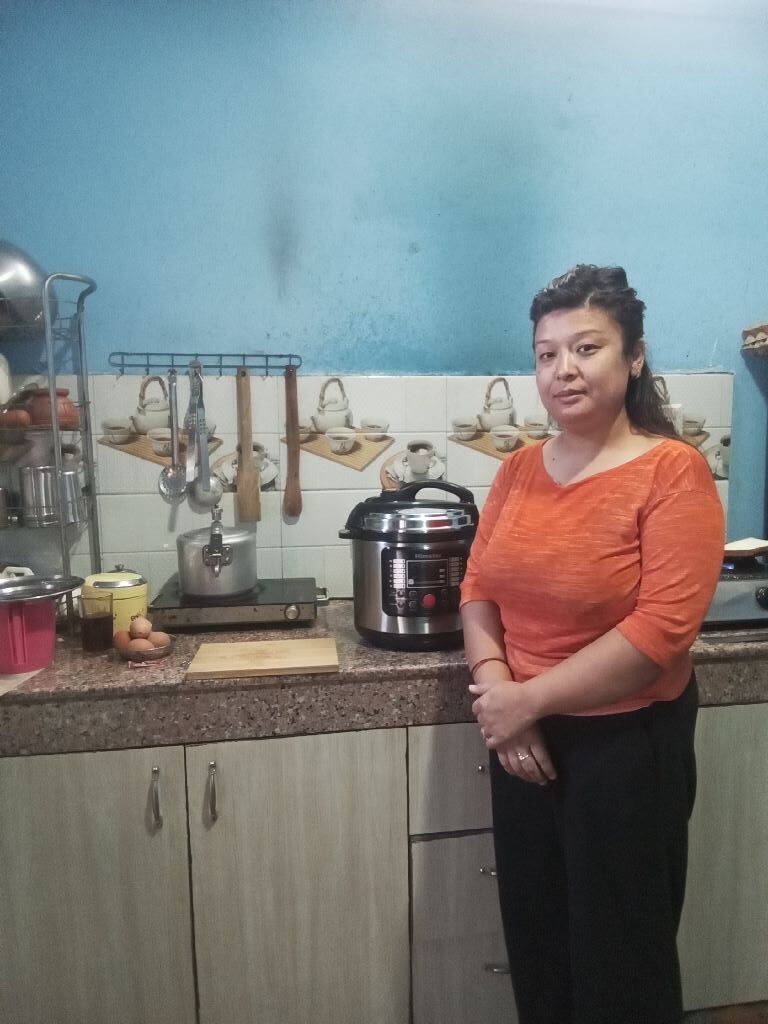
Featured Image: DCM study participant from Nepal. Photo credit: Practical Action Consulting, 2025.
AI disclaimer: AI was used in the early stages of data analysis and synthesis, with the results then checked and edited by a human. The content and reflections were led by the author.