- Date
- 3rd March 2026
- Categories
- Scaling eCooking
By Dr. Simon Batchelor OBE (Gamos Ltd. / Loughborough University).
We have numerous webinars, which are dutifully recorded and contain a wealth of insights. This blog is part of a series to turn a rich in-depth webinar into something akin to an ‘executive summary’, so the busy researcher might read to see if they want to listen to the whole webinar.
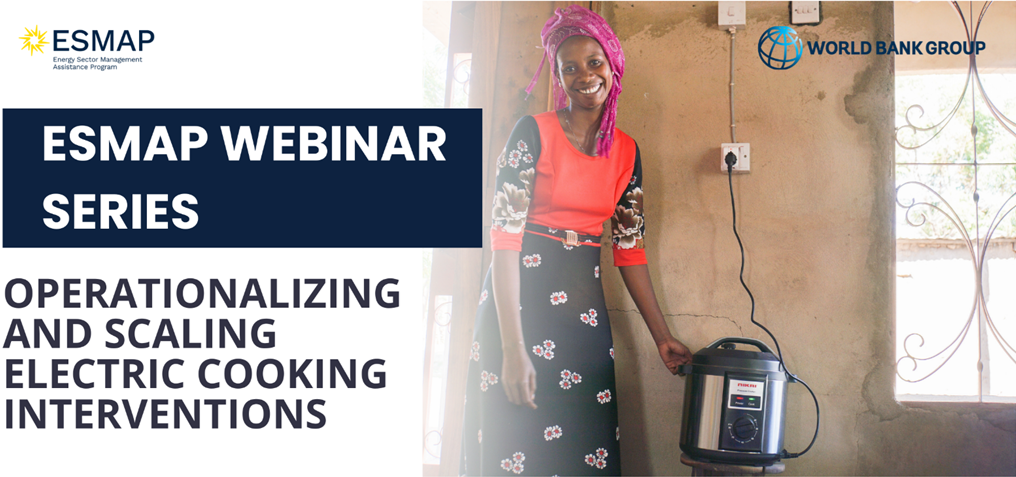
In this case it is Operationalizing and Scaling Electric Cooking Interventions on 20th January 2026 one of the webinars within the recent ESMAP webinar series. The “Operationalizing Clean Cooking” webinar brought together global and national actors who are helping to change that narrative, with a particular focus on electric cooking (e-cooking) as a scalable, mainstream solution. The discussion moved from big-picture framing to concrete national experiences in Tanzania and Uganda, underlining how modeling, tariffs, utility-led innovation, and finance are converging to make e-cooking viable at scale.
The transcript from the webinar was given to AI to convert into a summary, and then a human did the final edit.
Why Clean Cooking Must Be Central to Energy Access
In her opening remarks, Yadviga (“Yadviga”) Simon-Kolaneva, Energy Practice Manager for Eastern and Southern Africa at the World Bank, underscored the scale and urgency of the challenge with the usual statistics……around 2.1 billion people still lack access to clean cooking……dirty cooking fuels mainly biomass and fossil-based drive forest degradation, urban air pollution, climate change, and health burdens, disproportionately affecting women and children and yet in public discourse, “access” is still widely equated with electricity connections, relegating clean cooking to an afterthought.
She linked this directly to Mission 300, launched in April 2024, which aims to connect 300 million Africans to electricity—but with a critical twist: clean cooking is now explicitly embedded in the targets, not treated as a separate or optional agenda.
For Yadviga, the turning point is clear: a decade ago, the big questions were “Will electric cooking work?” and “Is it affordable?” Today, the focus has shifted to how to scale and make it nationwide, a profound milestone in the clean cooking journey.
From Pipe Dream to Mainstream: The MECS Program and Global Momentum
Professor Ed Brown, Director of the Modern Energy Cooking Services (MECS) program at Loughborough University, provided the historical and technical context behind this shift. Why was clean cooking left behind?
When MECS began in 2018, it set out to understand why the global community was failing to deliver clean cooking at scale, especially compared to the relative progress on electricity access. Key questions included:
- Why was clean cooking barely keeping pace with population growth?
- Why was it consistently treated as an energy side-issue, rather than a central pillar of development and climate strategies?
MECS examined the full suite of modern cooking fuels, electricity, LPG, ethanol, biogas and other high-tier options and found that electric cooking held particularly strong potential for scale because it can ride on existing and planned power infrastructure investments. Over the past several years, MECS has tested new, efficient appliances (notably electric pressure cookers), demonstrating that e-cooking can be far more affordable than previously assumed. It has conducted economic modeling and then “ground-truthed” it through real-world pilots, focusing on:
- Consumer desirability
- Actual usage patterns
- Financial viability
And it has worked on drawing more finance into the sector, including results-based financing (RBF), impact finance, carbon methodologies and large-scale carbon deals.
Ed highlighted some of the most visible signs of momentum:
- The Global Electric Cooking Coalition (GeCCo), launched at COP in 2023, now counts 36 members across governments and major institutions.
- The African Development Bank has already invested around US$15 million in e-cooking initiatives across three East African countries, with more expected.
- A landmark World Bank–Ghana Article 6 bond will support the delivery of around 250,000 e-cooking appliances through UpEnergy.
- Local manufacturing capacity is emerging in India and beginning in Africa.
- Several countries are now actively developing national e-cooking strategies.
In Ed’s view, the core message is simple but transformative: no modern energy access program should be designed without explicitly considering electric cooking as a key load and service.
Planning for Scale: Modelling Tools and Integrated Approaches
Scaling e-cooking is not just about hardware and subsidies; it also depends on robust planning and modelling tools. Professor Matthew Leach, part of the MECS senior management team, outlined the modelling landscape and how it supports policy and investment decisions. We have developed that talk into its own blog.
Tanzania: TANESCO as a Driver of E-Cooking
The webinar then turned to practical national experience, starting with Tanzania. Irene Goel, Director of Communications and Corporate Affairs at TANESCO, described how the national utility is taking a proactive, leadership role in scaling e-cooking.
TANESCO’s work began by confronting real, context-specific constraints. It sought a way to overcome high upfront costs of efficient appliances, the Low awareness and misconceptions around the cost (“electric cooking is too expensive”) and safety, to take into account cultural preferences for charcoal and firewood, to address the limited availability of efficient appliances in rural and peri-urban markets and to look at the mismatches between growing demand (driven by awareness) and local supply of appliances.
Why TANESCO is well placed to lead. Irene emphasized TANESCO’s structural advantages. It has extensive national reach and high public trust as the main utility, it has significant generation capacity (around 3,900 MW installed vs. roughly 2,000 MW demand), creating space to promote new loads like cooking, its ongoing grid expansion and reinforcement, align with higher loads from e-cooking, and it also has alignment with national climate and clean cooking commitments.
Irene also noted that they now had an internal workstream on institutionalization of e-cooking within TANESCO. E-cooking is now embedded in TANESCO’s corporate business plan with clean cooking champions designated across roughly 30 regions.
TANESCO has launched a broad public campaign, including the flagship “Kuni ni Umeme” message—positioning electricity as an affordable, safe, clean, and convenient cooking solution. On the operational side, they have piloted two important models:
- Staff Adoption Program
–In partnership with MECS, TANESCO offered subsidized electric pressure cookers (EPCs) to staff, repaid through payroll deductions.
– Over 4,500 EPCs have been distributed.
– Staff have become credible ambassadors within their communities—“you can’t preach what you don’t use yourself.” - On-Bill Financing (OBF) Pilot for Customers
– 500 EPCs distributed across 32 regions.
– Customers repay via small, fixed monthly deductions on their electricity bills (e.g., about TZS 12,500 per month). The objectives are to remove upfront cost barriers, test integration with utility billing systems and improve affordability and access.
Customer feedback from the OBF pilot highlighted demand for more flexible payment options (cash and installments), inclusion of other appliances (e.g., induction cookers), ability to access more than one device, larger-capacity appliances for bigger households and better notifications and tracking (e.g., automated alerts when repayment is complete).
TANESCO also noted key risks and challenges—such as what happens if a customer moves or dies, or perceptions that TANESCO is “turning into an appliance seller”—requiring careful design of legal, regulatory, and consumer protection frameworks.
Uganda: Tariffs and Regulation as Enablers
From Tanzania’s utility-led approach, the discussion moved to Uganda, where the regulator has played a central role. Patrick Tutembe, Principal Economist at the Electricity Regulatory Authority (ERA) of Uganda, described how tariff innovation and regulatory leadership have enabled e-cooking momentum.
Before 2019 the grid access in Uganda was around 25%, but only about 3% of households used electricity for cooking. Even among that 3%, electricity was rarely used as the primary cooking fuel. Electricity was widely perceived as too expensive for cooking, with little hard evidence to compare it to charcoal or LPG.
However, ERA partnered with the main utility to conduct a cost comparison study for institutions (schools and hospitals), comparing biomass vs. electricity. They used the findings to design Uganda’s first institutional e-cooking pilot, retrofitting the kitchen at Mulago National Referral Hospital to electric cooking (with LPG backup). That facility has now been using electric cooking continuously since 2020.
Designing the E-Cooking Tariff
In 2022, a presidential directive restricting charcoal supply to Kampala created both a challenge and an opportunity. ERA responded by introducing a dedicated e-cooking tariff with two main goals: – Shift cooking loads from biomass to electricity and ensure that households do not pay more for cooking with electricity than they would with charcoal or LPG.
Because Uganda’s metering systems cannot yet distinguish “cooking” units from other electricity uses, ERA mined the billing data to understand typical domestic consumption levels and common end-uses (lighting, phone charging, ironing, etc.). That analysis reasoned that cooking tends to be a “higher-tier” use coming after basic lighting and appliance needs, and concluded that to protect sector finances, they could not cross-subsidize all domestic units. The design they arrived at meant all domestic customers get an initial lifeline block of 15 units/month at a very low tariff, and the e-cooking block is from the 81st to the 150th unit in a month (70 kWh) which is billed at a reduced e-cooking tariff (around US¢11/kWh, vs. ~US¢20/kWh for standard domestic units). The cross-subsidy is borne by other domestic consumers, justified by system-wide benefits (higher load factors, more stable revenues), societal benefits (health, climate, forest protection) and alignment with national goals to increase per capita electricity consumption and support development. This structure sends a clear signal: Uganda wants electricity to be a cost-competitive cooking option, especially when using efficient appliances.
Unlocking the Market
The tariff and communication efforts have catalyzed a broader ecosystem response. MECS supported the creation of a Uganda e-cookbook, updated in 2024, which demonstrates that local dishes can be cooked electrically and compares costs across biomass, LPG, standard electric, and efficient e-cooking with EPCs. Utilities and partners have piloted EPC distribution, often on financed terms. Supply chains have begun to scale up, with appliance suppliers, clean cooking associations and renewable energy associations all engaging in the EPC market.
Uganda is now seeing results-based financing facilities from donors (e.g., SNV, GIZ, UK Aid, World Bank), institutional programs converting school kitchens (over 100 schools) to e-cooking, emerging biogas + e-cooking hybrids backed by the African Development Bank and is developing a national e-cooking strategy and carbon finance framework to leverage emissions reductions for appliance affordability.
ERA’s ongoing priorities include improving grid reliability, especially for large institutional loads, supporting equipment financing markets for institutional e-cooking and ensuring, through tariff and regulatory levers, that electricity remains the least-cost, cleanest cooking option in the medium to long term.
Looking Ahead: From Pilots to Policy-Backed Scale
The webinar painted a picture of e-cooking moving decisively from proof-of-concept to systemic integration:
- Global programs and coalitions are helping shift perceptions and mobilize finance.
- Modeling tools are enabling evidence-based planning, from cooks’ pots to national power systems.
- Utilities like TANESCO are innovating around on-bill financing, staff-led behavior change, and nationwide campaigns.
- Regulators like ERA are using tariffs and policy signaling to unlock demand and crowd in private and development finance.
Perhaps most importantly, the session underscored that clean cooking is no longer a peripheral add-on: it is becoming central to how countries think about electricity access, climate action, and inclusive development.
…………………………..
Featured image credit: ESMAP.
As stated in the introduction, a transcript of the webinar was fed to AI, which created the raw blog, which was then edited by humans.