
- Date
- 8th June 2026
- Categories
- Clean Cooking, Commercial Cooking, Electric Cooking
By Jacob Fodio Todd, Richard Sieff & Nigel Scott
An in-depth MECS market estimation exercise identifies at least 35,000 commercial cooking businesses and vendors in Nairobi city (with a population of ~5 million), where it was piloted. A micro and small business cooking study of 200 businesses in Kenya finds that on average a food business employs twice that number, around 70,000 individuals at least in the capital. Even more remarkable is that each of those micro and small commercial cooking food businesses (using the same study data) serves on average 50 customers per day, potentially contributing to 1.75 million city dwellers meals per day. That is over a third of the population in Nairobi, served daily.
In this blog we explain how we got to those numbers. Findings are now emerging from several commercial cooking projects commissioned or supported by the MECS programme in 2025. These projects build directly on research gaps identified in a 2024 working paper, which highlighted limited understanding of the commercial cooking sector, and wondered what its role could be in scaling clean and electric cooking. Taken together, the new evidence reveals significant opportunities for eCooking and strengthens the case for further research and targeted investment.
In late 2024, MECS commissioned scoping studies to develop understanding of the main commercial cooking segments in Uganda, Nigeria and Kenya). These studies shed light on some of the in-country characteristics of the commercial cooking sector, deepening understanding of fuel use, segmentation and types of business.
The studies found that rapidly increasing urbanisation is accelerating the prospect of eating or buying foods outside the home. In cities, eating habits and diets are changing quickly, driven by factors such as time poverty among working households, reduced living space, and the increasing availability and popularity of affordable prepared and processed foods competing with the preparation of traditional foods. They also confirmed the dearth of literature, data or consolidated information about the sector, and critically highlighted a rudimentary understanding of the overall number of commercial cooking businesses (CCBs). This lack of data on cooking businesses is exacerbated in countries where the informal sector plays a large role in an economy: many informal cooking businesses remain hidden from traditional statistical measures.
This lack of data on market size has important implications as it limits stakeholder understanding of the scale of the clean cooking opportunity for CCBs which are arguably one of the most common business types in many countries and potentially deters engagement and investment. These concerns were raised in consultation with the Shell Foundation (SF), leading to two simultaneously launched MECS-SF collaborations in 2025: a new project to develop and pilot a commercial cooking market sizing methodology; and the addition of a research element to understand the Productive Use of Energy opportunity for women led CCBs within an existing results-based financing (RBF) programme.

Market Estimation Method Development and Pilot
Funded by MECS, the development of a market estimation methodology was piloted in Kenya with consultant Walter Kipruto. The objective was to take steps towards determining and showcasing the number of businesses to help identify areas primed for business cooking energy transition and unlock funding.
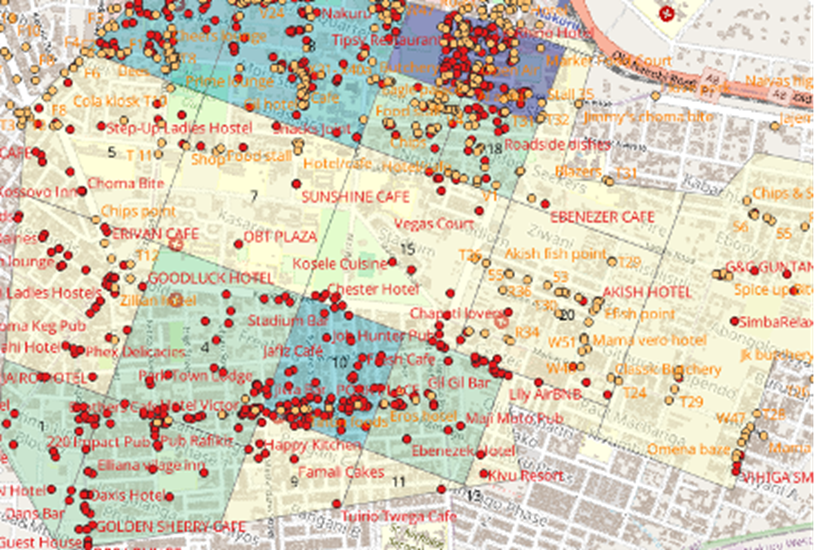
With two distinct steps, the formal businesses are captured though the use of common online mapping tools and social media with digital processing. Application Programming Interfaces (APIs) automate the data harvesting of keywords indicative of CCBs (e.g. cafes, restaurants, hotels). This process creates a database of ‘digitally listed’ CCBs for a limited number of target areas. A second step is primary data collection in the form of transect walks, to validate digitally gathered data (‘do the digital CBBs exist?’) and identify additional CCBs that have no digital footprint (often in the informal sector).
The data harvesting takes into consideration land-use, people density and buildings footprints and functional and spatial classifications of areas (e.g. urban, suburban, rural) from national datasets. The transect walks inform relationships between the number of digital and non-digital food vendors in different settings. The resulting ratios, aggregating multiple data points and area types, are being used to build a typology of vendor settings intended to predict the total number of vendors in target areas using digital data harvesting and land-use characteristics, without requiring transect walks.
This methodology is designed to be transferrable, scalable and deployable in many contexts to provide crucial insight into informal businesses that may only be locally known, as well as formal business registered with the respective authorities, that are highly likely to have a digital footprint. Using this methodology we were able to estimate the number of commercial cooking businesses in Nairobi and Nakuru counties and are currently working on a countrywide estimate and preparing the methodology for publication.
Cooking as a Productive Use of Energy (PUE)
The development of a methodology to map and estimate formal and informal businesses, was prompted by Shell Foundation’s (SF) PUE work. MECS worked with SF on its results-based financing (RBF) programme for Productive Use Appliances to Promote Gender Outcomes – a TEA (FCDO), Shell Foundation, Odyssey, CrossBoundary Advisory initiative. That initiative was launched in 2024, to stimulate private companies to undertake activities outside their usual scope of activity. The MECS contribution was to research, and analyse IoT stove data with BURN support, 400 of the roughly 2500 women-led businesses that have bought and adopted BURN induction stoves in Kenya and Tanzania as part of the SF RBF.
Initial findings are highly encouraging showing considerable impact including cost savings of $20+ dollars on average and carbon emission reductions of 1.1-1.7tCO2 per device per year, through reduced traditional fuel purchase and use. This is despite reported challenges such as electricity supply reliability and cookware size limitations. The study overall builds evidence of the value of cooking as a productive use of energy (PUE), an often-overlooked segment, which would benefit from a more pro-active and systematic focus from funders. It also highlights the incredible capacity, adaptability and incremental innovation of small businesses, embracing induction stoves and mitigating cookware limitations by making use of traditional cookware, pictured below.

What stands out, beyond the cost and energy savings, is the economic impact through the not insignificant contribution of these largely informal Micro, Small and Medium Enterprises (MSMEs) to the national economy. The time savings and reported income uplift was reported by over 73% of businesses after adopting the induction stoves, achieved through increased productivity, predominantly through faster cooking. Equally, according to this data, on average the ~200 cooking businesses in Kenya employ (or economically engage might be more accurate for an informal setting) conservatively twice that number and serve 50 customers per day on average.
Hence our introductory paragraph – An in-depth MECS market estimate study identifies, at the conservative end of the estimates, at least 35,000 commercial cooking businesses in Nairobi city (with its population of ~5 million) where it was piloted. A micro and small business cooking study of 400 businesses find that on average a food business employs or economically engages twice that number of ‘employees’, around 100,000 individuals in the capital. Even more remarkable is that each of those micro and small commercial cooking food businesses (using the same study data) serve on average 50 customers per day, potentially contributing to 1.75 million city dwellers meals per day. That is over a third of the population in Nairobi, served cooked food out of the house, daily.
*********************************************************************************************************
Featured Image: Electric warming cabinet and electric deep fat fryer in a hotel in Nairobi (Image Credit Jacob Fodio Todd, MECS)
AI Disclaimer: No AI was used in this blog.