
- Date
- 28th April 2025
- Categories
- Alternative Fuels
By Dr Chipo Mukonza, Matthew Stone and Dr Benjamin L. Robinson
Anaerobic digestion (AD) offers significant direct benefits at household, community, and commercial levels, transforming waste into valuable resources. It enables effective waste management, provides clean cooking gas, promotes a shift from synthetic to organic fertilisers, and generates cost savings through the utilisation of waste streams. Biodigesters are most cost-effective when located near readily available feedstocks (such as animal, agricultural, and kitchen waste) and water. This localised approach allows them to adapt to regional cooking practices, requires a less specialised workforce, simplifies management, and offers the dual benefit of biogas fuel and fertiliser as byproducts, depending on the type of biodigester used. However, the widespread adoption of anaerobic digestion is hindered by high upfront costs, operational challenges (such as venting, loss and leaking, poor construction and maintenance leading to failure and abandonment) as well as policy gaps, and clashes with socio-cultural public perception.
However, there is an opportunity in the biogas sector to democratise biogas systems and provide farmers information to better operate their systems. An active, internet of things enabled, monitoring approach to biodigester operation and maintenance can lead to a considerable increase in biogas availability (in some cases up to 60% increases in biodigester performance), thereby enhancing user experience and trust in biogas as a clean cooking fuel and technology especially when the meter is cost-appropriate to the context and concurrent benefits.
This blog post examines the role of smart metering in unlocking the full potential of biogas for cooking, exploring how this technology can address key challenges, empower households, improve data collection for better policymaking, and ultimately foster a sustainable biogas market. Furthermore, this blog highlights the opportunities presented by smart metering and its impact on affordability, usage monitoring, and overall sustainability.
Smart Metering for Biogas
Implementing smart metering systems for biogas production offers several benefits and challenges (Figure 1). One of the primary benefits is the enhanced efficiency and stability of biogas production through real-time monitoring and control of critical parameters such as temperature, flowrate, gas consumption and pressure.

This capability allows for the optimisation of the anaerobic digestion process, which is crucial for maintaining the appropriate conditions for methanogenic bacteria and preventing issues like over or under feeding that can lead to system failure. Smart metering systems facilitate data-driven decision-making, enabling operators to select the optimal feedstock and adjust process conditions dynamically, thereby improving gas yield and resource management. The use of IoT in biogas systems also supports remote monitoring, providing users with real-time insights into digester performance and allowing for timely interventions to address any deviations from optimal conditions. The remote monitoring of biogas also unlocks a huge opportunity for improving biodigester performance by tracking gas consumption, leakage, and venting (Figure 2 below). For biogas providers and policymakers, smart meters offer a wealth of information. Aggregated data can provide insights into biogas usage patterns, identify areas with high potential for biogas adoption, and inform targeted interventions. This data can also be used to develop more effective financing models, such as pay-as-you-go schemes, making biogas more accessible to low-income households. Furthermore, the data can help verify carbon emission reductions, opening opportunities for carbon financing and incentivising biogas adoption.

However, the implementation of smart metering systems is not without challenges. Security concerns, particularly related to IoT vulnerabilities, pose significant risks, including potential data breaches and unauthorised access, which could compromise system integrity and user privacy. Moreover, the integration of such advanced technologies requires substantial initial investment and technical expertise, which may be a barrier for widespread adoption, especially in regions with limited resources. Despite these challenges, the potential for improved sustainability and efficiency in biogas production makes smart metering systems a promising development in the renewable energy sector.
Aligned with the triple value proposition of improved user experience, enabling pay-go, and connecting to carbon financing, figure 3 below outlines a typical application of the smart biogas system in East Africa at the household level.
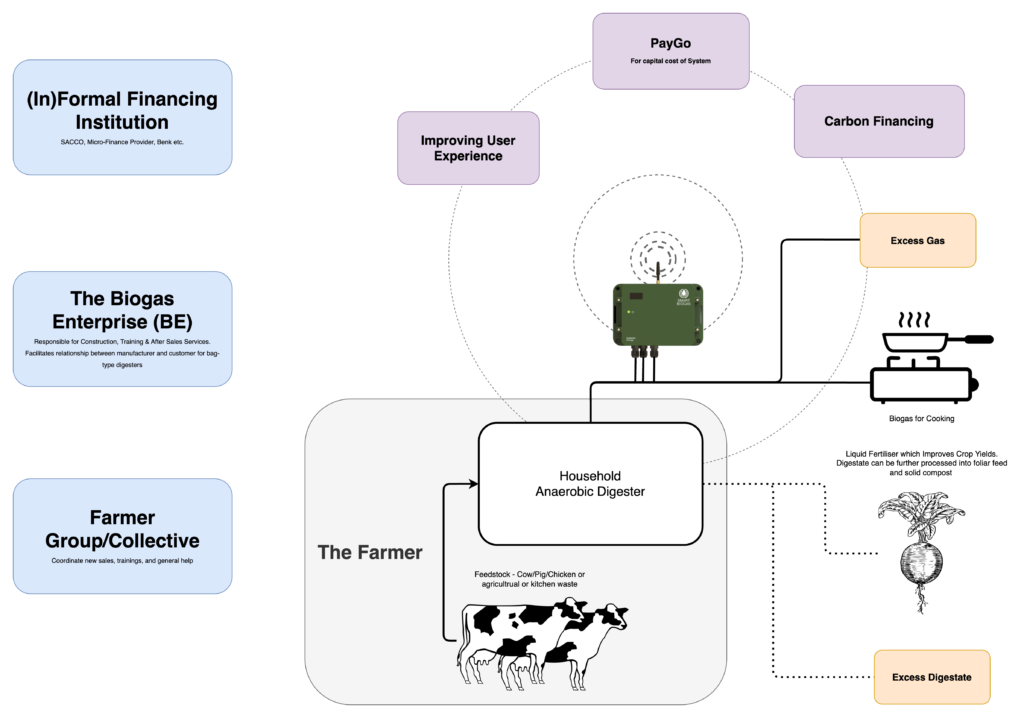
In addition to the household level, Smart Biogas unlocks a number of interesting and different delivery models across other scales, especially the community and commercial scales. Within these scales it becomes possible to blend approaches and leverage public-private partnerships to operate biodigesters at even greater cost savings.
Biodigesters at any scale are complex living systems that require careful management and are not always easy for users to operate optimally. A common “install and ignore” approach or “fit & forget” attitude both for biodigesters themselves and any accompanying smart meters, fails to realise their full potential. This lost opportunity negatively impacts the environmental benefits of biogas and can erode user confidence in the technology. Active monitoring of biogas usage can maximise efficiency. This blog presents some of the impact stories of installing smart meter for biogas cooking.
Case Study: Impact story from Jinja, Uganda
In 2022, Biogas Uganda Solutions Ltd (BSUL) and Inclusive Energy installed 60 Smart Biogas meters, including one at Rita’s farm (Figure 4). In 2023, the system revealed that her digester was venting gas for an average of 5 hours daily, limiting her cooking time to just 2-2.5 hours. Unaware of the issue, Rita had accepted this as normal. With insights from the Smart Biogas Platform, a BSUL Quality Service Provider identified the problem and advised her to increase her cooking time, reducing pressure and minimising gas loss. As a result, Rita was able to increase her cooking time to 3.5-4 hours per day, demonstrating how real-time monitoring can optimise biogas usage and enhance energy efficiency. This case study demonstrates how the “install and ignore” approach identified earlier can be addressed through adoption of smart metering.
Next Steps for Stakeholders in Smart Biogas Meter Adoption
Financial barriers are a major hurdle, particularly for rural households and small-scale farmers who may struggle with the upfront costs of smart biogas meters. To make this technology more accessible, governments and financial institutions should promote affordable financing models, such as pay-as-you-go (PAYG) schemes, microloans, or subsidies for low-income users.
One such promising pilot by Biogas Uganda Solutions Ltd (BSUL) has demonstrated the potential of Smart Biogas meters for transparent and fair agreement between Biogas installers and end users. Through a lease-to-own model integrated with a Pay-As-You-Use (PAYU) scheme, 24 farmers, half of them women, have successfully installed and used biodigesters in low-income regions in Uganda. The smart meters track usage, ensuring payments align with gas consumption, making the technology more accessible and ensuring use and customer satisfaction before payment. A revolving fund has been established to scale the initiative, enabling more farmers to adopt biogas who would otherwise be unable to afford it. Initiatives such as these can ease the financial burden while enabling more widespread adoption. Additionally, partnerships between biogas companies and carbon financing programs can further offset costs by linking smart metering adoption to carbon credit incentives. Leveraging real-time data for system optimisation and policy decision-making can also strengthen the biogas sector. Engaging in community discussions and user groups can help share best practices and improve overall system management.
As we look ahead, the integration of smart technologies in biogas systems offers a promising path toward greater energy resilience, environmental sustainability, and improved livelihoods for millions worldwide.
***************************************************************************************************************
Featured Image: Rita and her Smart Biogas System and Stove. Photo Credit: Inclusive Energy