- Date
- 13th June 2025
- Categories
- electric cooking, General, Webinar
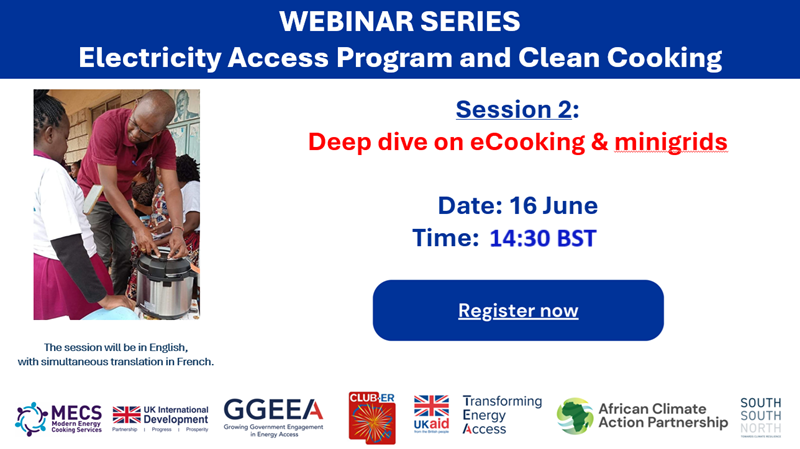
Registration is open for the forthcoming webinar “Deep dive on eCooking & minigrids”, led by Growing Government Engagement in Energy Access (GGEEA) and supported by the UK Aid (FCDO) funded Transforming Energy Access (TEA) programme, to be held on Monday 16 June 2025, 14:30 – 16:00 BST.
Clean cooking and access to reliable electricity are critical for sustainable development, impacting health, gender equality, economic opportunities, and environmental sustainability. In areas lacking access to national grids, mini-grids powered by hybrid, solar and hydro sources offer a promising solution for providing electricity. Simultaneously, the promotion of electric cooking (eCooking) presents a cleaner, more efficient alternative to traditional biomass fuels. The integration of eCooking into mini-grid systems offers mutual benefits, increasing the load factor and revenue streams for mini-grid operators while providing end-users with a modern, clean, and convenient cooking solution. However, effectively integrating eCooking into mini-grid planning, design, and operation requires a deep understanding of the technical considerations, business models, social factors, and policy environment.
This session will delve deep into the integration of eCooking solutions with mini-grids to address energy access challenges. It aims to provide participants with a comprehensive understanding of how these innovative approaches can transform off-grid communities. The overall objective of this webinar is to equip participants – policymakers, with the challenges and opportunities in deployment of integrated eCooking and mini-grid solutions, contributing to improved energy access. The webinar will be led by Dr. Will Clements, researcher at Modern Energy Cooking Services (MECS).
The webinar is the second event of a three-webinar series exploring the intersection of cooking technologies and electrification policies, focusing on affordability, financing mechanisms, and the role of innovative solutions like mini grids.