By Ed Brown and Eva Idugboe (Loughborough University).
Building on a busy first three days, MECS and our Global Electric Cooking Coalition (GeCCo) partners kept up a strong presence across sessions and discussions at COP31 in Antalya, Türkiye: from appliance standards and national clean cooking ambitions to the role of electricity in the wider energy transition.
Across these days, one message kept returning: electric cooking is now firmly part of the conversation, and the task ahead is making sure the appliances, electricity systems and partnerships behind it are built to last.
Why quality matters: our Standards Pavilion event
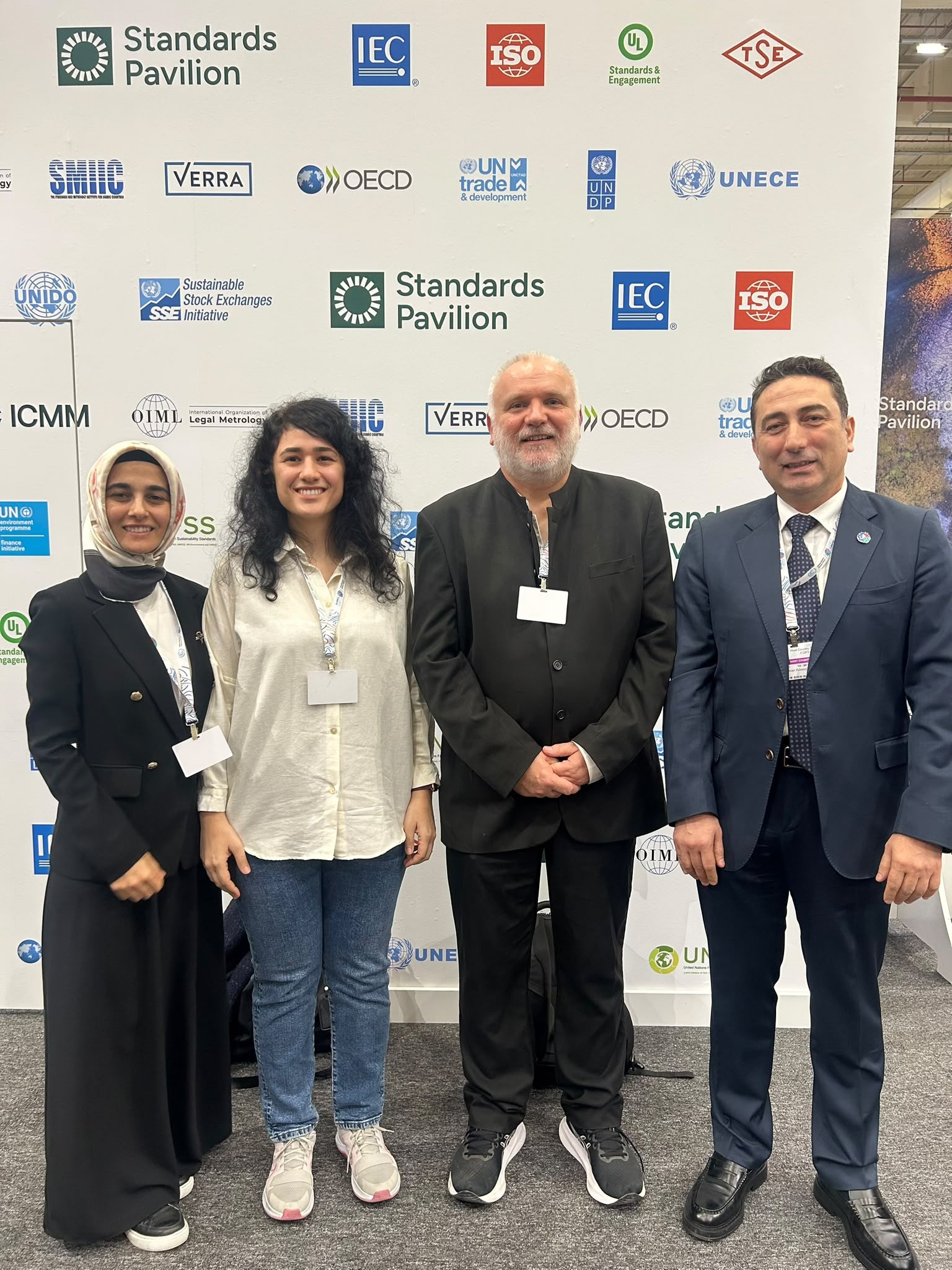
On 12th November, MECS hosted “Enabling Access to High Quality, Efficient eCooking Appliances for Emerging Economies” at the Standards Pavilion in the Blue Zone. After a brief overview from Prof. Ed Brown, CLASP and the International Electrotechnical Commission (IEC) set out why standards and appliance quality are so crucial to the long-term success of the electric cooking transition. The IEC also shared highlights from the event on LinkedIn.
The second session gave two of Türkiye’s major appliance manufacturers, Kumtel and Beko, the chance to explain why their business models focus so strongly on quality and efficiency, and to explore how they might engage more closely with the fast-growing markets of Africa and South Asia. Bhushan Trivedi of ATEC added insights from serving a growing number of markets across both regions.
The discussion then turned to country experience. Justine Akumu of Uganda’s Ministry of Energy and Mineral Development described Uganda’s work under the MECS-supported eCooking Scale and Support Programme, with a particular focus on collaboration with the Uganda National Bureau of Standards. This was complemented by a presentation on TANESCO’s on-bill financing programme in Tanzania, and a contribution from Eng. Bashiir Mohamed Soofe, Head of Energy Projects at the Ministry of Energy and Water Resources of Galmudug State, Somalia, who stepped in at short notice to speak on Somalia’s ambitions for an eCooking transition. Across all three countries, the conversation highlighted how the quality of cooking appliances, and of the electricity systems that serve them, underpins a sustainable transition.
In the final session, chaired by Prof. Ayse Demir, Tamojit Chatterjee of Sustainable Energy for All (SEforALL), Patrick Tonui, Head of Policy and Regional Strategy at GOGLA, and Henry Neufeldt of the UN Environment Programme (UNEP) took up these themes from a global perspective. We will share a more detailed account of the event once the recording is available.
Charting the road to Nairobi
MECS was also represented at the Leaders’ Roundtable on Clean Cooking in Africa, hosted by the COP31 Presidency, Tanzania, the International Energy Agency (IEA) and the Clean Cooking Alliance. The roundtable reviewed progress since the first Summit on Clean Cooking in Africa in Paris in 2024 and looked ahead to the second Summit, to be hosted by the Government of Kenya in Nairobi on 27 to 28 January 2027.
Pakistan: a major growth market for electric cooking
On the evening of 12th November, Prof. Ed Brown took part in a fireside chat at the Pakistan Pavilion. Pakistan is emerging as a major growth market for electric cooking. The event built on a recent visit by GeCCo Global Manager Alicia Butterfield, who took part in the national consultation workshop on Scaling eCooking in Pakistan, led by the National Energy Efficiency and Conservation Authority (NEECA), the Sustainable Development Policy Institute (SDPI), UNESCAP and MECS. COP31 gave us the opportunity to continue and deepen that conversation (see SDPI’s photo from the event). The opportunities for eCooking growth in Pakistan are significant, and MECS and GeCCo look forward to playing our part in this transition.
Electrification moves centre stage
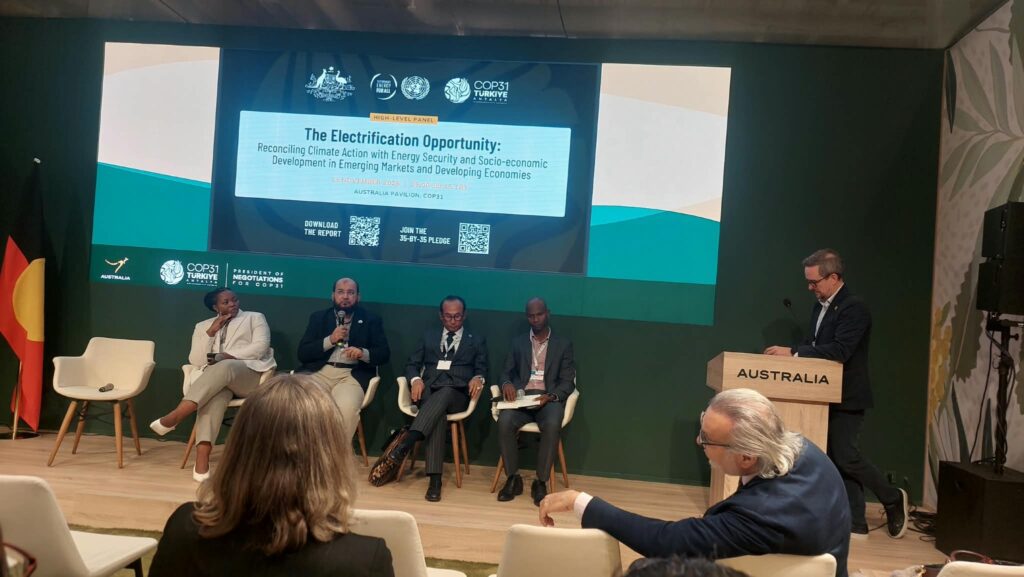
On 13th November, MECS attended a high-level panel at the Australia Pavilion led by SEforALL on its flagship report, The Electrification Opportunity. The report, launched by the COP31 Presidencies with the Australian Government, aims to elevate end-use electrification in energy transition planning and in countries’ third-generation Nationally Determined Contributions (NDCs 3.0). It directly supports the COP31 Presidency’s 35-by-35 Global Electrification Pledge to raise electricity’s share of final energy consumption to 35% by 2035. As in the report itself, the discussion frequently referred to electric cooking as a key part of accelerated electrification.
The session was followed by an impromptu meeting between Electrify Now, SEforALL and MECS, where we explored how to grow the partnership between GeCCo and Electrify Now.
Clean cooking portfolios with the Global Biofuels Alliance
On 16th November, MECS joined a roundtable hosted by the Global Biofuels Alliance. It brought together governments, international organisations, financial institutions, industry, standards bodies, researchers and practitioners to examine how countries can scale locally appropriate portfolios of clean cooking solutions, including electricity, LPG, sustainable bioethanol, biogas, biomethane and health-compliant advanced biomass. Discussion covered the policy, standards, supply chain, affordability, institutional and financing conditions needed to sustain adoption, and how the Alliance can advance biofuel-based clean cooking while complementing the work of established clean cooking institutions.
MECS offered reflections on our work with the African Energy Commission (AFREC) on multi-fuel pathways for clean cooking strategy development, alongside our research on approaches to bioethanol development, our review of current thinking on biogas, and initiatives we have supported on bio-LPG.
Building partnerships
One of the most valuable parts of any COP is the chance to sit down with partners and chart out opportunities for collaboration. Highlights over these days included:
Somalia: a conversation with Somalia’s Ministry of Energy and Water Resources on supporting the implementation of the electric cooking dimensions of the National Clean Cooking Strategy, which was launched earlier in the week.
Kenya: a catch-up with colleagues from the Ministry of Energy and Petroleum and the Energy and Petroleum Regulatory Authority (EPRA) on recent developments accelerating the eCooking transition in Kenya, including the Kenya E-Cooking Market Development Project, financed by the African Development Bank and co-financed by Italy through the Rome Process/Mattei Plan Financing Facility, which MECS helped to develop with the AfDB, the Ministry of Energy and Kenya Power. The Ksh1.1 billion programme, approved by Cabinet in October, will deliver 100,000 electric cookers across four counties: Nairobi, Kiambu, Machakos and Kajiado. We also discussed how we can deepen our partnership.
ICLEI: a wide-ranging discussion with Dr Meggan Spires, Director of Sustainable Finance and Global Coordinator for Sustainable Finance at ICLEI Africa, on deepening our existing partnership in Uganda and on combining our strengths globally to place clean cooking more firmly within urban planning, service delivery and local and regional governance. Our recently published work on subnational planning for the eCooking transition shows the kind of themes we hope to build on.
CCAC: an update for our Climate and Clean Air Coalition (CCAC) colleagues on progress under our CCAC-funded Accelerating eCooking Uptake in Africa and South Asia (ACUASA) project, and a discussion on strengthening the growing relationship between the global superpollutants and electric cooking communities. One example is Prof. Ed Brown’s interview at the CCAC Annual Meeting in Bangkok in October, for the We Don’t Have Time and CCAC series Accelerating Action on Climate and Clean Air.
Making the superpollutants case for electric cooking
At COP31, Prof. Ed Brown also joined We Don’t Have Time’s special report on superpollutants, “Cooling the Planet: The Race to Cool”, hosted by Nick Nuttall alongside Durwood Zaelke, President of the Institute for Governance & Sustainable Development. Ed argued that electrification, the central theme of this COP, makes now the time for a transition to electric cooking, which also helps utilities by increasing electricity demand. He drew on Tanzania’s experience, where TANESCO’s on-bill financing pilot, supported by MECS, achieved repayment rates of around 96% and led the utility to adopt a target of a million households cooking with electricity. He also highlighted a part of the clean cooking story that is rarely told: methane is released through the incomplete combustion of biomass, the production of gas and leaks from gas stoves, which makes the case for electric cooking a superpollutants and health case as well as a carbon one. Watch the full conversation on YouTube.
Looking ahead
From appliance standards to national strategies and global electrification goals, these days showed how firmly electric cooking is now part of the climate conversation. MECS and GeCCo will continue to build on these partnerships through the second week of COP31 and on the road to the Nairobi Summit in January.
…………………………………………….
Featured image, top: Neslihan Akkaya, Dr. Ayse Demir, Prof. Ed Brown and Osman Koseoglu at the Standards Pavilion, COP31 (photo credit: Ayse Demir).
Drafted by Ed Brown, researched and edited by Eva Idugboe.
AI disclaimer: No AI was used in the production of this output.