
- Date
- 29th July 2026
- Categories
- eCooking, Technology
By Dr Yesmeen Khalifa (MECS, Loughborough University) and Dr Simon Batchelor, (OBE) (Gamos Ltd. / Loughborough University)
The MECS-supported pilot in Got Ngur Village, Nwoya District, Uganda, tested an important question for modern energy cooking transitions: can battery swapping enable eCooking in a rural mini-grid community where household connections are too weak to run an electric pressure cooker directly?
What was tested
The pilot, implemented by Bayes Consulting with support from Loughborough University and MECS, enrolled 50 households over three months. Each household received a 500W, 5-litre Ewant DC EPC powered by portable 1.4 kWh lithium iron phosphate battery packs. Instead of charging at home, households swapped depleted batteries for charged ones at a central station connected to the Mandulis Energy hybrid solar-biomass gasification mini-grid. An electric three-wheeler supported doorstep battery delivery, reducing the burden on users and improving convenience.
This model directly responds to a key lesson from wider SEforALL and MECS work on battery-supported eCooking: battery swapping is most relevant in “Goldilocks” contexts where households are close enough to a station for regular swapping but lack electricity access strong enough for direct cooking1. Got Ngur offered exactly this type of test case. The households participating in the pilot were not directly connected to the mini-grid.
Key findings:
The technology worked, but the system needs redesign for scale
The technical performance was strong. The EPCs achieved a 96% reliability rate and successfully cooked staple dishes including beans, rice, posho and meat stew. Bean cooking time fell from several hours on firewood to around 30–45 minutes under pressure. Across 232 dMRV-recorded cooking sessions, average energy consumption was 0.755 kWh per cooking event, with an average cooking duration of 22.5 minutes.
User satisfaction was also high. Overall EPC satisfaction reached 4.63 out of 5, with station operator support scoring highest at 4.88. Training, affordability of the pilot swap fee, and convenience of the swap service were also rated positively. This matters because adoption is not only about appliance performance; it also depends on trust, support, after-sales service and the fit between technology and everyday cooking routines.
However, the pilot also revealed clear constraints. Battery duration was the weakest dimension, scoring 2.94 out of 5, with 40% of households reporting that the battery ran out before the last meal was complete. The 1.4 kWh pack was not sufficient for households cooking two to three meals a day. As a result, no household fully abandoned firewood. Families continued to stack fuels, using the EPC mainly for beans and rice, while retaining firewood for morning tea, posho and backup during outages.
The mini-grid became a critical bottleneck
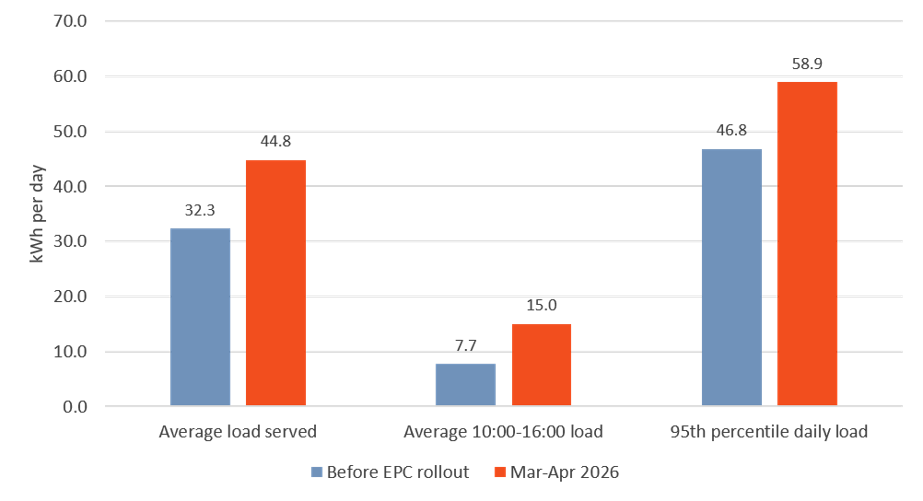
The pilot also showed that battery swapping can create valuable daytime demand for a solar-based mini-grid, but only if the host system has enough headroom. During the pilot, the Mandulis mini-grid’s average daily load increased by 38.7%, from 32.3 kWh to 44.8 kWh. Charging demand became high enough that the operator had to withdraw 11 EPCs from circulation, reducing the active fleet from 50 to 39 households.
This is one of the most important lessons from the pilot: battery swapping can solve the household-side constraint, and it can improve utilisation of the mini-grid, particularly during the middle of the day. However, such utilisation has its limits depending on the headroom of the grid. In this pilot, the Mandulis mini-grid only had a 40% headroom and that was reached by the 39 EPCs. Future deployments could start with a clearer view of the system and its headroom, including PV output, battery bank configuration, charging windows, peak load margins and the needs of existing customers.
The pilot gave limited insights into the commercial viability
At its small scale and with a heavily subsidised introductory swap fee, the pilot was not commercially viable. The service recorded 417 swaps, generating US$57.92 in revenue and covering just 1.04% of operating costs. Average usage reached 3.6 swaps per household per month. Based on households’ existing cooking fuel use, however, the team had predicted around 16 swaps per month under a full fuel-switching business model. This mismatch is perhaps unsurprising in a pilot of limited duration that required such a significant behavioural change.
So, what might a scaled version of the pilot look like? A more useful commercial pathway emerges when the service is viewed not as a stand-alone battery business operating at today’s utilisation, but as an incremental service built around an existing mini-grid. This was an experimental pilot, and it is no criticism of the team to observe that several cost-saving measures become possible at scale. The pilot operated a battery delivery service; a commercial model might instead use central collection points. Battery costs are also likely to fall through bulk procurement and the continuing decline in battery prices, we assumed a cost of around US$150 per battery.
If household usage increased from the observed 3.6 swaps per month to around 14–16 swaps as familiarity and confidence grew, close to the level the team associated with near-complete fuel switching, each household would consume around 20–22 kWh of electricity per month. The Mandulis mini-grid, in its current configuration, could not support 39 households at this level, but many other mini-grids have considerably greater spare generation capacity. Let us therefore assume that a grid with adequate headroom, or the Mandulis system with only modest additional investment in PV capacity, could accommodate this increased demand. Mandulis currently charges most customers US$0.25 per kWh, so let us also assume that this is the tariff charged to the battery-swapping service. At this rate, the electricity itself would cost the swap operator around US$5 per household per month, while increasing Mandulis’ annual revenue by approximately US$2,500, assuming that spare generation capacity is available.
With these relatively modest changes, our indicative reconstruction suggests that the full-service cost could fall from around US$37 per household per month to approximately US$20–22 per household per month. Assuming battery lifetimes of eight to ten years, together with tighter control of administration and repair costs, this could fall further to around US$17–18 per household per month.
This would still sit above the reported baseline cooking expenditure of US$7.17 per month. However, the report notes that this represents only the amount households typically pay to purchase approximately half of their firewood, with the remainder collected free of charge. If the economic value of that “free” wood is recognised, the effective baseline cooking cost is closer to US$14 per household per month, suggesting that a service costing around US$17 per month is no longer dramatically out of reach. It is also important to recognise that this revised modelling simply applies a small number of straightforward changes to the pilot assumptions; it does not represent a comprehensive redesign of the business model.
Nevertheless, the availability of freely collected wood remains a significant challenge. Some form of additional support through carbon finance, results-based financing or a utility cross-subsidy would therefore still be needed to bridge the remaining affordability gap of perhaps US$7–9 per household per month. Viability may depend as much on utilisation, battery costs, logistics design and the ability of the mini-grid operator to share in the value created by higher electricity throughput as on the technology itself.
While the Bayes team identify affordability as a core barrier, the pilot provides only limited evidence on actual willingness to pay. Was low usage really a question of willingness to pay, given that swaps were heavily subsidised, or was it primarily a consequence of the short pilot period and the considerable behavioural change required for households to alter long-established cooking practices? Usage would reasonably be expected to increase over time as households became more familiar with the appliances and recognised new opportunities to use them. For example, very few participants used the EPC simply to prepare morning tea, despite this being one of the easiest and most convenient applications.
Planning for scale, improving operational efficiency and optimising battery size all warrant further investigation and are likely to bring willingness to pay and commercial viability into closer alignment. As the Bayes team themselves note, the most promising long-term pathway is likely to be a blended business model combining household payments with concessional capital, results-based finance, carbon finance, productive-use customers and potential cross-subsidies from mini-grid operators who benefit from increased daytime electricity demand.
Recommendations for the next phase
The next demonstration could move from proof of concept to a more commercially realistic test. The report recommends testing with a larger mini-grid with more headroom, potentially around 500 households, with staged pricing to understand real willingness to pay. It also recommends upgrading to 2 kWh or larger battery packs, or testing a two-battery rotation model, so that a single swap can cover more of a household’s daily cooking needs.
Payment design they say, could also benefit from a change. A monthly bundle or prepaid wallet could reduce mobile money transaction friction and give operators more predictable cashflow. The dMRV system could be strengthened with better connectivity, offline data storage and dual-SIM capability to support reliable monitoring for usage, performance and carbon accounting.
Finally, future pilots should place GEDSI at the centre of design and evaluation. In Got Ngur, women carried the main responsibility for cooking, while men often influenced appliance purchase decisions. This reinforces the need for engagement with both cooks and decision-makers, while also tracking who benefits from time savings, convenience, cleaner kitchens and new service models. Inclusion should not be treated as a co-benefit added at the end, but as part of technology design, financing, customer support, monitoring and long-term impact measurement3.

The key message is therefore sharp: the technology performs, users value it, but we need longer term usage data, and the business model needs flexing for affordability and system-level viability.
This pilot matters provides the start of an evidence chain needed to move battery-swapping eCooking from an innovative idea towards a more robust, inclusive and scalable clean cooking solution for Uganda and similar weak-grid contexts.
For more information about the battery swapping pilot for eCooking in Uganda, please follow this link.
*********************************************************************************************************
References
1 SEforALL, MECS. Battery Supported eCooking Technologies with a Discussion on Battery Swap Models Whitepaper, Sustainable Energy for ALL 2026. https://www.seforall.org/system/files/2026-02/seforall-whitepaper-battery_supported_ecooking_technologies_with_a_discussion_on_battery_swap_models-fd-2-pdf-preview.pdf (accessed July 28, 2026).
2 Piwang H. Piloting a Battery Swapping Station for Electric Cooking in Uganda. MECS programme, Loughborough University, 2026 https://mecs.org.uk/wp-content/uploads/2026/07/Piloting-a-Battery-Swapping-Station-for-Electric-Cooking-in-Uganda.pdf (accessed July 28, 2026).
3 Khalifa Y. Leaving no one behind: Embedding GEDSI in modern energy cooking transitions. MECS programme, Loughborough University, 2026 https://mecs.org.uk/wp-content/uploads/2026/05/Leaving-no-one-behind-Embedding-GEDSI-in-modern-energy-cooking-transitions.pdf (accessed May 14, 2026).
*********************************************************************************************************
Featured Image Credit: The image is generated by ChatGPT using photos taken by Bayes Consulting, as seen in the “Piloting a Battery Swapping Station for Electric Cooking in Uganda” report.
AI Disclaimer: AI tools were used to support the structure of this blog, with all content refined and authored by a human.