- Date
- 23rd February 2026
- Categories
- Alternative Fuels, Carbon Finance, Clean Cooking
By Dr Samir Thapa (MECS Programme)
Clean cooking sits at the intersection of energy access, public health, gender equity, and climate change. Among available options, household biogas stands out as a proven, locally appropriate solution in countries like Nepal. What is less widely appreciated is that biogas is also a high-quality climate change mitigation activity – each installation delivers measurable and verifiable greenhouse gas emission reductions. At scale, these reductions, sold as credits, can generate carbon revenues that has potential to do more than supplement existing programs – lay out changes that can fundamentally reshape how biogas and other clean cooking systems are financed and sustained.
This blog brings together evidence from a sequence of related publications based on my PhD to show how that shift could happen. Moving from 1) household willingness-to-pay (WTP) analysis to 2) experiments eliciting preferences for alternative credit designs using carbon revenues, and finally to 3) qualitative insights from banks and program implementers, the research tells a consistent story. The challenge facing biogas is not a lack of household interest or value, but a financing architecture that fails to recognise households as investors and providers of environmental services. Re-thinking how carbon revenues flow towards households and rural credit markets opens new pathways for scaling biogas beyond subsidy-dependent models.
Household biogas has long been recognised as one of Nepal’s most effective clean cooking solutions. It reduces firewood consumption, improves indoor air quality, delivers climate mitigation, and aligns closely with rural livelihoods. Yet despite decades of subsidy support and a mature supply chain, adoption remains far below technical potential.
At scale, household biogas installations substantially reduce greenhouse gas emissions, creating meaningful carbon value which presents an opportunity to change the status quo in how biogas is financed. However, carbon revenues, where generated, have largely been absorbed at program level rather than used to reshape household incentives or credit markets.
The persistent gap between potential and uptake therefore raises a fundamental question: is the problem really affordability, or is it the way finance and incentives are structured?
A sequence of research from willingness-to-pay analysis, through experiments in financing, to qualitative institutional assessment offers a coherent answer. Together, these studies suggest that households are not passive subsidy recipients, but active economic agents willing to invest, provided financing mechanisms recognise their preferences, constraints, and contribution to environmental services.
Willingness to Pay: Revealing Suppressed Demand for Biogas
The starting point is the WTP analysis, which uses the contingent valuation method with the Heckman selection model, to examine how the provision of carbon revenue earnings influences household willingness to pay the full market price. This way the study challenges a deeply entrenched assumption in energy access policy: that rural households cannot afford clean cooking technologies without heavy upfront subsidies.
The study demonstrates that a substantial proportion of households are willing to pay close to, or even at, full market prices for biogas plants when realistic financing conditions are presented. Importantly, willingness to pay is not static. It increases significantly when households are offered two critical elements: access to credit and a share of carbon revenues as an environmental income.
This is a crucial insight in the context of suppressed demand. Traditional subsidy models assume low demand because observed purchases are low. However, the study shows that demand is latent rather than absent. When households are constrained by liquidity and uncertainty, rather than by lack of interest, upfront subsidies alone do not unlock adoption.
The introduction of a modest, predictable annual environmental income from carbon revenues changes household decision-making. It lowers perceived risk, improves affordability over time, and reframes the biogas plant not merely as a consumption good, but as a productive household asset. In economic terms, carbon revenue distribution shifts the intertemporal budget constraint faced by rural households.
Encouraging Biogas Construction: Carbon Revenues as Smart Finance, Not Charity
The second study moves from preference elicitation to policy design using discrete choice experiments. Whereas contingent valuation reveals the direct WTP of households under different financing conditions, the choice experiment observes how households trade off interest rates, repayment periods, and carbon-linked environmental income when choosing whether to invest in a biogas plant. It examines how biogas markets respond when carbon revenues are used differently, not as hidden project finance, but as transparent instruments to reshape household finance and credit conditions.
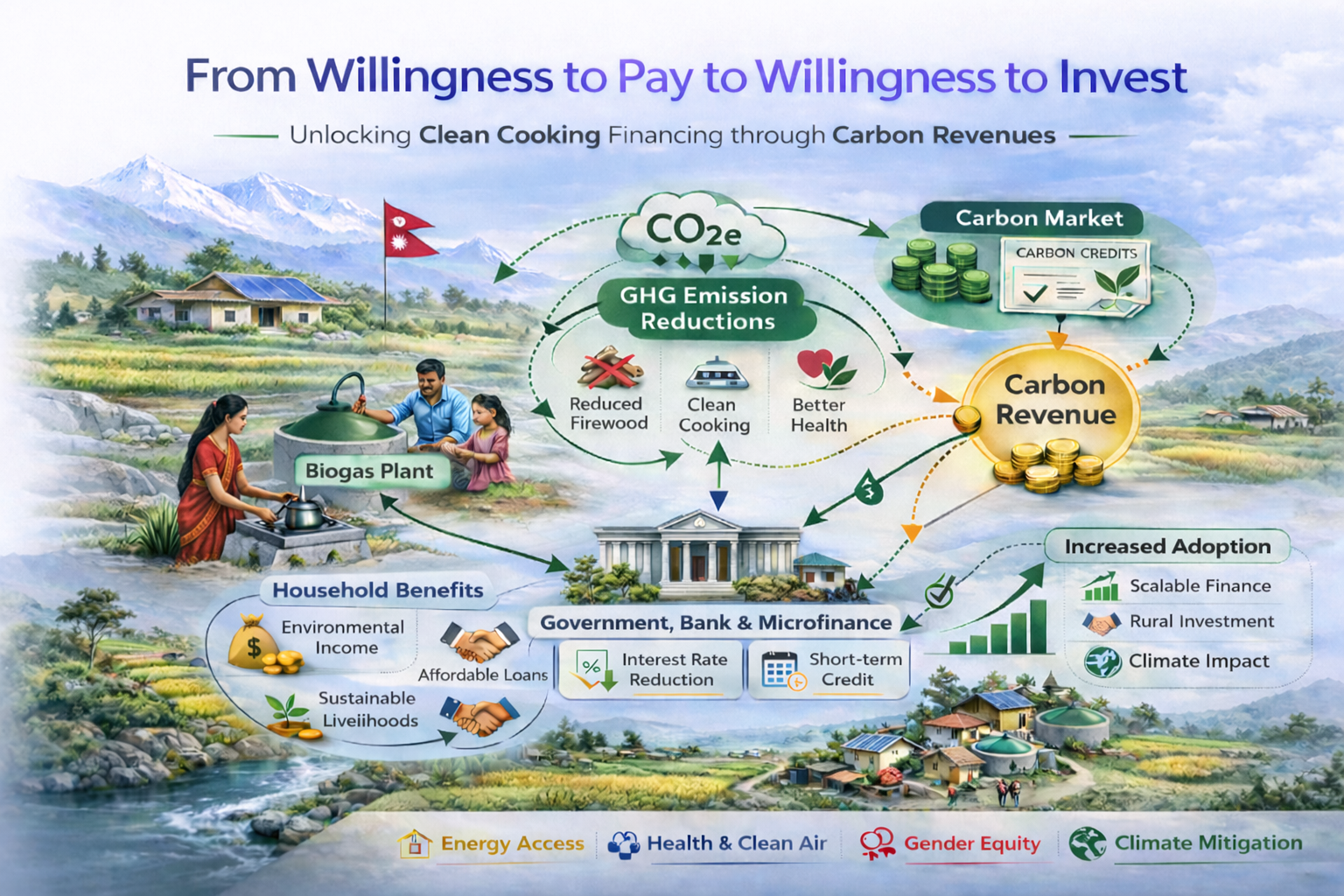
The core argument is simple but powerful: using carbon revenues as interest rate subsidies and environmental income is more efficient than as upfront purchase subsidies. Upfront subsidies reduce prices, but they also distort markets, encourage dependency, and weaken incentives for financial institutions to engage. By contrast, recycling carbon revenues into interest rate buy-downs improves loan affordability while preserving price signals.
Equally important is the role of environmental income paid directly to households. Regular, modest payments linked to verified emission reductions improve cash flow, strengthen loan repayment capacity, and increase household confidence in taking credit. Unlike upfront subsidies, environmental income rewards continued use and proper operation of the biogas plant over time.
Empirical simulations show that even relatively small reductions in effective interest rates, combined with environmental income, can substantially increase market uptake. This blended use of carbon revenues aligns closely with results-based financing principles increasingly favoured under climate finance frameworks. Households receive benefits after installation and use, reinforcing long-term adoption rather than one-off construction.
Crucially, this model recognises households as providers of environmental services. Biogas users generate verifiable emissions reductions, yet historically, carbon revenues have been mostly captured upstream by programs and intermediaries. Redirecting a portion of this value back to households is not a subsidy in the traditional sense, it is payment for services rendered.
What the Institutions Say: Insights from Qualitative Analysis
While quantitative models demonstrate what could work, a third line of inquiry examined why existing systems struggle to deliver. Focused discussions with banks, microfinance institutions, program managers, and sector experts revealed a consistent picture of structural misalignment.
First, financial institutions view biogas lending as high transaction cost and low margin. Small loan sizes, dispersed rural clients, and limited collateral make conventional lending unattractive. Existing subsidy regimes do little to change this calculus; often public subsidies are inflated and rigid, disconnected from financing realities and creating mismatches, thus crowding out credit and reinforcing poor expectations of grants.
Second, carbon revenues, despite accumulating at national level, remain institutionally disconnected from household finance. Banks do not factor carbon income into credit appraisal, partly because households do not receive it directly, and partly because governance arrangements around carbon funds remain opaque.
Third, supply-side actors report that subsidy-driven markets create volatility. Installation rates fluctuate with policy cycles rather than household demand. Vendors scale up and down accordingly, undermining service quality and after-sales support.
Yet the findings also reveal opportunities. Financial institutions express openness to risk-sharing mechanisms, interest rate support, and predictable revenue streams that improve repayment capacity. Carbon revenues, if transparently linked to household income, could serve precisely this function, bridging climate finance and rural credit markets to substantially increase energy access.
From Subsidies to Systems: A Coherent Policy Narrative
Taken together, the three strands of research tell a consistent story. The problem is not that rural households undervalue biogas, nor that markets cannot function. The problem lies in how value flows are structured.
Willingness-to-pay analysis reveals suppressed but real demand. Financing experiments show that carbon revenues can unlock this demand more effectively when used to support credit rather than replace it, especially where there are functioning rural credit markets. Institutional analysis explains why current systems fail and how they could evolve.
The implication is crucial: carbon finance can do more than co-finance the installation of biogas stoves; it can rewire rural energy markets. By recognising households and communities as investors and environmental service providers, policy can move beyond one-off subsidies toward durable, scalable systems – irrespective of their costs – if appropriate financing mechanisms are put in place.
As Nepal, and many other countries, prepare for new carbon market mechanisms influenced by the Paris Agreement principles, these insights are timely, especially when viewed alongside related work. The potential for scale through demand aggregation using established consumer financing channels combined with emerging Article 6 carbon market designs and improved accounting of climate pollutants such as black carbon, can elevate carbon finance from a marginal co-benefit to a central pillar of modern and just cooking transitions.
Together, these strands point to a common conclusion: as carbon markets mature and methodologies improve, carbon revenues are increasingly capable of supporting sustained household-level investment in clean cooking – not just by paying for technologies, but more so by shaping finance and incentives. Therefore, designing carbon revenue flows that reach households, such as the cook-to-earn and cash-for-cooking, and further innovating is not only a matter of equity; it is a matter of efficiency, market development, and long-term impacts.
***************************************************************************************************************
Featured Image: “From willingness to pay to willingness to invest”. Image Credit: Author, Dr Samir Thapa, 2026.
AI Disclaimer: ChatGPT was used to review the two journal papers and the PhD thesis mentioned in the blog to formulate its structure.