
- Date
- 6th November 2026
- Categories
- eCooking, Scaling eCooking
By Dr. Jon Leary (Gamos East Africa), Dr. Helen Tighe (Loughborough University), Alicia Butterfield (Loughborough University), Tim Woolnough (Gamos Ltd.).
In Attendance: Irene Gowelle and Bianca van der Kroon.
Against a backdrop of shifting Dutch political priorities, the Energy at a Crossroads workshop, held 12-13 October and organised by the Netherlands Enterprise Agency (RVO), brought together practitioners, governments and partners to review two decades of progress and consider what future support the energy-access sector may need. A recurring question throughout the event was how to move beyond counting connections and devices to measure reliable, affordable service and functioning sustainable local markets. Clean cooking, in particular eCooking, featured as an integral part of that wider agenda: different panels debated the balance between rapid appliance distribution and institution-building, while other discussions explored results-based and carbon finance, gender inclusion and the risks of interventions that do not translate into sustained use. As part of the workshop, the Global electric Cooking Coalition (GeCCo) organised a session to examine how electric cooking could support the financial viability of the power sector and the central role utilities can play in accelerating the scale up of electric cooking.
Utility-enabled eCooking
The session, “Leveraging the Power Sector: The Central Role of Utilities in Catalysing Clean Cooking Transitions” brought experience from East Africa to share with participants working across West Africa. The key lesson was that utilities can do more than supply electricity: their customer relationships, payment systems and planning processes can help build a market for modern electric cooking.

Existing expenditures on cooking fuels offer a lucrative opportunity for utilities
In his overview presentation, Dr Jon Leary, Director Gamos East Africa, emphasised that households are already spending substantial money on cooking fuels. For instance, in Kenya, a comparison from an early household cooking sector study put annual household spending on charcoal at about KES 68 billion, against roughly KES 46 billion in annual revenue from KPLC’s domestic electricity sales. Although those figures are historical and do not represent a current market estimate they nevertheless illustrate an important point: a share of this existing expenditure could become electricity demand if appliances, tariffs, service and supply are suitable.
For utilities, electric cooking can increase electricity use among existing customers and improve the value of infrastructure that is already in place. For customers, electric cooking can reduce exposure to indoor air pollution and save both time and money. These outcomes depend on sustained use and on whether electricity is both reliable and affordable for the meals people want to cook.
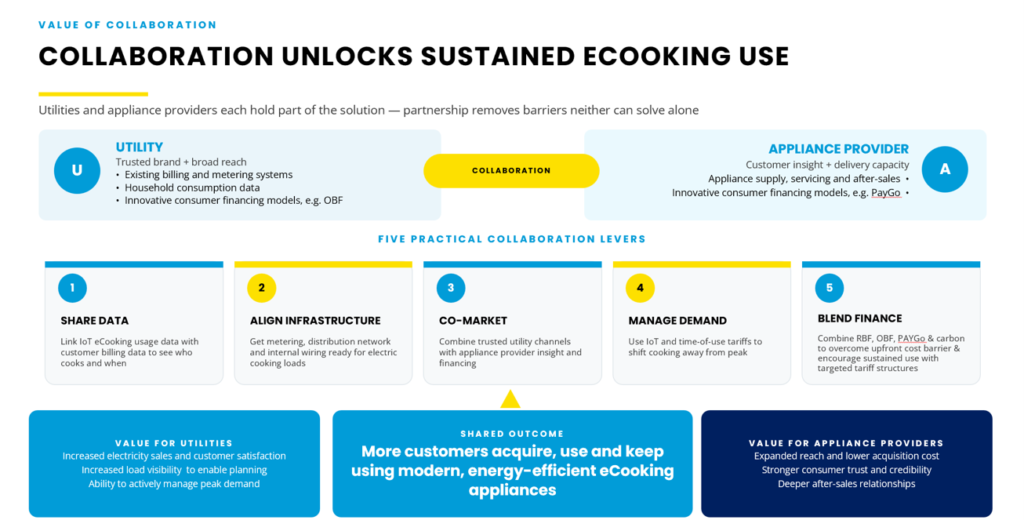
Utilities bring capabilities that are hard to replicate: partnership with appliance companies can ensure wider acquisition and sustained use of modern, energy-efficient eCooking appliances
Utilities have broad customer reach, trusted brands, billing and metering systems, and a direct interest in how demand changes over time. Those strengths can complement cooking appliance companies, who bring product knowledge, customer insight, retail channels, repairs and after-sales service. Collaboration between the two can connect these capabilities across five practical areas: sharing relevant customer and appliance-use data; coordinating appliance rollout with network upgrades; co-marketing; managing demand through tariffs and usage information; and blending finance to reduce upfront costs.
The panellists presented a range of East African examples which highlight different parts of this model. The Ethiopian utility’s experience with the development of the electric injera mitad, dating back to the 1970s, demonstrates the importance of matching appliances to local foods. Uganda has already deployed cooking-specific tariffs and in Kenya, and eCooking awareness is central to the utility’s demand stimulation programme. In October 2025 Tanzania’s TANESCO launched its “Konekt Umeme, Pika kwa Umeme” (“Connect Electricity, Cook with Electricity”) initiative, an on-bill financing programme designed to address appliance affordability by spreading upfront costs over time.
TANESCO: converting access into a valuable energy service
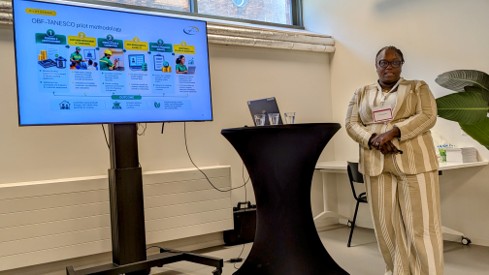
Irene Gowelle, TANESCO’s Director of Communications and Customer Experience, described how the utility is connecting awareness with access and affordability. TANESCO is working with local appliance suppliers and using its LUKU prepaid system to spread payments over six to eight months, with repayments deducted from electricity unit purchases, typically in the range €10 to €16 per month. The utility is also enabling staff to purchase appliances through payroll deductions, exploring pay-as-you-go options and working with CRDB Bank on connections linked to Mission 300 to increase reach and accessibility. Now targeting both new and existing customers, TANESCO already has a customer base of over 6.5 million, underlining the extent of its reach. The session noted a national eCooking target to increase adoption from 5% to 20% of utility customers by 2034.
At the time of the session, TANESCO reported 423 awareness activities, more than 1,720 appliances distributed through customer on-bill financing, and 6,400 requests through the staff payroll mechanism. It reported 541 customers had completed repayment, around 1,100 were actively paying, and 40 had yet to start. Irene relayed that a number of non-starting accounts related to appliances taken for newly built, unoccupied homes or to customers using alternative meters. TANESCO have identified the lesson was to follow up with customers and coordinate across utility teams before interpreting a delayed payment as unwillingness to repay.
From their experience to date TANESCO have identified 5 key lessons from their OBF implementation:
- Affordability drives adoption: Flexible instalment plans and financing mechanisms help households overcome upfront appliance costs, making electric cooking more accessible and attractive.
- Institutional readiness is critical: Successful implementation depends on strong systems for customer data management, financing, repayment collection and customer support, backed by effective programme coordination.
- Awareness must be linked to adoption: Demonstrations and awareness campaigns are most effective when paired with clear pathways to appliance acquisition, maintenance services and ongoing customer follow-up.
- Partnerships enable scale: Collaboration between utilities, appliance suppliers, maintenance providers and other stakeholders is essential to expand reach, improve service delivery and ensure long-term programme sustainability.
- Reliable power supply underpins success: Consistent and dependable electricity is fundamental to building consumer confidence, delivering a positive user experience and sustaining long-term electric cooking adoption.
The experience shows the need to connect awareness with a credible route to purchase and support. Demonstrations alone cannot overcome an unaffordable appliance price; finance alone cannot build confidence in unfamiliar technology. A dependable supply of suitable appliances, customer service, and reliable electricity all shape whether customers keep cooking with electricity.
Enabling evidence-based decision making
A utility-enabled approach will not fit every electricity system in the same way, or at the same time. The panel discussed practical questions raised about reliability, peak demand, the range of appliances households need, and whether distribution networks can support cooking loads. These are not reasons to assume that electric cooking is unsuitable. They are reasons to assess the system and the customer proposition together.
Tim Woolnough, research engineer at Gamos, introduced MECS’s new Grid Investment Balancing Model (GIBM), which explores the financial performance of electricity systems and the payback on individual utility projects. The model combines general electricity demand with specialised MECS eCooking load profiles, allowing users to investigate how cooking by households, institutions and businesses could contribute to electricity use and project returns.
A central feature is the comparison of payback trends with and without eCooking. This helps users explore how additional cooking demand could improve the utilisation of electricity infrastructure and strengthen utility financial performance. The model also compares available supply with combined demand, considering both overall generation and instantaneous peak capacity.
GIBM allows users to define projects, adjust parameters and investigate how sensitive the results are to different assumptions. Project files can be saved and shared, supporting collaborative exploration of alternative scenarios. Its flexibility allows analysis of a whole electricity system or a more specific utility investment, providing a practical way to examine the relationship between supply capacity, demand and financial returns.
A fruitful discussion following the presentations explored the challenges of modelling complex investment scenarios, including how to generate sensible load profiles and select assumptions appropriate to the setting, and areas the tool could begin to be applied in the wider industry. The discussion highlighted the importance of representing both existing electricity demand and proposed cooking loads when exploring an investment, and of testing how expected results can change with varied assumptions.

From East African experience to West African opportunity?
East Africa offers useful experience, but not a template to copy wholesale. West African electricity systems differ in access, reliability, generation mix, fuel use, utility structure and institutional capacity. Discussion focussed on how to identify a credible starting point: establish what the utility is trying to achieve, understand the local cooking market, assess power-system conditions, and determine what evidence and partnerships would be needed for a pilot and scaling.
A useful early signal is whether a utility is already working to stimulate or manage demand. Where it is already actively stimulating demand, cooking may be a relevant next area to explore. Where supply is severely constrained, the immediate priority may be system reliability and planning for future loads.
A learning visit was proposed for West African stakeholders to visit TANESCO and see first hand how their approach is working. This would enable West African representatives to understand whether this utility-led approach might work in their contexts.
Conclusion
Parallel discussions throughout the wider workshop dived deeper into the linkages between clean cooking and the power sector. Clean-cooking dialogues emphasized balancing faster adoption with long-term market-building; results-based and carbon-finance sessions asked how funding can support durable markets and community value; and the failure-focused session showed that lower prices do not necessarily produce greater use. Together, these lessons point to a customer offer that combines suitable appliances, finance, service and reliable supply. Ultimately, successful adoption depends not on an affordable price alone, but on a complete pathway to enable sustained use, one that utilities are uniquely positioned to deliver.

………………………………………..
Featured image, top – Figure 1: Jan Cloin of RVO opening the Energy Access at a Crossroads Workshop by inviting participants to use Dutch diplomacy, Dutch timing and Dutch courage throughout the next two days (photo credit: Jon Leary, Gamos East Africa).
AI disclaimer: AI was used to transcribe the dialogue during the event, to summarise sessions and identify key points to include and produce an initial draft. The authors then added context, refined and verified text.