- Date
- 12th February 2026
- Categories
- Carbon Credit, Clean Cooking, Metered Methodology
By Prof Matt Leach (Gamos Ltd.)
Sparked by recent events, an article in the Financial Times has once again questioned the credibility of clean cooking carbon credits, echoing long-standing critiques of traditional cookstove methodologies that rely on indirect assumptions, infrequent surveys, and highly uncertain baselines. These concerns are not new, and in many cases they are justified.
But what the commentary fails to acknowledge is that the clean cooking carbon market is already moving beyond these older approaches.
Over the past several years, MECS has led the development of a new generation of Metered and Measured methodologies (or in other terminology, Continuously Tracked) that directly addresses the very weaknesses highlighted in the Financial Times article. These approaches are now reshaping how integrity is defined, assessed, and delivered in clean cooking carbon finance, firstly within the Voluntary Carbon Market and recently within the compliance markets of the Paris Agreement and its Article 6.
What the Berkeley evidence actually says about metered approaches
The FT article cites the 2024 study undertaken by researchers at the University of California Berkeley and published in Nature Sustainability, suggesting that the study dismissed cookstove credits as largely worthless as clean cookstoves actually saved only a fraction of the carbon emissions claimed.
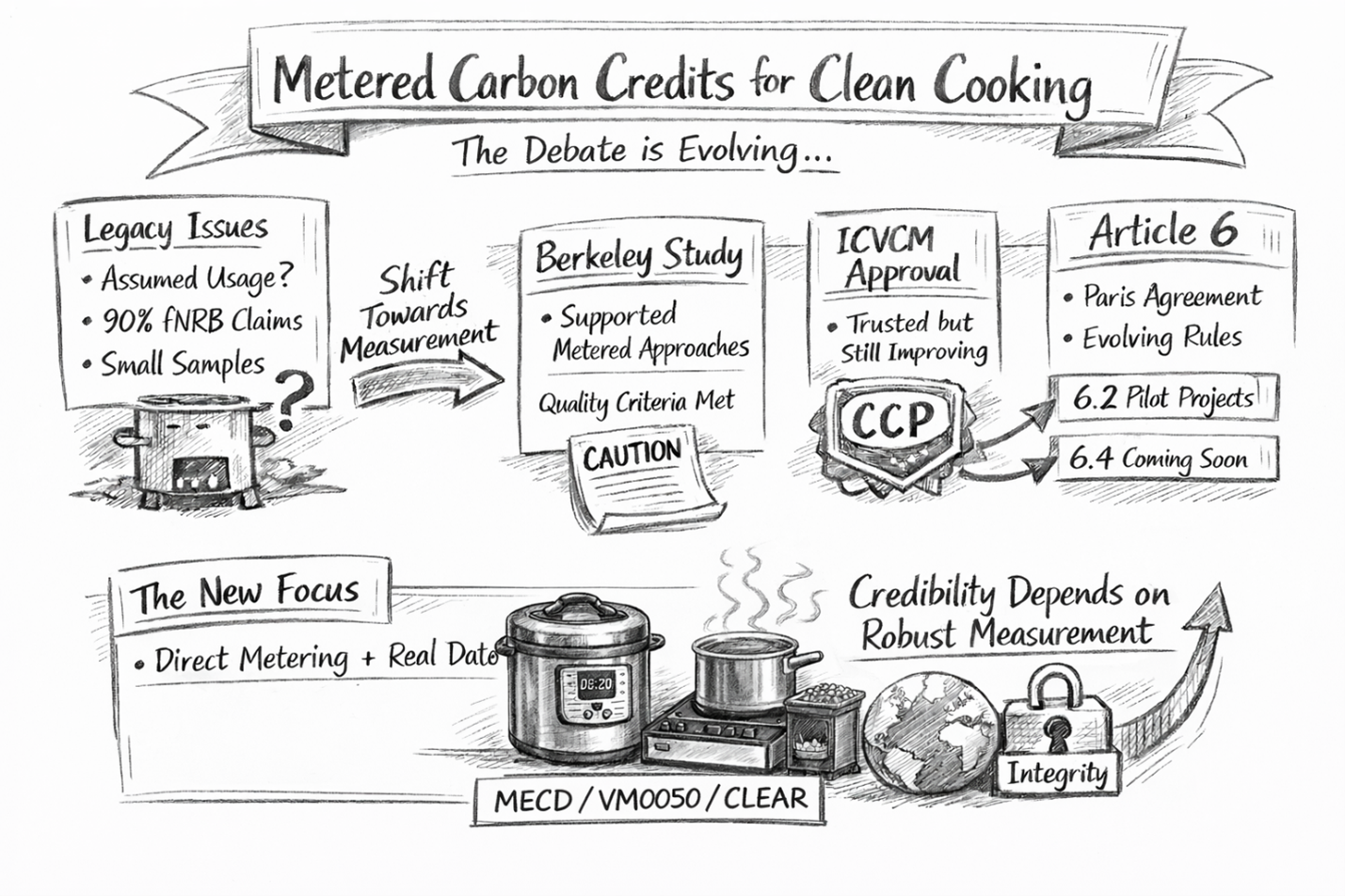
It is important to be precise about what the Berkeley research did – and did not – find. The study raised serious concerns about legacy cookstove methodologies that rely on infrequent surveys, assumed usage and small samples, as well as highlighting key assumptions that are often untenable. Importantly Berkeley highlighted potential for abuse of the value for fraction of Non-Renewable Biomass, which many developers used to claim was in the 90% range. Recent thinking shows should be a fraction of that: for example, 35% for Kenya. However, Berkeley did not find evidence of systematic over-crediting in approaches where energy use is directly metered, noting that the latter avoids many of the sources of bias and uncertainty that lead to inflated claims in older methodologies. The Berkeley team have specifically recommended the Gold Standard Metered & Measured Energy Cooking Devices (MECD), initiated and established by MECS, and state that as long as projects use it with appropriate values for the fraction of Non Renewable Biomass (fNRB) and for Adoption, Usage and Stacking, the projects will meet their recommended quality criteria.
Since the Berkeley report, Verra has published its own standard based, on the same metered approach, as VM0050 for Energy Efficiency and Fuel-Switch Measures in Cookstoves.
Independent validation: ICVCM approval of metered methodologies
This shift toward metered approaches has also been independently validated at the highest level of voluntary carbon market governance. In 2025, the Integrity Council for the Voluntary Carbon Market (ICVCM) approved three cookstove methodologies, two of which were the GS and Verra metered approaches. This matters because ICVCM approval is explicitly designed to identify methodologies that meet the highest bar for additionality, robustness, and confidence – not simply good practice.
ICVCM’s endorsement of metered and measured methodologies complements last year’s first‑ever ‘A’ rating awarded by BeZero to EcoSafi’s MMECD cookstove project.
Taken together, the Berkeley findings, ICVCM approval and high project ratings point in the same direction: the key question is no longer whether clean cooking credits can be credible, but whether they are measured or merely assumed. This is not a marginal improvement – it is a structural shift in how clean cooking emissions reductions are quantified.
Metered methodologies are not static: article 6 and MECD version 2
The relevance of metered approaches now extends well beyond the voluntary market.
Metered and measured methodologies are also central to many clean cooking programmes developing under the bilateral mechanism Article 6.2 of the Paris agreement. Public announcements have included a major investment to scale Supamoto’s IoT‑enabled pellet gasifier stove in Zambia through an Article 6.2 crediting programme based on the MECD. ATEC likewise announced its first Article 6.2 project in Malawi, applying the same methodology for induction stoves. Although Article 6.2 participants may adopt any methodology, or develop their own, government parties have signalled a clear preference for high‑integrity approaches, and metered and measured methodologies are the focus.
Within the multi-lateral Article 6.4 mechanism, no clean cooking methodologies have yet been finalised, but metered approaches are expected to be central. The CLEAR methodology, developed by the Clean Cooking and Climate Consortium (4C), has developed a Continuously Tracked approach by drawing on the original GS MECD. While CLEAR includes non-metered options, these require additional safeguards and conservative assumptions, underscoring the continued preference for continuously tracked approaches where feasible.
Within the voluntary carbon market, Gold Standard has just closed a public consultation on Version 2.0 of the Metered & Measured Energy Cooking Devices methodology, seeking to further strengthen integrity safeguards. The revision was initiated as part of their overall programme to make all their methodologies ‘align’ with Paris Article 6 approaches. For the MECD, GS highlights one major upgrade: mandatory 100% metering, requiring direct measurement for every device and eliminating sampling uncertainty. MECS really welcomes this enhanced focus on metered usage, along with several other refinements that ensure the methodology meets every-tightening international expectations about integrity.
The debate has moved on
The criticisms raised in the Financial Times article are valid – for a previous generation of cookstove credits.
But applying them wholesale to today’s clean cooking carbon market misrepresents where the sector now stands. Continuously tracked, fully metered methodologies were developed precisely in response to the integrity challenge. With Gold Standard’s Version 2.0 on the horizon and equivalent approaches embedded in Article 6, the debate is no longer about whether clean cooking credits can be credible – but whether they are measured or merely assumed.
***************************************************************************************************************
Featured Image Credit: AI created infographic based on prompts by Simon Batchelor, 2026.