- Date
- 31st July 2026
- Categories
- eCooking, Scaling eCooking
By Dr Yesmeen Khalifa (MECS programme, Loughborough University)
Put thirty-five people in a room and ask what should happen first to scale eCooking, and the answers will depend on where they sit in the transition.
A government official may begin with policy and standards. A utility may focus on electricity demand, network planning, and tariffs. A market actor may prioritise investment and supply chain. A consumer organisation may ask whether appliances are affordable, trusted and suited to everyday cooking. None of these perspectives is wrong, but none is sufficient on its own.
This is one reason eCooking transitions are difficult to deliver. The challenge is not simply to identify good actions. It is to bring different actors together around a sequence of actions that is credible across policy, infrastructure, finance, markets and lived experience, and to clarify who will lead, who must collaborate and what could prevent delivery.
At the MECS Annual Workshop 2026, Dr Yesmeen Khalifa designed and led an interactive exercise to test whether the MECS Jigsaw could help participants rehearse that process. The workshop itself was the case study; the wider question was whether a framework developed to explain the complexity of scaling eCooking could also support structured prioritisation, negotiation, and implementation planning.
| An important distinction This was a structured role-play, not a substitute for a formal multi-stakeholder consultation. Participants first expressed their own views, then adopted an assigned stakeholder persona and reasoned from that institutional perspective before entering mixed-sector discussions. The purpose was to emulate the tensions and trade-offs that arise in real planning processes and to test a repeatable method for working through them. |
From a framework to a decision-making rehearsal
The MECS Jigsaw was developed as a practical way of showing that eCooking cannot be scaled through a single intervention or a neat linear pathway. Progress depends on interconnected conditions across three core areas: policy and enabling environment, consumer awareness and demand, and supply chain. Some actions provide foundations for transition; others become more important as markets mature; and the relative priority of each action varies by context1.
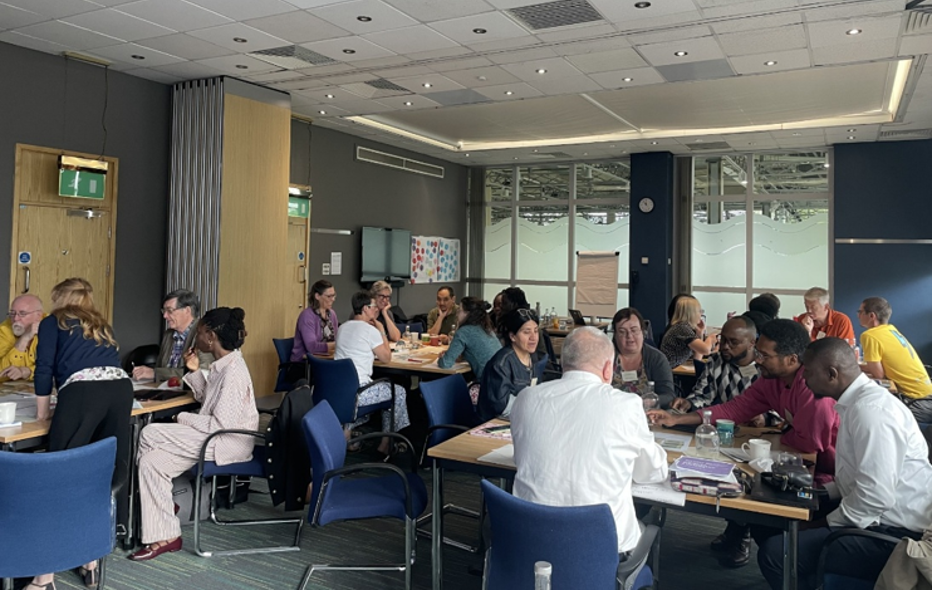
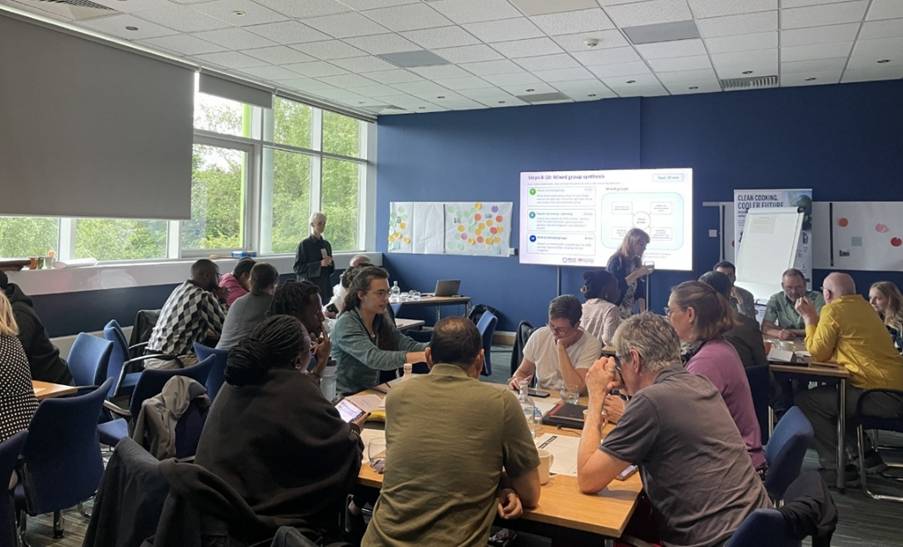
For the workshop, the Jigsaw became the shared language through which participants could compare priorities. Around 35 participants from MECS, CLASP, ESMAP and partner organisations took part. Each received a badge with two allocations: a stakeholder persona for the first group discussion and a mixed-sector group for the later negotiation. This design made the change of perspective explicit from the outset.


The first lens: Capturing individual perspectives
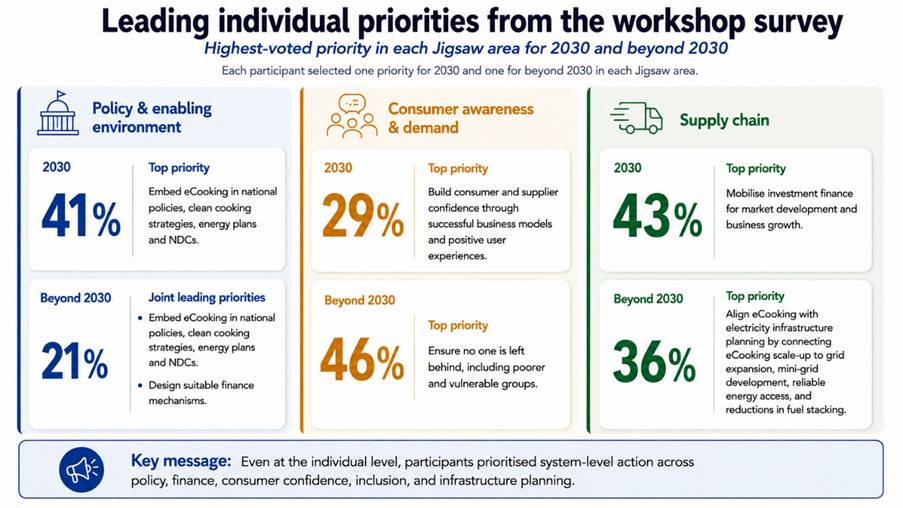
Before any group discussion, participants completed an individual survey. They selected one priority for 2030 and one for beyond 2030 within each of the three Jigsaw areas. This provided a baseline before institutional roles or group dynamics shaped the conversation.
The individual results suggested a strong appetite for system-level action. For 2030, 41% selected embedding eCooking in national policies and strategies as the leading policy priority, 43% selected mobilising investment finance as the leading supply-chain priority, and 29% selected building consumer and supplier confidence as the leading consumer priority. Looking beyond 2030, ensuring no one is left behind attracted 46% of votes within the consumer area, while aligning eCooking with electricity infrastructure planning attracted 36% within the supply-chain area.
These results were useful, but they represented personal judgement. The next question was whether priorities would look different when participants were asked to think as institutions rather than as individuals.
The second lens: adopting a stakeholder persona
Participants then moved into four groups and were asked to take on the perspective, incentives, and constraints of their assigned stakeholder category: government and public institutions; utilities and electricity system actors; market and supply-chain actors; and consumers, community organisations, and demand-side enablers.
This role-play mattered because it changed the question. Participants were no longer asking only, “What do I think is important?” They were asking, “What would this actor be expected to prioritise, what can it realistically influence, and what might it resist?” Using the Jigsaw cards, each group sorted the actions across time horizons, added missing issues through wildcard cards, and narrowed the options to a short list.
| Stakeholder persona | Priorities by 2030 | Priority beyond 2030 |
| Government and public institutions | Safety, warranty, and performance standards; alignment with electricity infrastructure planning | Local job creation |
| Utilities and electricity system actors | Tariff and enabling-environment reform; integration of eCooking into infrastructure planning | Ensuring no one is left behind |
| Market and supply-chain actors | Investment finance; mixed-media promotion and market development | Framing eCooking as a public-good opportunity |
| Consumers and demand-side enablers | Consumer finance; consumer and supplier confidence | Addressing fuel stacking |
The differences were revealing. Government and utility personas concentrated on rules, standards, and system planning. Market actors emphasised capital, market development, and promotion. The consumer-facing group brought affordability, trust, and continued fuel stacking to the foreground. The Jigsaw did not erase these institutional differences; it made them visible and discussable.
Testing priorities against delivery
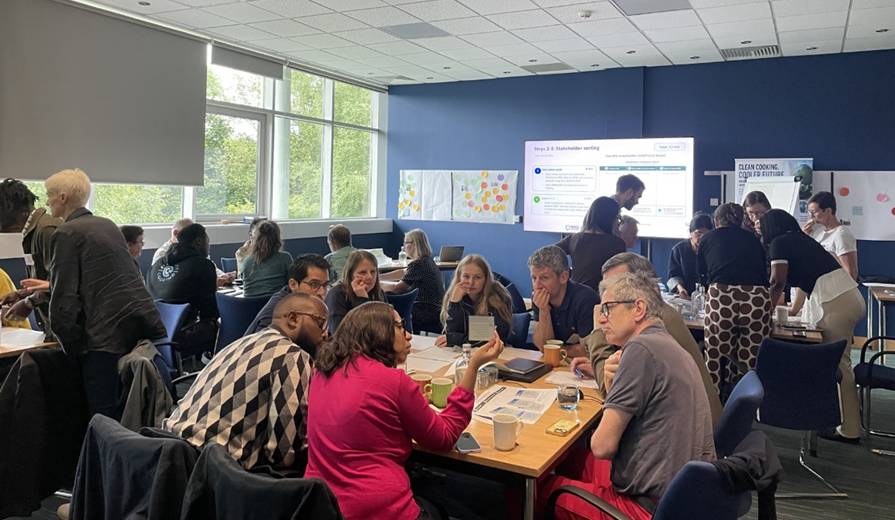
The stakeholder discussions did not stop at identifying which actions should be prioritised. For each shortlisted action, participants also considered who should lead, which organisations would need to collaborate, what could prevent implementation and how those risks might be mitigated.
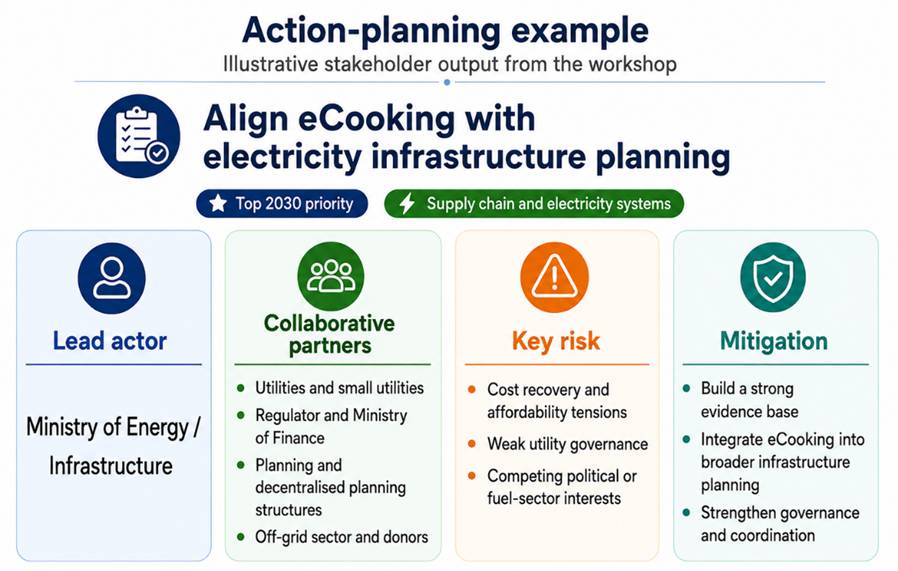
The additional questions changed the quality of the discussion. “Strengthen standards” became a conversation about the role of standards bureaux, technical experts and suppliers, the risk of inappropriate benchmarks and the need for credible testing and international comparison. “Expand consumer finance” became a question of which financial institutions could lead, how utilities and PAYGo providers might collaborate, and how concessional finance could address short lending horizons. “Align eCooking with infrastructure planning” required participants to confront electricity costs, governance and the coordination needed between ministries, regulators, utilities, and off-grid actors.
By attaching actors, risks and mitigation measures to each priority, the stakeholder groups moved from expressing preferences to testing deliverability. Each group then delivered a two-minute pitch presenting its top two actions for 2030 and its top action beyond 2030, together with the lead actors and the principal implementation risks and proposed mitigation measures. The outputs were still preliminary, but they resembled the beginnings of an implementation roadmap rather than a workshop wish list.
These priorities and delivery propositions were carried into the mixed-sector groups, where they were challenged and refined from different institutional perspectives.
The third lens: when priorities meet resistance
The room changed when participants moved into mixed-sector groups. Each group now included the four stakeholder perspectives, so an action that had appeared self-evident within one persona had to withstand questions from the others.
This stage generated visibly more debate than the stakeholder discussions. Policy ambitions encountered questions about cost and institutional capacity. Infrastructure proposals were tested against affordability and user experience. Market-development ideas faced questions about regulation, consumer protection, and inclusion. Participants had to explain assumptions, recognise dependencies and compromise over timing.
That friction was not a failure of consensus; it was the point of the exercise. Real eCooking strategies are shaped through negotiation between actors who hold different mandates, resources, and forms of knowledge. A credible roadmap must therefore be strong enough to survive scrutiny beyond the perspective that first proposed it.
The original plan was for each mixed-sector group to conclude this stage with a further two-minute pitch. In practice, the pitches could not be completed because the cross-sector discussions took considerably longer than anticipated. This was itself a revealing outcome: unlike the stakeholder-persona groups, where participants reasoned from a broadly shared institutional position, the mixed groups needed more time to question assumptions, reconcile competing priorities and negotiate acceptable compromises. Future applications of the method should therefore allocate substantially more time to this stage.
The groups nevertheless documented their agreed priorities for the final gallery walk and collective ranking.
Where the room landed
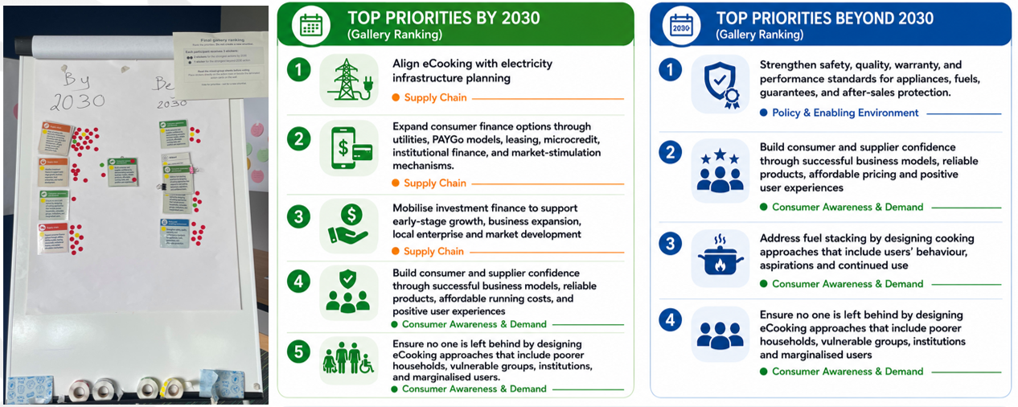
The exercise concluded with a gallery walk. Having documented their negotiated selections, the mixed groups displayed their final priority actions, and participants used two votes for the strongest 2030 priorities and one vote for priorities beyond 2030. The result was a ranked workshop outcome rather than a claim of formal sector-wide consensus.
Priorities by 2030
- Align eCooking with electricity infrastructure planning — Supply chain and electricity systems
- Expand consumer finance — Supply chain and affordability
- Mobilise investment finance for market development — Supply chain and finance
- Build consumer and supplier confidence — Consumer awareness and demand
- Ensure no one is left behind — Inclusion across the transition
Priorities beyond 2030
- Strengthen safety, quality, warranty, and performance standards — Policy and enabling environment
- Build consumer and supplier confidence — Consumer awareness and demand
- Address fuel stacking — Consumer practices and sustained use
- Ensure no one is left behind — Inclusion across the transition
How priorities evolved across the exercise
With the final workshop ranking established, it was possible to compare the collective outcome with the individual baseline. The most interesting finding was not a wholesale reversal of participants’ initial views, but a process of refinement, repositioning and connection across different parts of the eCooking system.
| Issue | Individual baseline survey | Outcome after deliberation | Interpretation |
| Embedding eCooking in national policy | Led the individual policy vote for 2030 (41%) | Did not appear in the final top five ranking | The collective discussion moved from broad strategic endorsement towards delivery-critical enablers. |
| Electricity infrastructure planning | Shared second place in the individual 2030 supply-chain vote (18%); led the beyond-2030 supply-chain vote (36%) | Became the highest-ranked 2030 action | Cross-sector discussion brought forward the need to connect cooking demand with power-system planning earlier. |
| Consumer finance | Received 18% in the individual 2030 supply-chain vote | Entered the final 2030 priorities | Affordability became a cross-sector delivery issue rather than a consumer concern alone. |
| Consumer and supplier confidence | Led the individual 2030 consumer vote (29%) and remained important beyond 2030 (21%) | Appeared in both final time horizons | Trust, product reliability, and positive experience were treated as continuing conditions for scale. |
| Ensuring no one is left behind | Dominated the individual beyond-2030 consumer vote (46%) | Appeared in both final time horizons | Deliberation brought inclusion forward as an immediate design requirement as well as a long-term objective. |
| Safety standards and fuel stacking | Received relatively modest individual shares | Both entered the final beyond-2030 priorities | The persona and mixed-sector stages surfaced system-critical issues that simple individual ranking could understate. |
What the exercise demonstrated
The workshop demonstrated how a structured process can make institutional differences visible and use them productively. Individual voting captured participants’ starting positions; stakeholder personas exposed how mandates and constraints shaped priorities; mixed-sector negotiation revealed dependencies and trade-offs; and the delivery questions translated broad ambitions into provisional responsibilities, partnerships, risks and responses.
Consensus emerged through reframing rather than through participants abandoning their starting positions. Participants retained many of their underlying concerns but reconsidered them in relation to wider system dependencies and the practical requirements of implementation.
This is why the Jigsaw appears promising as a practical framework for structured dialogue, prioritisation, and decision-making. Used carefully, it can help bring multiple viewpoints together and support the development of a more integrated and implementable roadmap.
From rehearsal to real-world application
The method could be adapted for a Ministry of Energy developing an eCooking strategy, a utility considering demand stimulation, a donor or development programme designing a portfolio, or a regional body convening actors around shared priorities. The actions selected would vary by country and institution, but the underlying progression could remain: establish individual views, examine the issue through stakeholder roles, negotiate across sectors, and test priorities by identifying leadership responsibilities, collaborative partnerships, implementation risks, and mitigation measures.
The role-play also points to the next test. Applying the approach in a country setting would require real representation from institutions and communities, locally grounded evidence, attention to power imbalances, and enough time for participants to challenge the assumptions built into the Jigsaw itself. In other words, the workshop was a rehearsal, not the final performance.
Complex transitions are constrained less by a shortage of proposed actions than by fragmented perspectives, unclear responsibilities and weak coordination. A method that helps actors see the whole puzzle, understand each other’s priorities and begin assigning responsibility could make an important contribution to turning eCooking ambition into delivery.
*********************************************************************************************************
Reference
1 Batchelor S, Sieff, R. MECS and Jigsaws. MECS programme, Loughborough University, 2022.
*********************************************************************************************************
Image Credits: Workshop photographs were taken by Yesmeen Khalifa. All other images were created using ChatGPT.
AI disclaimer: ChatGPT was used to support the drafting and editing process. The analysis, interpretation and final content were reviewed, refined and authored by Yesmeen Khalifa.