- Date
- 3rd June 2025
- Categories
- eCooking, Electric Cooking
By Dr Simon Batchelor OBE (Gamos Ltd. / Loughborough University).
This blog challenges the centrality of energy efficiency as the core criteria for eCooking appliance choice, and acknowledges that context and behaviour are other strong influencers. It suggests that in addition to energy efficient devices, hotplates and infrared also have a role in the ‘eCooking’ ecosystem.
Last year, a friend told me he had an electric pressure cooker and an induction stove. He admitted that when he first got the two devices, he did a lot of cooking with the EPC, but that over time he has defaulted to doing rice or stew on the induction stove – because of convenience. He asked me why MECS emphasised the EPC? I admit I was a bit blunt with him and said that his increased use of the induction over the EPC was probably because he didn’t care about 5 US cents (GBP 4p). As a well paid UK based middle manager, the 5 cent difference between cooking a meal on the induction stove and cooking it in an EPC didn’t really feature in his thinking. 5 cents was not enough to provoke a change of behaviour. But we emphasise the highest energy efficiency and the greatest cost effectiveness because for someone on $2 dollars a day, 5 cents makes a difference, and multiply that for every day, and the sums begin to add up.
So in MECS we relate energy efficiency with cost savings, i.e. reduced electricity consumption, while acknowledging that those savings are small for any one meal. That has been the basis of one of the key drivers of the MECS research – ‘energy efficiency’ – how can we maximise energy efficiency in eCooking while still covering all the diversity and range of cuisines found in our target countries?1
The importance of energy efficiency leans into the cost per meal. When we started proposing that eCooking was a way of leveraging the existing electrical infrastructure to include eCooking, we would get push back that cooking with electricity would be too expensive for households. The assumption by some decision makers and professionals was that in almost all circumstances and contexts, cooking with electricity would be more expensive than cooking with wood, charcoal, or LPG.
We have been able to gather plentiful evidence that has proven the ‘too expensive’ assumption to be wrong. The evidence becomes particularly strong when we use an energy efficient appliances. Across multiple countries and in the context of urban and peri urban cooking fuel prices, electricity on an energy efficient electric pressure cooker consistently comes in at less than half the cost of charcoal, of LPG and indeed half the cost of an old style resistive element hotplate.
Old style resistive element hotplates or infrared stoves?
When decision makers felt that cooking with electricity would be too expensive they often made such statements based on their very limited experience of cheap hotplates in Low and Middle Income countries. Cheap hotplates based on a resistive coil don’t transfer the heat very effectively to the pot and can be wasteful, even radiating some of the heat downwards to the open base2. Poor hotplate to pot connections, radiation and convection losses from uncovered hotplates, all contribute to lower ‘stove efficiency’ (and lower long term affordability).
So our priority was to focus on minimizing losses and improving the system energy efficiency. Electric pressure cookers also use a resistive heating element embedded in a hotplate under the deep pot – but the pot fits so well, and has no bumps and dents, and there is minimal air flow, so ‘connection, convection and radiation’ losses are minimized. EPCs are said to be constrained in what dishes they can cook – they can’t do chapati and the one (deep) pot of the EPC is mildly restrictive – I say mildly because we have shown multiple times that East African households can do 90% or more of their regular cooking in an EPC.
Despite this evidence of significant energy efficiency in EPC and perhaps because of the restrictive nature of the deep pot, some private sector actors and indeed some governments (e.g. Nepal) focus on the flexibility of induction stoves. Induction heats the pot more directly, and therefore minimizes the ‘connection, conduction, radiation’ losses, although it doesn’t have the additional energy efficiency features of the EPC of ‘control and insulation’. So in energy measurements across multiple contexts (and multiple cookware, and multiple cuisine), Scott et al.3 were able to show that induction uses approximately 80% of the energy used by a hotplate, but an EPC uses roughly a half:
| Device | Energy used, expressed as a proportion of energy used by hotplate |
|---|---|
| Hotplate | 100% |
| Infrared | 105% |
| Induction | 79% |
| EPC | 56% |
from kitchen performance data based on multiple countries, multiple cuisines, multiple contexts.
Since the EPC and induction are more energy efficient than both resistive hotplates and their close cousin infrared cookstoves, we have tended to publicly emphasise EPC and induction. We also note that rice cookers and airfryers are also energy efficient but are also constrained in the range of meals they can cook. The outcome is that we don’t often mention hotplates and infrared stoves even though we discuss these with our partners.
So when does maximizing energy efficiency become a lower priority?
I started with my story about how the cost of the meal may not have been the priority for a UK friend. He was more interested in convenience.
As touched on above, induction stoves offer efficiency gains but have been prioritized by some actors as they allow for greater flexibility. Working with a number of partners, inductions stoves featuring IoT data collection have been developed and deployed4.
The theory of induction is that it transfers the energy into the pot more effectively (than a resistive hotplate), thus saving a percentage of the energy. Indeed it does this by creating a magnetic field within the pot and the pot itself becomes hot. But it can only do this with an ‘induction ready’ pot. One that has iron or steel in it.
As a consequence, many of our partners selling and promoting induction stoves have bundled a provision of a new set of cookware, an ‘induction ready’ set of pans. We have really interesting research going on in Bhutan at the moment, where about 700 households have started using IoT enabled induction stoves and we are working towards an Article 6.2 carbon project for the whole country. The households though are in three groupings, each with a slightly different set of cookware. Early surveys showed the first set of cookware was too small, the second set, too large… we are not sure yet how people will respond to the third set. We hope that research will shed some light on what people want in an induction ready set of pans.
Interestingly then, that idealized flexibility of the induction stove only comes to the foreground if the stove is matched with the ‘right’ cookware, where ‘right’ depends on the consumers needs and wishes for size, depth, even shape.
As we have moved to scale, the research has shown that quite a significant number of households want to use their old pans. A combination of sentimentality and familiarity, means that people just want the size and shape of their existing old pans. Pans which are often aluminum and don’t work on induction. Familiar and precious cookware can be a key driver of stove choice.
The induction may save them an extra USD$3 per month on their fuel bill, but it requires upfront expenditure for a new set of cookware. When the cookware is bundled into the sale price of the induction stove as it is with ATEC and BURN, and covered to some extent by carbon finance, then upfront cost of the cookware becomes less of an issue.
However, people in Bhutan and India don’t all want new pots and pans, and want to keep what they are familiar with. In many cases this is so strong that they would rather have infrared stoves or hotplates on which they can use their existing cookware, than pivot to an induction stove. And if that means getting an infrared stove that is not quite as efficient as an induction stove, then so be it. As long as the fuel expenditure on the infrared stove is less than the alternatives (LPG, charcoal, purchased wood), then they would prefer to minimize the cooking sequences, the behaviour change, between other fuel stoves and new eCooking stove. The sentimentality and familiarity attached to the old cookware becomes a key deciding factor.
So when we reflect on my opening story about my friend not worrying about plus or minus USD 5 cents, we are finding in our research that some of the eCooking adopters are also not worried. They would rather have the ability to use their own familiar cookware, than be forced to switch it out for the sake of some relatively small predicted saving in the future.
One significant caveat to this though. I did say above ‘As long as the tariff is such that their monthly costs for eCooking are less than for LPG or charcoal, or purchased wood, then they may choose infrared or even a hotplate’, and that depends on context specific relative pricing.
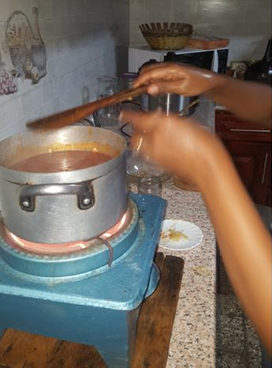
Low Tariff:- A prime example of a low overall tariff is Ethiopia, where a home grown industry of very cheap electric resistance stoves has grown. The devices have minimal durability and require repair frequently, but are made locally and found popularity when the tariff was less than 5 US cents per kWh. The stoves were well adapted to people curved bottom cookware. The tariff has now risen to, I believe, 8 US cents so the industry and consumers are having to make adjustments. Zambia was reporting 34% households using eCooking pre 2016 (on old resistive heating driven 1950’s style cooker ovens) when the tariff was 6 US cents per kWh, although while the tariff remains very low the quality of the supply is encouraging people to turn away from eCooking.
Generous lifeline tariff:- The other circumstance was where the lifeline tariff has a large band. This was the case I found in my recent work in Bhutan. Domestic households get 100kWh free, and indeed rural households in the more remote locations get 200kWh free. Even 100kWh is enough to cook on even with a lower efficiency electrical stove. And imagine – if the alternative is to transport an LPG cylinder up mountainous pathways or utilize free electricity it’s not surprising that infrared stoves are popular in Bhutan. (If you haven’t seen the Bhutanese film Lunana, I recommend it. It’s not about cooking but it is about life choices.)
So in both these circumstances consumers may choose to pivot to eCooking because its cheaper than alternative fuels. True, included in their unmapped decision making is probably its ‘modernity’ and the wider benefits to health, convenience, time, & environment. However, while they pivot because of cost, for the sake of minimizing behaviour change they choose a ‘lower’ efficient eCooking device such as a hotplate or infrared stove.
This is great for the consumer, as it still improves health, reduces carbon etc compared to alternative polluting fuels… but it is perhaps not so great for the country as a whole. At 5 US cents per kWh, or where electricity is free, the utility is unlikely to be covering its costs of providing that energy. Utilities talk about ‘full cost recovery’ and there are very few African utilities that achieve full cost recovery. When utilities approach full cost recovery it creates a need for a tariff which is in a more realistic region of 20 US cents or more. Zambia, the study referred to above suggested USD 11 cents was the cost recovery point, and while the price has remained low, that has meant that the infrastructure in Zambia is now stressed to the point where people are getting something like 3 hours a day of electricity. So for the good of the country, tariffs need to be realistic, and to do that we need steady balanced supply and demand (which can be supplied by eCooking) and that demand is best from an energy efficient appliance so the consumer gets the most performance for their money.
Conclusion
I started the blog by saying that hotplates and infrared might have a role to play in the transition to eCooking, but acknowledging that while we work with partners on them, we rarely discuss them in our publications. Just to repeat where I started – when we researched how to get cost effective eCooking in environments with electricity prices above 20 US cents per kWh we found that energy efficiency was a key element to making it cost effective in multiple contexts. However, the discussion above raises circumstances in which we might question the centrality of energy efficiency as a simple guide to appliance choice. Whilst for some people, the most important thing may be to minimize costs, for others it may be more important to use a single device that can cook all their meals, a single device that can easily swap pots for different sauces or they may just want to use their existing pots and pans.
So we do need to spend a bit more research on mapping the role of hotplates and infrared in the ‘eCooking’ ecosystem? Even with the lower5 efficiency there are contexts and circumstances where resistive heating stoves are more cost effective to the household than charcoal and LPG. This is particularly true where the electricity tariff is low, where lifeline tariffs may offer large discounts, or where traditional fuels are expensive (e.g. buying in small quantities in urban centres). Indeed we do have partners who in their modelling are showing that the introduction of eCooking (on a national grid or a mini-grid) can increase demand for electricity, which justifies the connection costs, and that can result in government, utilities and mini-grid developers being able to offer a lower tariff and still reach full cost recovery.
In a forthcoming blog we will explore this further.
………………………………………………………….
[1] Just to note that another key driver is the taste of food; from the start we have always acknowledged that messing with people’s meals requires delicate navigation. Improve energy efficiency on a meal that doesn’t taste right would not be progress!
[2] https://mecs.org.uk/blog/energy-transfer-in-kitchen-appliances/ for an introduction to the slide deck.
[3] https://www.mdpi.com/1996-1073/17/13/3318. Please note that this data is from real world situations not lab based results. If you match a pot with an infrared stove such that the size of the pot covers the infrared stove, you can in a lab get a similar efficiency to an induction stove. But the real world data includes pots of different sizes.
[4] The most public are Burn and ATEC.
[5] (Note I am saying lower, not low; lower than induction and EPC, even lower the efficiencies are higher than most biomass stoves).
Featured image: Locally made resistive heater stove in Ethiopia (photo credit: Hilawe Lakew Tesema, 2020).