- Date
- 19th November 2026
- Categories
- COP31, eCooking, Electrification
Reflections from the Global Electrification Ministerial and Forum in Antalya
By Dr. Simon Batchelor OBE (Gamos Ltd. / Loughborough University).
Watching the Global Electrification Ministerial at COP31 on their feed, I was pleasantly struck by how much of the conversation resonated with the work we have been doing at Modern Energy Cooking Services (MECS) over the last decade. Interestingly, much of that resonance came from speakers who did not mention cooking at all!
The COP31 Presidency has proposed an ambitious target – increasing electricity’s share of global final energy consumption to 35% by 2035. Chris Bowen, the Australian Minister, argued that the 35-by-35 pledge was both ambitious and achievable, but would require a fourfold acceleration in the historical rate of electrification. It is an interesting target, and while you would think it would be easily understood, I had an conversation at the weekend. My friend Rosemary, a generally well informed green eco activist UK citizen, expressed shock that it was so limited, that it was ‘only’ 35%? I had to point out that the 35% would include all industry, shipping, planes, cars, everything, and only after clarifying that point did she begin to get it. Fatma Varank, COP31 CEO and Turkish Deputy Minister was careful to emphasise that this was a collective global ambition, recognising that individual countries have different priorities, starting points and investment needs. It’s a potentially good headline target but perhaps it might need its own MECS related blog to unpack it. I was also interested in Francesco La Camera’s (Director-General IRENA) observation that 35-by-35 should not really be seen as another climate target, but rather as a means of implementing the commitments we have already made.
However, for the moment, lets focus back on what the ministerial contributors actually said. For many years, the international energy transition debate has focused on how we generate electricity and what we saw here was how the conversation is turning more to how we use it. This is a welcome development.
Energy security and climate action coming together
Fatih Birol, Executive Director of the International Energy Agency (IEA), made the observation that Governments have long perceived a choice between energy security and the transition to clean energy. He argued that recent energy crises are bringing those objectives into alignment.
Countries are increasingly investing in renewables, he said, not primarily for environmental reasons but because they offer domestically generated energy, reducing exposure to volatile international fossil fuel markets. Later, Karolina Štelmokaitė, Lithuania’s Vice-Minister of Energy was particularly forthright on this point, explaining that its rapid expansion of renewables was motivated not by a desire to be climate champions, but by a desire to be free and independent.
Birol noted that electricity demand is already growing three times faster than overall energy demand, driven by electric vehicles, air conditioning, data centres and artificial intelligence. I held my breath, hoping that as champion of clean cooking he might add eCooking to the list – but he didn’t. Nevertheless, he argued that the proposed electrification pledge could become a turning point, sending an unmistakable signal to investors: electricity is the future.
Azerbaijan’s Energy Minister, Parviz Shahbazov, added a regional dimension, describing how interconnected electricity markets and green energy corridors could open new markets for renewable generation. And of course, electrification opportunities in emerging markets and developing economies differ from those in developed economies. The Finnish representative similarly emphasised that electrification must be accompanied by investment in clean generation, networks and system flexibility, while reminding us that emissions reduction, rather than electrification itself, should ultimately be the measure of success. However, while Europe and China are concerned with replacing petrol and diesel vehicles and gas heating, many developing economies are still building the infrastructure that will shape their energy consumption for decades.
Indeed, Damilola Ogunbiyi, CEO of Sustainable Energy for All (SEforALL), reminded the meeting that some 80% of new electricity demand is expected to come from emerging markets and developing economies. She stressed that countries will follow different electrification pathways and, importantly for MECS, singled out electric cooking in Ethiopia, suggesting that getting it right there could save a household almost $710 annually. It was encouraging to hear the economics of cooking featured in such a high-level discussion, although across the whole Ministerial, cooking was barely mentioned. I note that SEforAll also launched at COP31, a report supportive of the electrification agenda.
Making better use of the infrastructure we already have
Perhaps the most interesting intervention for MECS came from Greg Jackson, CEO of Octopus Energy. Jackson described electrification as a consumer revolution, like smartphones, the internet and budget airlines. Governments can create the enabling conditions, but it is consumers choosing products that improve their lives who drive the transformation. He also made an important point about infrastructure economics: electricity systems have substantial fixed costs, so making better use of them, particularly in periods of abundant renewable generation, could deliver more electricity services at lower average cost. As he put it, we need more electricity over less infrastructure, and that requires flexibility.
This is remarkably close to the proposition MECS has explored in its journal paper on the mutual support between electricity access and modern cooking, and the more recent ‘Two birds, two loops’ paper. Additional demand improves the utility’s finances and, in turn, helps make electricity more affordable.
Of course, the impact depends on circumstances. Additional demand at an already constrained evening peak could require expensive network reinforcement, but efficient appliances, thermal storage, batteries, smart tariffs and the timing of institutional cooking may help manage it. Jackson’s examples were predominantly electric vehicles, heat pumps and solar panels. Could we add electric pressure cookers and induction stoves to that list?
The UK’s contribution – innovation, flexibility and investment
Katie White, the UK’s Minister for Climate Transition, outlined how clean electrification could deliver greater energy security, affordability and economic growth. She suggested the benefits could be even greater for emerging markets and developing economies, where electrification can extend energy access, create employment and support industrial development.
She highlighted several UK innovations: the Kraken software platform, which is opening markets for consumer flexibility; dynamic transmission line ratings that increase the capacity of existing infrastructure; and tariffs that enable electric vehicles and batteries to operate collectively as grid assets. She also recognised the financing challenges facing developing economies: higher costs of capital, fiscal and debt pressures, inadequate infrastructure and a fragmented international support landscape. Through the Global Clean Power Alliance Finance Mission, the UK is working with partners to prepare investable projects, reduce risks, aggregate investment opportunities and strengthen regulation. New support for Africa and Southeast Asia is particularly relevant to the countries in which MECS works. There seems to be considerable scope for connecting this work with what the UK has already learned through its investment in modern cooking services.
Could the consumer-side innovations transforming UK electricity markets be adapted to developing economies, where eCooking rather than electric mobility or space heating might initially offer the largest opportunity for additional household demand? I reflected on this in a recent blog.
The minister emphasised that growing electricity demand must go hand in hand with clean generation, modern grids, storage and flexibility. This is precisely the integrated approach MECS has been advocating.
Indonesia – an opportunity hiding in plain sight?
Hashim Djojohadikusumo, Indonesia’s Special Presidential Envoy for Climate and Energy showed the scale of electricity investment now being contemplated in emerging economies. He outlined ambitions to install 100 GW of solar capacity over the next three to five years, alongside other generation developments and some 48,000 kilometres of transmission and distribution infrastructure. He also reported that $2.94 billion of energy transition projects had reached financial close since COP30. The emphasis was on developing the entire electricity system, not just generation, with industrialisation, transportation, digitalisation, AI and data centres identified as key demand drivers.
Sadly, again, cooking was not mentioned. Yet Indonesia spends heavily on subsidised LPG for cooking, much of it imported. Given the meeting’s emphasis on energy security, there is an obvious question about whether domestically generated electricity could replace imported cooking fuel and serve wider economic objectives. It wasn’t stated, but we know the Indonesian government is seriously considering a pivot to eCooking.
There are, of course, challenges. Many Indonesian households have connections with limited power capacity, and subsidised LPG is hard to compete with. But appliance efficiency, consumer financing, appropriate tariffs and technologies that enable cooking on lower-capacity connections could help overcome these barriers. Indonesia’s planned investment in electricity infrastructure offers a chance to consider these issues together. Could a modest complementary investment in modern cooking services improve the returns on that infrastructure while reducing exposure to international LPG markets and the fiscal burden of subsidies?
Financing both sides of the electricity system
Another encouraging contribution came from Dan Jørgensen, the European Commissioner for Energy. In discussing the opportunities for electrification in developing economies, he recognised the need for affordable finance not only for clean power and grids, but also for households and businesses purchasing electric equipment. That reflects our work with Tanesco in Tanzania on On Bill Financing.
Similarly, Jaime de Bourbon de Parme, Director of the OECD Environment Directorate, explicitly recognised that mobilising investment for electrification needs to encompass generation, grids and end-use sectors. Germany’s State Secretary, Dr Heike Henn, also called for reducing financing barriers in Africa, seeing COP32 in Addis Ababa as a unique opportunity to showcase African leadership in electrification..
These are important statements. Historically, the financing of electricity infrastructure and the financing of cooking transitions have largely been treated as separate endeavours. Development banks invest billions in electricity generation and networks, while clean cooking programmes seek funding to overcome the relatively modest upfront cost of appliances. Might both investments be more effective if they were considered together?
As discussed in our recent blog on Burundi, if financing a cooking appliance generates a sustained stream of additional electricity purchases, the appliance investment could contribute to the economic justification for the infrastructure investment. Conversely, investment in more reliable and affordable electricity makes the cooking appliance a more attractive proposition for the household.
The newly announced Electrify Now Finance Coalition, alongside initiatives such as the Global Clean Power Alliance and Mission 300, could provide opportunities to explore this relationship more systematically.
Ensuring the poorest are not left behind
The discussion was not without its warnings. Dr Shezra Mansab Ali Khan Kharal, Pakistan’s Minister of State for Climate Change, described the extraordinary growth of distributed solar generation, much of it driven by consumers themselves while cautioning against a transition that leaves poorer households paying a disproportionate share of electricity network costs. This is an important consideration for modern cooking services. Those with access to capital may increasingly be able to generate, store and use electricity at relatively low cost. Those without may face electricity tariffs that reflect the costs of supporting a network with declining sales. How we design tariffs, consumer finance and subsidies will therefore matter enormously. Growing electricity demand must not become an objective detached from the needs and circumstances of the people using it.
For MECS, the opportunity is not simply to encourage greater consumption of electricity. It is to enable households, particularly poorer households, to substitute expenditure on traditional cooking fuels with a more affordable, convenient and healthier electricity service. And as Maciu Nalumisa, Fiji’s Minister for Local Government brought to the table (pun intended), it is part of food systems as he spoke of solar and storage powering markets and food processing. And the uncertain future…. the COP31 Youth and Climate Envoy, Hüseyin Atakan Kubat, reminded us that the transition will also depend on a generation of young engineers, technicians and entrepreneurs – something particularly relevant to the emerging eCooking sector.
The missing end use?
Despite the encouraging direction of the ministerial, I was struck by how infrequently cooking featured in the discussion.
The Norwegian representative explicitly recognised clean cooking among the essential services that electrification must deliver, and SEforALL highlighted the Ethiopian opportunity. But much of the wider discussion revolved around transport, industry, heating, cooling and, increasingly, artificial intelligence and data centres.
These are all important drivers of electricity demand. Yet in many developing countries, cooking is one of the largest household energy requirements. We have said so many times before across the MECS platform that its electrification offers not only climate benefits but potentially significant improvements in health, gender equality, household expenditure and the quality of public services. Nor is cooking simply another demand for electricity. The transition from traditional biomass cooking to efficient electric appliances can substantially reduce the total energy required to prepare a meal, while increasing the demand for electricity. It contributes to both electrification and energy efficiency.
In that sense, cooking could make a particularly interesting contribution to the 35-by-35 ambition. It increases the numerator – electricity consumption – while potentially reducing the denominator – total final energy consumption. It connects directly with the Turkish energy ministry framing its own energy strategy around three Ds – demand, dependency and decarbonisation.
As attention turns towards COP32 in Ethiopia, there is an opportunity to make cooking much more visible within the emerging global electrification agenda, especially if as Damilola says, Ethiopia is ‘ripe’ for a transition.
Perhaps we can take heart as MECS that the challenge for MECS is no longer primarily to persuade the international community of the merits of electric cooking. There is growing recognition of those merits. Rather, it is to demonstrate that the international community’s ambitions for electrification, energy security and affordable electricity might themselves be more readily achieved if modern cooking services were an integral part of the investment proposition.
In other words, what if cooking is not simply another beneficiary of the energy transition, but one of the things that helps make it happen?
The COP31 Global Electrification Ministerial and Forum, held on 10 November 2026, is available to watch through the UNFCCC webcast.
…………………………………………………..
AI declaration:- A transcript was made of the whole meeting, while listening and taking human notes. The blog was human written and tidied up by AI.
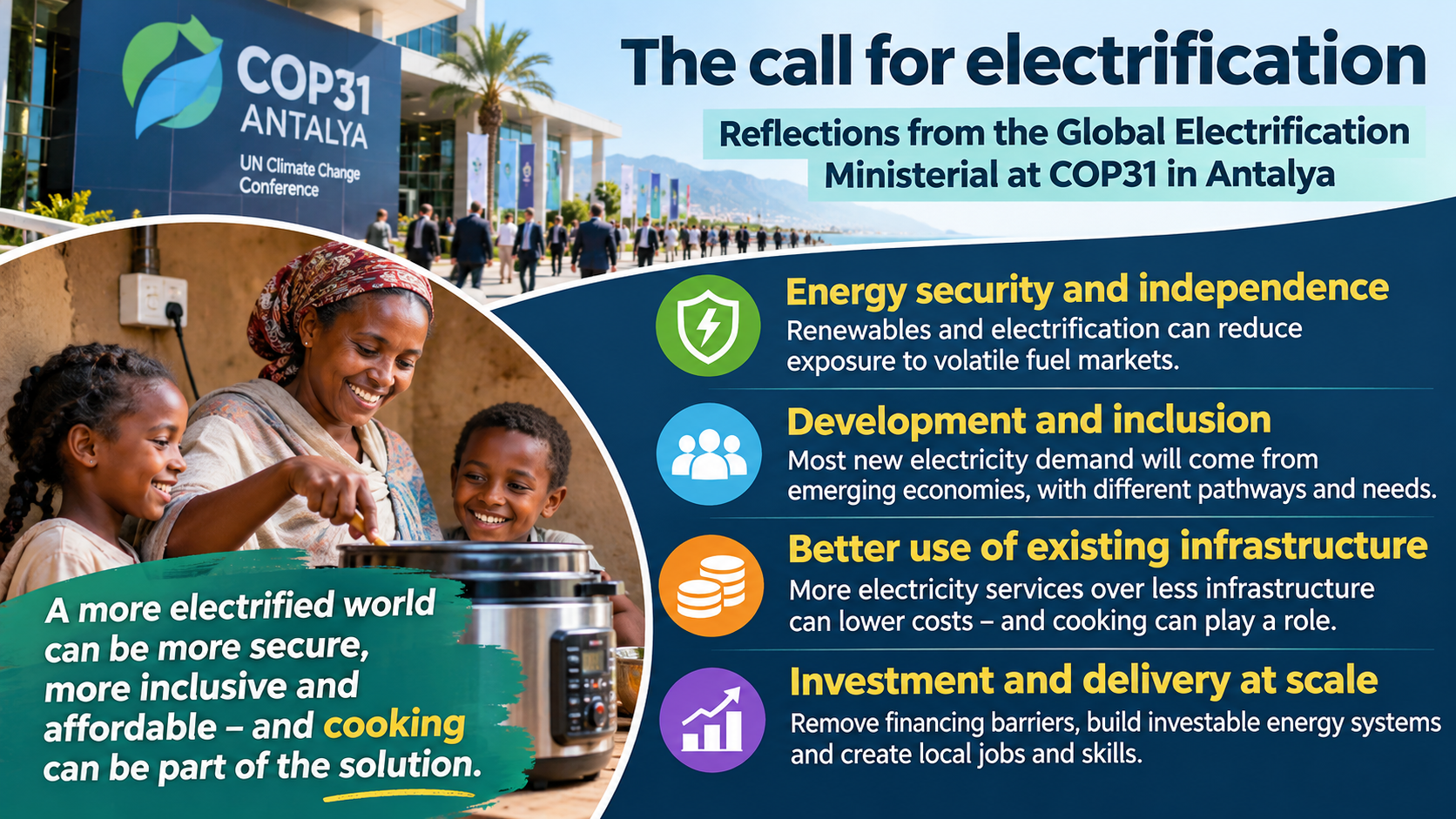
Image credit:- AI generated from prompt by S. Batchelor and the text of the blog.