
- Date
- 23rd November 2026
- Categories
- eCooking, Institutional Cooking
By Joseph Kariuki, Research Associate, Gamos East Africa and Lavender Munyasa, IOT Specialist, Gamos East Africa.
This blog shares findings from the School Kitchen and Cooking Study (SKACS) in Kenya, which measured how school kitchens cook and what energy they use. It covers 29 schools cooking with firewood and charcoal and 12 schools using grid or solar electric cookstoves. It shows that school-day and dish-level measurements together explain energy demand better than averages alone; cooking times must be read alongside batch sizes and context; reliable smart-meter data supports system sizing and operating-cost estimates; and moving to clean cooking should be planned around the whole kitchen, not a single appliance.
School kitchens prepare meals for hundreds of learners and staff each day. Despite this, evidence about how much energy those kitchens use, how long staple foods take to prepare and how cooking practices differ between schools remains limited. Without this information, it is difficult to size clean cooking systems, estimate accurate operating costs, or understand what changes after a school adopts electric cooking.
The School Kitchen and Cooking Study (SKACS) protocol was developed by the Modern Energy Cooking Services programme to address this evidence gap. It combines school-day measurement of total kitchen energy use with dish-level observation of foods, quantities, cooking processes and times. In Kenya, it was applied in two linked phases at different schools: first in 29 schools cooking with firewood and charcoal, and then in 12 schools using grid or solar electricity.

Establishing the biomass benchmark
From March to June 2026, the Kenya SKACS study covered 29 schools, with 18 using firewood only, 10 with both firewood and charcoal , and one used charcoal only. Firewood was burned in three-stone fires and improved institutional cookstoves. And charcoal was used in traditional metallic, clay and improved jikos.
Trained enumerators completed a cumulative 337 school survey days. For school day level measurements, they weighed piles of firewood and charcoal at the beginning and the weight at end of the day once all cooking had finished. At dish level, they recorded the food and water quantity, pot and stove in use, cooking process, start and end times, and fuel weights before and after cooking where these could be measured. The study recorded 662 dish preparations, linking overall daily consumption with activity at individual pots. Qualitative interviews also captured cooks’ experiences and information from school management.
Across the 29 schools, 306 daily firewood observations recorded 30.1 tonnes of firewood consumption, while 74 daily charcoal observations recorded 608 kg. These totals illustrate the scale of fuel demand in institutional kitchens, but they are not a per-school benchmark: the participating schools differed substantially in population, menus, schedules and cooking equipment.
School population entries ranged from 130 to 5,699 learners and staff, and the typical number cooked for varied similarly. The 662 recorded dish preparations covered more than 20 dish types, alongside 88 water-heating events. Rice (89 records), vegetables (82), porridge (80), githeri (77), beans (68), ugali (66) and tea (53) were the most frequently recorded dishes. Some schools prepared only a mid-morning meal and lunch, while larger boarding or comprehensive schools also cooked breakfast and supper. Stove and pot capacity shaped practice: where an improved institutional cookstove or available pot could not accommodate the full meal, cooks divided food between pots or used a three-stone fire for the additional volume. Ten schools used both firewood and charcoal, further limiting simple fuel comparisons.
Extending the study to electric kitchens
From June to October 2026, SKACS extended the approach to 12 schools where Ecobora, a Kenyan clean-energy company, had installed institutional electric cookstoves. Six schools used grid electricity and six used solar electric systems. Nine of the 12 schools used only 300-litre cookstoves, while the tenth combined 300-, 200- and 30-litre units. As for the other two, one used an 80-litre unit, and the other used two 400-litre units. Across 128 daily survey submissions, SKACS recorded 167 dishes: 87 using grid electricity and 80 using solar electricity.

The school-day and dish-level records answered different questions. School-day measurement showed total daily energy use, the sequence of meals and also noted any interruptions and whether firewood was still used. Firewood appeared alongside electric cooking on 52 of the 128 recorded school days. Enumerators found several reasons: cooks were still gaining confidence in temperature adjustment and techniques for foods such as ugali and rice hence opting to use firewood instead; one 300l appliance could not always hold the full meal or prepare two dishes needed at the same time; and grid blackouts, low voltage, limited morning solar charge on cloudy days and temporary appliance faults could threaten fixed serving times. Dish-level records connected these operating conditions with individual foods, quantities, cooking processes and elapsed time.
What common dishes showed
The same seven dishes were among the most frequently recorded across the two phases. Figure 4 compares their median quantity in the monitored pot and median elapsed cooking time. The SKACS firewood records are separated into three-stone fires and improved firewood cookstoves, while the eSKACS records distinguish grid and solar electricity. Showing quantity and time together makes differences in batch size visible and avoids treating cooking time alone as a measure of performance.

The results describe cooking as observed rather than a controlled comparison of technologies. Batch quantities, school routines, soaking practices, pots and operating conditions differed. For example, the median ugali quantity recorded on improved firewood cookstoves was 45 kg, compared with 11.5 kg on three-stone fires. Differences in elapsed time should therefore be interpreted alongside quantity and context.
Githeri remained one of the longest-cooking dishes across all five pathways. Earlier controlled tests using similar 9 kW 300l electric cookstoves showed that githeri could be actively heated for about two hours and then allowed to finish cooking with retained heat in the insulated pot. Although this self-cooking method had been demonstrated during initial training, cooks were concerned that switching off early might leave food undercooked at the fixed lunch time. Intentional switch-offs were recorded in only 19 dish observations and temperature adjustments in seven. During later visits, enumerators provided refresher training on temperature adjustment and self-cooking. Ecobora is also introducing its UPISHI interface, which provides dish-specific preset times and automatic switch-off alongside manual adjustment.
Building reliable energy monitoring
Smart meters were an important part of eSKACS because they allowed electricity consumption to be recorded throughout the school cooking day. When combined with the dish-level observations collected by enumerators, the meter data helped connect overall energy demand with the foods being prepared, the quantities cooked and the time taken.
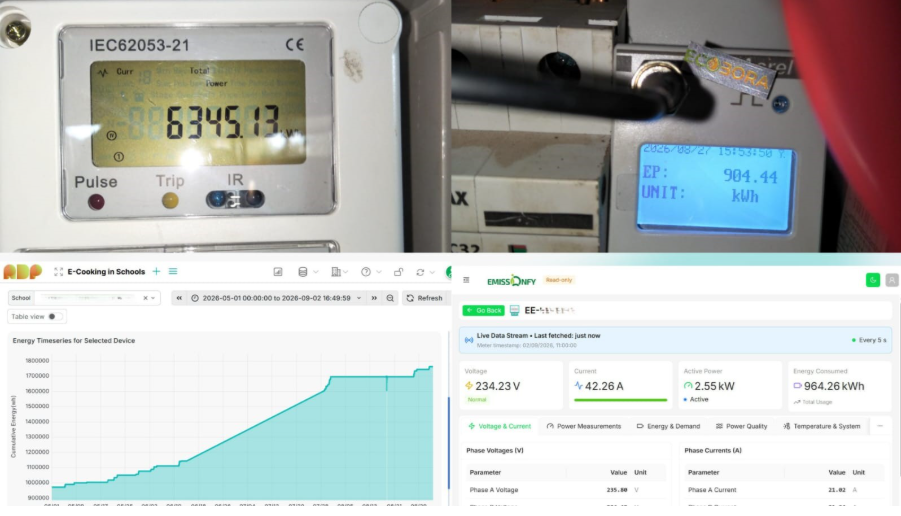
Enumerators photographed the physical meter displays and recorded the readings in KoboToolbox. The team then cross-checked these observations against data from meters supplied by the Access to Energy Institute (A2EI). During eSKACS, Ecobora installed its own meters and introduced a new monitoring platform, Emissionfy.This validation process helped align physical readings, transmission records and the reporting periods used in the study. It also provided an opportunity for Ecobora and the MECS Kenya team to strengthen the monitoring process as the new meters and platform were introduced.
Reliable smart-meter data have value beyond the research study. They can help schools and technology providers understand daily electricity demand, identify periods of unusually high or low consumption, estimate operating costs and investigate interruptions or technical faults. For solar-electric schools, consumption data can also inform the sizing and management of generation, battery storage and cooking appliances.
For eSKACS, combining smart-meter data with field observations produced a more complete account of how electricity was being used in school kitchens. The experience also demonstrated why monitoring systems should be validated under everyday cooking conditions before their data are used for planning or reporting.
What the two studies add
Together, SKACS and electric SKACS connect the scale of school energy demand with the day-to-day decisions behind it. SKACS documented biomass consumption and the variety of stoves, dishes and batch sizes in 29 schools. eSKACS extended that evidence to 12 schools using grid and solar electricity, while also showing when and why firewood continued to be used.
The central design lesson is that an energy transition must be planned around the whole kitchen rather than a single appliance rating. Systems need to accommodate the largest batches, dishes prepared simultaneously, available pots, fixed serving times and the reliability of the energy supply. Average consumption alone cannot answer those questions.
School-day and dish-level measurements are complementary. Daily totals show the demand a system must meet and whether other fuels are used. Dish records explain how food type, quantity, stove choice and cooking practice contribute to that demand. Meter comparisons add a third layer by checking whether consumption is captured and reported consistently.
The studies also show the value of collaboration after data collection begins. Participating schools and cooks provided the operational context; trained enumerators connected measurements with kitchen practice; and Ecobora and the MECS Kenya team used the evidence to improve monitoring, provide additional cook training and identify where technical support was needed.
For the wider sector, the practical conclusion is clear: measurement is most valuable when it informs system sizing, cook support and ongoing management, not only research reporting. Building these functions into future institutional electric-cooking projects can help schools move from installation to dependable everyday use.
A second blog will examine that post-installation period in more detail, including grid reliability, solar-system management, maintenance, additional cook training and the support arrangements needed to sustain electric cooking.
………………………………………………….
Featured image, Image 2, top: Fuel being weighed in school kitchens to measure consumption over the cooking day. (Photo Credit: Joseph Kariuki, Gamos East Africa).
AI declaration: The blog was human written and tidied up by AI.